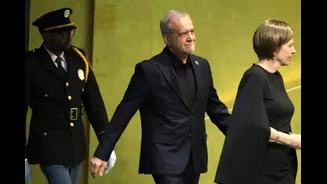




Iran’s President Masoud Pezeshkian told his Russian counterpart, Vladimir Putin, on Thursday that Tehran was “trying our best to end the war as soon as possible”, and thanked him for Moscow’s position
on the situation in West Asia.
“We’d like to thank you for your position regarding the situation in the region
“, Pezeshkian told Putin. “We are trying our best to put an end to the war as soon as possible, and make sure our rights are respected”.‘We’d like to THANK you for your position regarding situation in region’ — Iran’s Pezeshkian to Putin
‘Trying our best to put end to war as soon as possible, maker sure our rights are respected’
‘But if they [US] act unilaterally, it’s impossible to accomplish in near future’ https://t.co/WAgpRCGp9M
— RT (@RT_com) October 8, 2026
The two leaders met ahead of the Commonwealth of Independent States summit in Turkmenistan, as Russia and Iran continue to strengthen diplomatic and military cooperation amid regional tensions.
Pezeshkian also warned that if the United States fails to accommodate Iran’s interests, the conflict could drag on for a longer period. “But if they (US) act unilaterally, it’s impossible to accomplish in near future”, he said.
Putin Pledges To ‘Do Everything’ To Help End War
During the meeting with Pezeshkian, Putin vowed to “do everything” to help end the war and “contribute to the settlement” of the conflict.
His remarks came as talks between the US and Iran came at a standstill last month, after the two sides reported a fresh spate of strikes.
“We are ready to do everything that is in our power to contribute to the settlement of this situation,” Putin said during the meeting, according to Russia’s Tass news agency.
Putin said Iran had made “real efforts” to end the war. Pezeshkian, meanwhile, affirmed that Iran would not “walk away” from efforts to find a diplomatic solution to the conflict.
The war in West Asia began on February 28 this year, after the US-Israel alliance launched joint strikes on Iran amid stalled talks over the country’s nuclear programme.
In retaliation, Tehran targeted US-linked facilities across the Gulf, while also blocking the key Strait of Hormuz, a strategic waterway that provides for nearly 20 per cent of global energy trade.