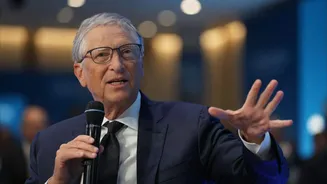








Microsoft co-founder Bill Gates has issued one of his starkest warnings yet regarding artificial intelligence, predicting that automation could permanently erase millions of jobs and calling for specific
roles to be designated as “Human Reserved”.
Writing in a detailed essay on his Gates Notes blog, the tech pioneer warned that world leaders and institutions are dangerously unprepared for the impending economic upheaval.
The ‘Human Reserved’ Job Concept
To cushion the impact of wide-scale automation, Gates urged governments to establish a “Human Reserved” policy framework—comparing it to nature reserves where commercial development is deliberately restricted to protect precious ecosystems.
Under this proposal, policymakers would legally shield or encourage specific human-led roles, particularly in sectors where empathy, ethics, and personal connection outweigh pure technical efficiency:
- Empathy-Driven Healthcare: Roles in eldercare, hospice care, and delivering critical medical diagnoses should remain human-centric.
- Early Education & Mentorship: Teaching and youth development roles that rely heavily on social skill development and human bonding.
- Critical Ethics & Judgement: High-stakes decision-making roles in governance and mental health services.
Unprecedented Workforce Disruption
Unlike previous technological revolutions—such as the steam engine or personal computing, which eventually created more jobs than they destroyed—Gates argued that AI is “utterly, absolutely, completely, totally different” because it replaces human cognition directly.
He highlighted that entry-level and mid-level roles across software development, law, customer service, and data analysis will face rapid displacement over the next decade. Additionally, the rise of advanced robotics will soon see machines competing directly for physical tasks in hospitality and construction.
Proposed ‘Token Tax’ on AI and Robots
To level the playing field, Gates advocated for radical tax reforms, pointing out that current tax systems reward businesses for replacing human workers with software. While employers pay payroll taxes for hiring humans, investments in robots or AI systems can often be written off as business expenses.
Gates proposed introducing a “token tax” on AI usage and direct taxes on automation robots. Revenues generated from these levies would fund retraining programmes, strengthen social safety nets, and support displaced workers navigating career transitions.