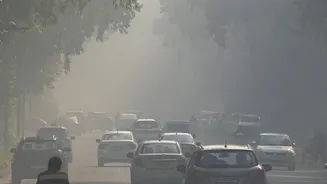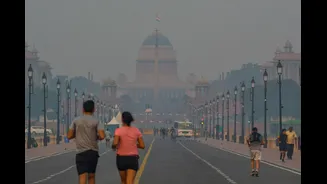

Delhi continued to reel under heavy pollution on Saturday, with the Air Quality Index (AQI) staying in the “very poor” category. According to the Central Pollution Control Board (CPCB), the AQI stood at around
376–380, while visibility dropped sharply across several parts of the city. Early morning, areas such as the Barapullah flyover showed a thick layer of toxic smog blanketing the national capital.
The Commission for Air Quality Management (CAQM) has invoked all measures under Stage IV of the Graded Response Action Plan (GRAP) across Delhi and the National Capital Region (NCR) to curb pollution levels.
On Saturday morning, Delhi’s air quality remained poor to severe at several locations, with AQI recorded at ITO (433), Anand Vihar (428), Jahangirpuri (425), Ashok Vihar (412), DTU (411), Chandni Chowk (410) and Dwarka Sector 8 (409), while IGI Airport T3 (321), IIT (332), Lodhi Road (336), Mandir Marg (344) and Aya Nagar (298) also reported high pollution levels.
Centre directs visible improvement within a week
Union Environment Minister Bhupender Yadav has directed authorities to ensure a visible improvement in air quality within one week. Chairing a review meeting with officials from Delhi, Haryana and Uttar Pradesh, Yadav stressed the need to maintain momentum in pollution-control measures as air quality continues to deteriorate.
“This is the fourth review meeting in recent weeks. Strict action must be taken against defaulters, but the general public should not face unnecessary inconvenience,” Yadav said. He added that corrective actions must be implemented immediately, with another review planned after 15 days.
Monthly reviews from January 2026
The Union environment ministry said that monthly review meetings would be held from January 2026 to assess action plans prepared by states. These meetings will focus on addressing implementation gaps through coordinated efforts between neighbouring states at the highest level.
The ministry issued directions to improve traffic management at 62 identified traffic hot spots across the NCR. Authorities were also asked to promote the use of electric and CNG buses for employees of corporate offices and industrial units.
Traffic, transport and infra measures
To reduce congestion during peak hours, staggered office timings for government offices, shopping malls and commercial complexes were suggested. The Centre also asked Gurugram, Faridabad, Ghaziabad and Noida to fast-track the Integrated Smart Traffic Management System (ITMS).
Yadav emphasised coordination with Metro rail authorities to improve last-mile connectivity. He also directed civic bodies to remove encroachments causing traffic bottlenecks within 10 days and ensure pothole-free roads through proper annual maintenance contracts. Drainage systems must also be improved to prevent damage during the monsoon.
Focus on dust, waste and public grievances
The minister directed authorities to immediately remove dust and construction and demolition waste lying on roads. Strict enforcement of construction bans during high pollution periods and steps to contain biomass burning were also ordered.
The ministry said coordinated redressal of pollution-related public grievances would be ensured under CAQM’s supervision, along with focused awareness activities to involve key stakeholders.