
First, the good news.
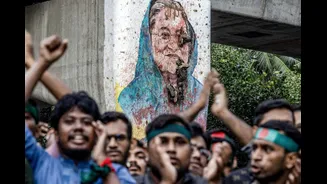
Thirty students who were at the heart of the 2024 ‘Gen Z revolution’, which toppled the Sheikh Hasina government, and who later became part of a political start-up called the National
Citizen Party (NCP), have rebelled against their own. They have condemned efforts by the party leadership to ally with the fundamentalist Jamaat-e-Islami in the promised February elections in Bangladesh.
These students have written a signed letter to party chief Nahid Islam expressing anguish at the 8- or 12-party coalition of Islamist outfits being drawn up with Jamaat, of which reports say the NCP will be a part.
They expressed serious reservations about Jamaat and its student wing Shibir’s “divisive politics, spying and sabotage, false blame-fixing, disinformation campaigns, and religious fascism”. But above all that, Jamaat’s heinous role and collaboration with the Pakistan forces in the 1971 genocide and Liberation War make it politically untouchable, the 30 students say. They fear that the whiff of an alliance with Jamaat has made centrist and neutral supporters of the ‘student revolution’ start abandoning the party in droves.
Fair, sensible points. But now, the bad news.
These 30 are overwhelmingly outnumbered. NCP joint member-secretary Zainal Abedin Shishir has claimed that 184 of the 214 central leaders of the party are unhesitatingly in favour of the truck with Jamaat.
So, the rebels will most likely resign or be gradually forced out.
An alliance with Jamaat or any legacy party or formation for the sake of power officially spells the end of the Bangladesh students’ movement, once a tremendously potent force which took on even the army and the police and overthrew an entrenched, allegedly autocratic PM.
The jostling and begging for power and position mark the fading of that halo, and also of the hope of freshness and integrity which millions of Bangladeshis had reposed in the student leaders.
There were reports that Nahid and some others were haggling with the BNP, which deigned to offer them just 5–6 of the 300 seats to be contested. Jamaat has been kinder — offering 30 seats at most — but only after using the students like disposable puppets while pulling the strings from the shadows, as well as creating deep rifts within the movement to weaken it in the post-Hasina scenario.
Once the icons of courage and sacrifice, these student leaders quickly revealed themselves as opportunistic, power-craven, and corrupt.
Nahid, for instance, who was appointed as an advisor for Information and Communication Technology (ICT) in the Yunus cabinet, has been embroiled in serious corruption scandals since mid-2025. His PA, Atik Morshed, and Morshed’s wife, Zakia Sultana Jui, were summoned by the Anti-Corruption Commission.
Nahid is being probed for nepotism in ICT ministry appointments, awarding contracts to allies without tenders, and amassing undisclosed wealth through bribes. A leaked audio in September 2025, purportedly of him discussing kickback,s further eroded public trust in him.
Asif Mahmud, who became the advisor for Youth and Sports, reportedly embezzled funds from youth development programmes and took bribes for event contracts. In February 2025, leaked screenshots and documents showed Asif purportedly stashing illicit funds in bitcoin wallets and receiving kickbacks from sports federations. The Anti-Corruption Students’ Platform, in a December 2025 Instagram campaign, demanded his wealth statement and accused him of misusing USD 4 million, which was part of a national youth festival budget.
The ACC initiated a preliminary inquiry in October 2025.
Many labelled Asif Mahmud a “symbol of corruption in Bangladesh 2.0”.
His former assistant personal secretary, Moazzem Hossain, was removed in April 2025 and faced a travel ban because of an ACC investigation into allegations of amassing hundreds of crores through lobbying, tender manipulation, and extortion.
What this batch of ‘student revolutionaries’ has ensured is that another wave of youth protest might be stillborn, or at best, weak and ineffective.
Their blazing display of greed, haste, bigotry, and immaturity will take time to fade from public memory.
Even their handlers, Jamaat, want to wash their hands of them once the goal is accomplished and an Islamist coalition comes to power.
What must be worrying these young leaders is that they have accrued a number of very powerful enemies. Some openly out there, some lurking in the shadows for the right time to strike. With frenzied public support souring into disillusionment, the protective ring is gone.
As Bangladesh prepares for the next phase of turmoil and uncertainty, some desperate visa applications could be on the way.
Abhijit Majumder is the author of the book, ‘India’s New Right’. Views expressed in the above piece are personal and solely those of the author. They do not necessarily reflect News18’s views.