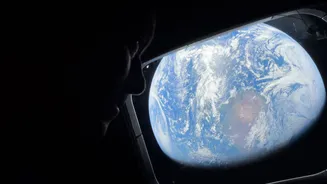







For the first time in over half a century, humans are venturing beyond Low Earth Orbit (LEO). While the Artemis II mission is a monumental leap for exploration, it is also a high-stakes laboratory for space
medicine.
Though the journey is a brief 10 days, scientists warn that deep space is an “extreme environment” that begins to rewire the human body the moment the rocket clears the atmosphere. From Canadian astronaut Jeremy Hansen to Christina Koch (the first woman to venture into deep space) the crew is providing the most critical health data in NASA’s history.
What Happens To The Astronauts In Space?
According to Dr. Farhan Asrar, a space medicine researcher at Toronto Metropolitan University who spoke to Prince George Citizen, three factors combine to place a significant strain on the body:

Deep Space Radiation
Radiation is the primary concern once astronauts enter deep space. It’s not just the amount of radiation; it’s the type. Galactic cosmic rays in deep space are more penetrating. These particles can slice through DNA, potentially leading to long-term cancer risks and damage to vital organs. ““Some of these particles are more penetrating and potentially more damaging, which makes this mission a step into the unknown,” he said.
Microgravity
The lack of gravity doesn’t just make you float; it confuses your internal systems. Motion sickness is the most common immediate side effect and even elite pilots experience nausea as their vestibular system (inner ear) loses its sense of “up” and “down.”
Plus, without gravity to pull blood to the legs, fluids shift toward the head, putting pressure on the eyes and the cardiovascular system.
The Mental Toll: Confined Conditions
Spending 10 days in a small capsule with three other people, surrounded by the vacuum of space, impacts cognitive function and stress levels. Scientists are studying how “short exposures” like Artemis II affect decision-making for future multi-year missions to Mars.
With Christina Koch on board, Artemis II marks the first time a woman has travelled into deep space. This is a scientific milestone, as researchers have never had data on how the female body, specifically the cardiovascular and immune systems, responds to higher radiation levels outside Earth’s magnetic field.