






Every Independence Day, India reflects on how far it has come from gaining political freedom in 1947 to becoming one of the world’s fastest-growing digital economies. This year, however, another shift
is unfolding.
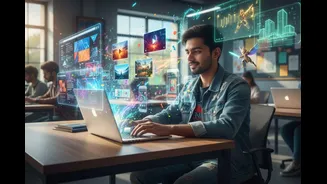
Generative artificial intelligence is moving beyond research labs and technology companies into everyday life. It is no longer just software engineers or Silicon Valley start-ups experimenting with AI. Students are using it to build apps, teachers to create lesson plans, architects to visualise buildings, farmers to access crop advice in local languages, entrepreneurs to design marketing campaigns and small businesses to launch websites without hiring agencies.
AI is reshaping creativity by giving millions of people access to tools that once required expensive software, specialised skills or large teams. The question now is whether generative AI is becoming India’s next great democratising force.
“The year 2026 could definitely be remembered as the year when AI moved ahead of experimentation and emerged as an everyday utility. For India’s young, digital first generation, AI is deeply embedded in how people create, communicate, discover and engage… The actual shift is not simply wider adoption but deep integration into product and workflows. This makes AI not only accessible but also practical and relevant to millions of users beyond traditional technology ecosystems,” said Parth Chadha, Co-Founder and CEO, STAN.
India’s Digital Transformation Is About Expanding Access
The first phase connected people through mobile phones. The second brought internet connectivity and digital payments to millions. The third enabled citizens to access public services online.
Generative AI could represent the next stage, where technology no longer simply provides information but actively helps people create.
India now ranks third globally in Stanford University’s AI Vibrancy Index and has the world’s second-largest AI talent pool. Government and industry estimates suggest that 87% of Indian enterprises are actively using AI solutions, reflecting how quickly businesses are integrating AI into their operations.
The IndiaAI Mission, investments in domestic AI models and growing collaboration between government, academia and industry all signal that AI is no longer viewed as an emerging technology but as a strategic national capability.
Unlike previous technological revolutions, however, generative AI is reaching ordinary users almost immediately.
According to IBM’s Institute for Business Value (IBV), AI could generate more than $500 billion in economic value for India by 2030. But realising that potential will require more than rapid AI adoption. It will depend on whether India can build the right digital infrastructure, governance frameworks, skilled workforce and industry-wide collaboration to scale AI responsibly.
Creativity Is No Longer Limited To Artists
Traditionally, creating something new required access. Designing a logo meant hiring a graphic designer. Producing a marketing campaign involved agencies. Building a video game required programmers, artists and animators. Even writing educational content often demanded subject experts and editors.
Generative AI is lowering many of those barriers. A farmer can generate personalised crop recommendations in a regional language. A schoolteacher can create quizzes and visual learning material within minutes. A small retailer can produce social media advertisements without employing a marketing agency. Architects can generate multiple building concepts before preparing detailed plans. Independent game developers can create characters, dialogues, artwork and coding assistance using AI tools.
The technology is also transforming creative industries themselves. Writers are using AI for brainstorming, musicians for composition assistance, filmmakers for storyboarding and designers for rapid prototyping.
Rather than replacing creativity altogether, AI is increasingly acting as a collaborator that speeds up repetitive work while allowing people to focus on ideas.
“Today AI is increasingly becoming a universal capability rather than a specialised profession…The bigger shift that we are witnessing is that creativity is becoming iterative and collaborative. People can easily build on ideas, remix them and improve them immediately. In today’s generation, originality comes less from mastering a tool and more from having a distinct perspective,” said Chadha.
The Rise Of India’s New Creative Economy
The implications extend well beyond traditional creative professions. Generative AI is enabling individuals to become entrepreneurs with far lower upfront costs than before.
The Orange Economy is a booming $30 billion sector driven by digital content creators, the gaming industry, and a government-backed tech initiatives. It employs nearly 8% of the nation’s workforce and is rapidly expanding through mobile-first storytelling and artificial intelligence
India’s creative economy is no longer confined to films, television or advertising. The sector was valued at around Rs 2.5 trillion in 2024 and is projected to grow at an annual rate of 7%, reaching nearly Rs 3.06 trillion by 2027. The steady expansion reflects the country’s growing appetite for digital content and the increasing role of creativity as a driver of economic growth.
Some of the fastest-growing segments are animation and visual effects (VFX), gaming and live entertainment. The animation and VFX industry are now worth around Rs 103 billion, the gaming sector about Rs 232 billion, while live entertainment has crossed Rs 100 billion. Together, these industries are reshaping how content is produced, distributed and experienced.
Collectively, India’s creative industries support more than 10 million livelihoods and contribute nearly Rs 3 trillion to the economy every year. Industry bodies believe that growth is only beginning. The Live Events Development Council (LEDC), for instance, wants to position India as a global hub for concerts and live entertainment by 2030, estimating that the sector alone could create an additional 15-20 million jobs over the coming years.
“India is uniquely positioned because it brings together scale, digital adoption, linguistic diversity and a young, highly connected population. Unlike international markets where AI is largely being introduced into already established digital ecosystems, India has an opportunity to develop more inclusive, multi-lingual and affordable applications that work across very different user contexts. With a combination of affordable technology, a strong developer ecosystem and rapidly growing digital communities, India has the potential to move beyond simply consuming AI to creating solutions that can be relevant beyond the country as well. The opportunity is to build for Bharat, not simply translate for it,” said Chadha.
What Is India’s Next Freedom Challenge?
Generative AI could represent the next chapter by giving people the freedom to create, innovate and build businesses without many of the traditional barriers that once limited participation. Yet technology alone will not determine the outcome.
India will also need to invest in AI literacy, digital skills, responsible innovation and regulatory safeguards. Questions around transparency, copyright, bias, privacy and responsible use will become increasingly important as AI becomes embedded in education, business and everyday life. Recent government moves requiring clearer labelling of AI-generated content reflect the growing effort to balance innovation with accountability.
“AI is definitely making creativity accessible, but accessibility does not always mean originality. When everyone uses similar tools, prompts, templates etc, there is a risk of creative output becoming repetitive. The differentiator here will definitely be human context. The experience, cultural references and perspectives that an individual brings to the table is what allows them to stand out. We witness on STAN also how a creator’s culture, interests and community dynamics helps them in becoming relevant as the audience tends to connect with them on a personal level. AI can accelerate content creation but individuality will always be the real creative advantage for one to succeed,” said Chadha.
Ultimately, the success of India’s AI journey will not be measured only by the number of models it builds or start-ups it creates. It will depend on whether millions of ordinary Indians can use these new tools to solve real problems, build sustainable businesses and express ideas that might otherwise have remained out of reach.