





The 2026 assembly election results have triggered a familiar but sharper question: are India’s regional parties losing their grip, or are they simply being forced to evolve in a political landscape increasingly
dominated by national players—more specifically the Bharatiya Janata Party (BJP) behemoth?
A Changing Map
Across states, the list of weakened regional players is growing longer and more politically significant.
In Maharashtra, both the Shiv Sena and the Nationalist Congress Party (NCP) have seen erosion after splits and leadership battles. In Punjab, the Shiromani Akali Dal is a diminished force compared to its earlier dominance. Elsewhere, the Bahujan Samaj Party has struggled to remain electorally relevant in Uttar Pradesh, while the Asom Gana Parishad has been reduced to a secondary player in Assam.
ALSO READ | BJP In Bengal, Vijay In Tamil Nadu: Assembly Elections 2026 Throw Up Big Winners And Losers
Even parties that remain in contention are facing uncertain futures: the Janata Dal (United) in Bihar and the Janata Dal (Secular) in Karnataka are grappling with shrinking bases and shifting alliances.
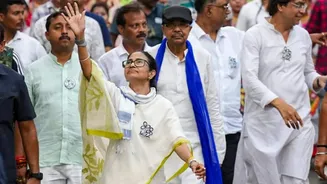
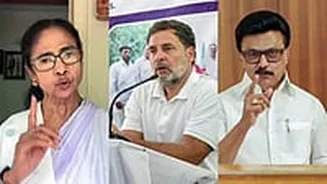
Now, the 2026 verdict has added two heavyweight names to this list—the Dravida Munnetra Kazhagam (DMK) and the All India Trinamool Congress (TMC)—both of which have suffered major electoral setbacks.
BJP’s Expanding Footprint
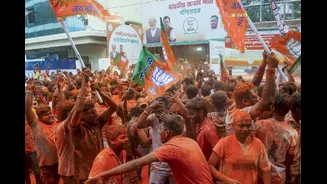
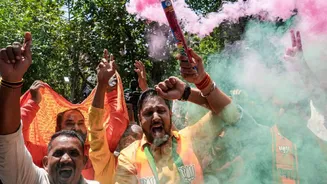
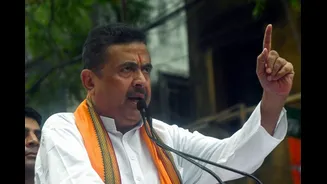
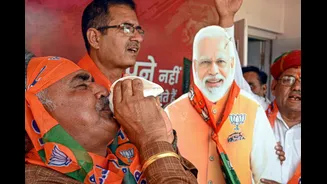
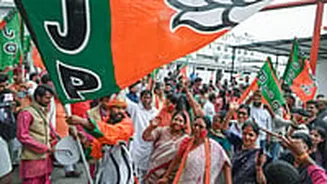
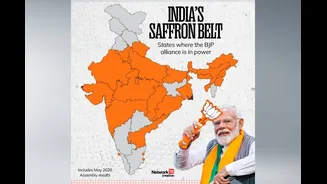
Running parallel to this decline is the steady expansion of the Bharatiya Janata Party.
The Times of India points to a clear “consolidation effect” where voters are increasingly backing national parties that promise scale, strong leadership, and welfare delivery. The BJP’s ability to break into states long dominated by regional forces, most notably West Bengal in 2026, underscores this shift.
This is not just electoral arithmetic; it is structural. The Indian Express says a strong cadre network, centralised messaging, and resource advantage allow national parties to compete across geographies in a way most regional outfits cannot.
Alliance Dilemma, Family Feuds
Regional parties once thrived as kingmakers in coalition-era politics. Now, that space is shrinking.
According to Deccan Herald, regional forces that fail to align with broader anti-BJP coalitions risk being sidelined altogether. A divided opposition splits votes, often benefiting the BJP’s consolidated base. This creates a paradox: regional parties must either ally and risk losing identity, or fight alone and risk irrelevance.
Internal fractures are compounding the problem. Many of these parties were built around a towering founder, but the absence of clear succession plans has turned “family control” into factional warfare.
ALSO READ | 3 States, 3 Big Questions: Who Wears CM Crowns In Bengal, Kerala And Tamil Nadu Now?
Take the Samajwadi Party. The very public rift between Mulayam Singh Yadav and his son Akhilesh Yadav before the 2017 Uttar Pradesh elections split the party organisation and confused its voter base. While Akhilesh eventually consolidated control, the damage in that election cycle was significant.
A similar pattern has played out in the Shiv Sena. After the death of Bal Thackeray, leadership tensions intensified, eventually leading to a split between factions led by Uddhav Thackeray and Eknath Shinde. What began as an internal power struggle ended up dividing the party, its symbol, and its core vote base.
In Bihar’s Rashtriya Janata Dal, succession has largely stayed within the family, with Lalu Prasad Yadav handing over to Tejashwi Yadav. But even here, periodic tensions among family members and questions of leadership hierarchy have surfaced, raising concerns about long-term stability.
The problem isn’t just who leads but how leadership transitions happen. Many regional parties struggle to “produce successors” beyond the family, limiting internal democracy and shrinking the talent pool. When multiple heirs stake claim, it often results in parallel power centres, cadre confusion on loyalty, and erosion of voter confidence.
In contrast, national parties, despite their own internal issues, tend to have broader organisational structures that absorb leadership changes more smoothly.
The larger impact is electoral. Voters increasingly see these feuds as distractions from governance, while rivals capitalise on the instability. In a political moment already tilting towards strong, centralised leadership, fractured regional parties find themselves at a clear disadvantage.
ALSO READ | ‘Shah-nakya’ Niti: How BJP’s Architect Of Expansion Conquers The Toughest States
Another underlying change is what voters prioritise.
Regional parties traditionally mobilised voters through identity markers such as language, caste, or sub-regional pride. But recent elections suggest a tilt towards leadership-centric and delivery-based politics.
The BBC notes that national narratives, welfare schemes, and strong leadership projection, areas where the BJP has invested heavily, are increasingly shaping voter behaviour.
The “Vijay Factor”
Yet, the story is not one of simple decline. New regional energy can still emerge if it taps into voter aspirations differently.
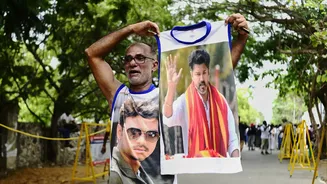
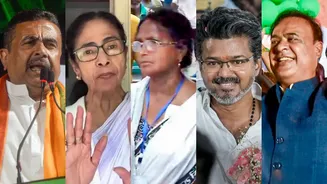
In Tamil Nadu, the rise of Vijay and his party, the Tamilaga Vettri Kazhagam, signals a potential disruption. His appeal, rooted in celebrity, anti-establishment messaging, and youth connect, suggests that regional politics is not dead, but evolving.
The key question is whether such movements can institutionalise themselves beyond charisma, something older regional parties are currently struggling with.
ALSO READ | No Press Interviews, No Social Media: How ‘Novice’ Vijay Engineered A Political Tsunami In Tamil Nadu
Vijay’s success story shows that regional parties are not vanishing but are under unprecedented pressure.
Electorally, they are losing ground in multiple states, organisationally, they are weakened by splits and succession crises, and strategically, they are caught between alliances and autonomy. At the same time, the rise of the BJP is accelerating a shift towards national dominance.
But Indian politics rarely stays static. The emergence of new players like Vijay shows that while old regional parties may fade, the space they occupied does not disappear; it simply waits to be reclaimed in a new form.