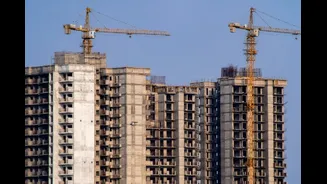








The geopolitical flare-up in West Asia and the price of an apartment in Bengaluru, Gurugram or Mumbai may seem unrelated. But a recent surge in global oil prices, a weakening rupee, and rising trade costs
amid tensions involving Iran are beginning to ripple through India’s real estate market.
Indian housing is no longer driven purely by domestic demand cycles. It is increasingly exposed to global forces such as oil prices, capital flows and geopolitical uncertainty that can shape both supply and demand in subtle but significant ways.
Let us understand how the fluctuating oil prices, currency pressure, capital inflows and geopolitical turmoil are affecting the real estate in the country.
Why Oil Is The Hidden Cost Behind Every Building
Crude, which hovered around $70-75 per barrel in February, crossed $100 per barrel, raising concerns about inflation, currency pressure, and growth.
At its core, real estate is a commodity-heavy business that includes materials such as cement, steel, aluminium, and plastics, each of which is energy-intensive to produce and transport.
When oil prices rise, the impact is not limited to fuel bills. It cascades through the entire construction ecosystem.
Transportation costs increase, making it more expensive to move raw materials across states. Manufacturing costs rise for key inputs such as steel and cement, where energy is a major component. Even finishing materials such as tiles, fittings, PVC products become costlier due to higher petrochemical prices.
“Geopolitical conflicts are impacting India’s housing market directly,” said Anurag Goel, Director, Goel Ganga Developments – a real estate company in Pune. “Construction costs have gone up due to supply chain disruptions and the rising prices of raw materials like steel, logistics and imported fittings, even with cement prices holding steady. Cement is simply one part of construction, and the real cost drivers are increases in transportation, labour, energy, and finishing materials,” Goel added.
For developers, this creates a margin dilemma. Absorb the costs and protect sales momentum, or pass them on to buyers and risk slowing demand.
Price increases are visible in all the large Indian metropolitan areas. However, the rate of these changes is different in each area, he pointed out.
Bhavik Bhandari, Chief Business Officer, Ashwin Sheth Group, a real estate and construction company in Mumbai, however, said that global tensions are creating short-term ripples, and not structural damage. “Higher input costs, supply disruptions, and cautious global capital flows are slowing some decisions, especially in the luxury housing segment. NRI investments have seen a temporary dip of 10 to 15%. However, India remains largely end-user driven, which keeps the market stable. Similar trends are visible globally, where uncertainty is delaying investments. Overall, this is more of a pause than a slowdown, and strong domestic demand continues to anchor long-term housing growth,” he pointed out.
The NRI Factor: How Much Do They Contribute To India’s Real Estate?
India is the world’s largest recipient of remittances, with inflows touching an estimated $135-136 billion in FY2025. A significant portion of this, roughly 38%, comes from the Gulf region. These flows are not just supporting household consumption; they are also a critical driver of real estate investment.
Non-resident Indians (NRIs) account for an estimated 15-22% of housing demand in India, with nearly 60% of that interest originating from West Asia. For years, many of these investors have diversified into global property markets, including Dubai, London, and parts of Europe. But geopolitical instability changes risk calculations.
Keshav Mangla, General Manager, Business Development, Forteasia Realty in Faridabad, Haryana, said that 15-20% of the housing demand in the premium and luxury segments in the major Indian cities can be attributed to NRIs, who are mostly professionals in the Gulf, the US, and the UK. “A growing number of these professionals are focusing on real estate in India due to the ongoing global uncertainties and instability in oil-dependent economies. Real estate in India is considered an emotional as well as a financial investment,” Mangla pointed out.
He explained that many NRIs choose to diversify rather than liquidate. “While some remain apprehensive about investing in foreign real estate markets due to currency fluctuations and geopolitical instability, India is perceived to be a stable alternative with superior, long-term value. NRI interest, especially in the gated community and luxury real estate developments, with globally competitive standards, is increasing in Indian metros like Mumbai and Bengaluru,” he added.
Can A Global Conflict Boost India’s Luxury Housing Demand?
Industry data suggests that the luxury housing segment (homes priced above Rs 1.5 crore) accounted for a dominant share of sales in 2025, reflecting a broader shift in market composition.
Homes priced above Rs 1 crore accounted for nearly 50% to 62% of total residential sales by volume in 2025, depending on the consultancy, a sharp increase from previous years.
Mumbai led total residential sales by volume in 2025 (29% of total sales), followed by Bengaluru and Pune. However, in terms of ultra-luxury (above Rs 10 crore) and high-end sales, Gurugram saw a massive surge, challenging Mumbai’s top position, according to Trident Realty — a real estate development company.
According to Mangla, during global conflicts, certain markets become more favourable and attractive for real estate investment. “The luxury residential real estate market is seen to be stable and safe, especially during times of uncertainty and conflicts. Thus, the demand for luxury real estate in India increases during such times. Premium luxury real estate developments are introduced to markets by developers to meet the demand of wealthy buyers,” he explained.
Developers, in turn, are doubling down on this segment, building larger homes, branding residences, and amenity-rich projects aimed at high-income buyers.
“It is interesting to note that global turmoil can also boost demand for luxury properties because of their safety and security,” said Goel. The reasons behind the surge in demand are better income visibility, improved lifestyles, post-pandemic ownership demand, and a growing desire for better living standards, he added.
Bhandari pointed out that global conflicts create uncertainty, but make India a reliable and stable market. He said that India’s GDP is projected to grow around 6 to 7%, which ranks among the fastest growth rates worldwide. The number of HNWIs is expected to rise by over 50% by 2027. NRI remittances reached almost $125 billion during 2023. Luxury housing demand has increased dramatically, as sales in the top 7 cities grew more than 75% during 2023. Investors maintain their interest in premium real estate because of the strong fundamentals and increasing wealth.
What Are The House Prices In Delhi, Mumbai, And Bengaluru Right Now?
“Home prices across Delhi, Mumbai, and Bengaluru continue to show steady upward movement because of strong end-user demand and a clear shift towards premium housing. Bengaluru has seen price growth of around 8 to 10% annually, while Mumbai remains resilient with limited inventory pushing values up by 6 to 8%. Delhi-NCR has recorded sharper spikes of 10-15% in select micro markets. The market maintains its healthy condition as buyers choose bigger homes and better living standards, which show their confidence in real estate as a long-term investment,” explains Bhandari.
Goel said home prices in Delhi, Mumbai, and Bengaluru markets continue to see a rise, though not at the rate or in the manner experienced in the post-pandemic period. “The upward trend continues to be in place, especially in the mid to premium segment.”
Mangla said the real estate demand in India surged in 2025 due to sustainable structural factors such as post-pandemic lower available property stock, the higher disposable income of buyers, and the desire to own houses as a result of the renewed lockdowns. “The desire for large homes improved due to hybrid work. The periphery of catchment areas of large houses improved due to better phygital (integrates physical property with digital technology) real estate. The phygital architecture market in India has greatly increased due to the combination of stimulus measures by the government, reforms in the law, and transparency. In the coming years, the combination of these factors will improve the demand in the emerging housing market in India,” he added.
Should Young Working Professionals Buy A House In The Current Situation?
“For working professionals in their 30s and 40s, this is a good time to consider home ownership, provided finances are well planned. Cities such as Delhi, Mumbai, and Bengaluru have experienced price rise, which has also delivered permanent value growth. Real estate provides three benefits such as permanent value protection, creation of new assets, and the ability to generate rental income. The key is to buy within your budget, focus on trusted developers, and look for a long-term holding rather than short-term gains,” Bhandari says.
India’s real estate sector is entering a new phase, one where local dynamics are intertwined with global shocks.
For homebuyers, this means navigating a landscape where prices and borrowing costs may become more volatile. For developers, it means balancing margins with demand in an uncertain environment. And for investors, it presents a dual narrative of risk and opportunity.