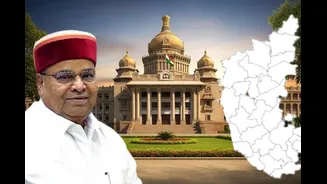









Karnataka Governor Thaawarchand Gehlot on Thursday abruptly ended his customary address to the joint session of the state legislature at Vidhana Soudha, refusing to read the full speech prepared by the Siddaramaiah
government. After reading just a few opening lines, the Governor walked out of the House, triggering protests and disorder inside the Assembly.
The incident has once again drawn attention to a growing pattern across opposition-ruled states. Governors in Karnataka, Tamil Nadu and Kerala have in recent months declined to read out the complete “Governor’s Address” drafted by state governments, reigniting a constitutional debate over the limits of gubernatorial discretion and the balance of power between the Centre and the states.
What Happened in Karnataka?
In the Karnataka Assembly, Governor Thawar Chand Gehlot read only a few lines of the speech prepared by the state government and then walked out. The speech contained 11 paragraphs that the Karnataka government had intended to use Governor’s address to sharply criticise the Union government’s decision to repeal the Mahatma Gandhi National Rural Employment Guarantee Act (MGNREGA). A copy of the speech prepared by the state government, accessed by CNN-News18, shows that the proposed address contained strong objections to the Centre’s move. The governor said he could not read parts that he believed were “false or misleading” and that it was inappropriate for a constitutional head to speak against the Centre.
He also objected to criticism of the central government’s new rural employment law, the “Vikas Bharat Guarantee for Employment and Livelihood Mission (Rural)” (VB-GRAMG). The governor argued that since the law was passed by Parliament, criticising it would be unconstitutional.
Tension Between State Governments and Governors In Other States
This tension between a state governor and the ruling state government is an issue which is not just limited to Karnataka. Similar incidents have occurred in Tamil Nadu and Kerala, where governors have skipped or altered portions of the speech prepared by state governments.
In opposition-ruled states, this conflict is more frequent and intense. The governor’s refusal is seen as interference in state affairs, especially when the state government is led by a different party than the Centre.
Tamil Nadu
Governor R.N. Ravi has repeatedly refused to read sections of the speech that refer to the “Dravidian model” or political ideology. He has also walked out of the Assembly, accusing members of disrespecting the national anthem.
Kerala
Governor Arif Mohammed Khan has long been in conflict with the Left government over issues such as university appointments. In January 2026, he omitted parts of the speech criticising the Centre’s fiscal policies.
What Does the Constitution Say?
The article 176(1) of the Constitution states that the Governor must address the Legislative Assembly at the beginning of the first session after every general election and at the beginning of each year.
The speech is prepared by the state government and reflects its policies and achievements. The governor is expected to read it without alteration.
The Supreme Court has said that the governor should generally read the speech prepared by the Cabinet because it represents the state government’s policies, not the governor’s personal views.
Who Writes the Speech?
The speech is drafted by the state government’s Cabinet. The governor’s role is to read it, not to add personal views or make changes.
If the governor refuses to read it or edits it, it may be viewed as a violation of constitutional convention.
What Can State Governments Do?
1. Approach the Supreme Court or High Court
State governments can challenge the governor’s refusal in court.
The Karnataka government plans to approach the Supreme Court’s Constitution Bench, arguing that the governor’s refusal violates Article 176.
In Tamil Nadu, the government is also considering legal action.
2. Challenge the Tradition of Reading the Speech
State governments can push for a constitutional amendment to change or abolish Article 176.
Tamil Nadu Chief Minister M.K. Stalin has announced plans to introduce an amendment, calling the practice a “British relic.”
Former President R. Venkataraman also described the tradition as a “useless formality.”
3. Pass a Resolution in the Assembly
Some states have passed resolutions declaring that the speech is considered “read” even if the governor refuses.
Tamil Nadu’s Assembly recently passed such a resolution, stating that the government’s original speech should be recorded as read.
4. Political Pressure
Opposition-ruled states can collectively challenge the Centre and demand a review of the governor’s powers.
What Happens if the Governor Refuses to Read the Speech?
Article 176 requires the speech, but the Assembly can continue its proceedings even if the governor refuses. However, repeated refusal could lead to a constitutional crisis and weaken the federal structure.