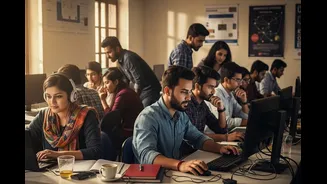

AI is reshaping the aspirations of students and the needs of employers. Universities face the challenge of addressing this mismatch and determining whether online or hybrid learning can help bridge the emerging
skills gap. With AI advancements, many jobs that were in demand five to ten years ago are no longer pursued by students. How can colleges meet this growing demand and close the skills gap?
Prof. (Dr.) Amit Jain, Vice Chancellor of Amity University Rajasthan, Jaipur, points out that the industry has fundamentally reset in the past decade. Roles such as data entry operators, travel desk executives, entry-level IT support, and basic telemarketing have been replaced by automation, AI systems, and cloud-managed services. In their place, new roles like AI and Machine Learning Engineers, Cybersecurity Analysts, Cloud Architects, Data Engineers, and AI ethics and governance specialists have emerged. The rise of Global Capability Centres (GCCs) has further increased demand for domain-specific R&D talent.
Prof. Ramgopal Rao, Vice Chancellor of BITS Pilani, emphasises that many jobs students prepared for a decade ago have evolved. Universities cannot chase every new role; instead, they should focus on building strong foundations, analytical abilities, and the confidence to learn continuously.
According to the World Economic Forum Education 4.0 India Report, only 4.7% of India’s total workforce has undergone formal skill training. Formal training can boost an individual’s salary by 4.7% compared to those without such training. In the primary sector, this wage increase is 36.9%, the report added.
“We should accept that many jobs students prepared for a decade ago simply do not exist in the same form today,” added Prof Rao. “Universities cannot chase every new role. Our responsibility is to build strong foundations, analytical ability, and the confidence to learn continuously. Curriculum reform must move away from rigid silos towards problem led learning, industry exposure, and hands on experience. Online and hybrid learning can support this transition, but only as an extension of campus based mentoring and practice. Technology is an enabler, not a substitute for academic design,” states Prof Ramgopal Rao, Vice Chancellor, BITS Pilani.
Meeting Industry Demands
“For higher education institutions, the challenge is to manage the industry ready part of education. Curricula must move at the pace of industry, not academic cycles,” states Jain.
Not just higher education, the change can come from schools too. By introducing students to age-appropriate AI concepts and project-based learning, schools can help them with ‘how to learn’, not just ‘what to learn’, says Manisha Malhotra, Director-Principal of Satya School, Gurugram.
“From a school’s perspective, the priority is to develop skills that machines cannot replace, such as critical thinking, problem solving, collaboration, empathy and innovation while preparing students to work confidently alongside AI, robots, and intelligent systems. Those who combine technical understanding with these human strengths will continue to hold lasting relevance in the workforce,” stated Malhotra. She further emphasised that rather than training children for specific careers, educational institutions should concentrate on developing strong, transferable skills like critical thinking, problem-solving, creativity, and adaptability.
What The Future Holds?
“Routine work will increasingly be automated, including many tasks that once defined entry level roles. At the same time, demand will grow for people who can integrate technology with domain understanding and human judgment. This will widen wage differences between those who merely operate tools and those who can frame problems and take responsibility for outcomes. Degrees will remain relevant, but only if they prepare students for multiple career transitions rather than a single placement at graduation,” said Prof Rao.
On a similiar note, Prof Jain states entry-level execution tasks will be increasingly automated, pushing professionals toward supervisory, strategic, and governance functions. “We’re moving toward a model where humans guide and oversee intelligent systems rather than perform routine operations,” states Prof Jain.
Arjun Nair, Co-Founder of Great Learning states that schools and colleges are witnessing a significant increase in demand for flexible, skills-oriented learning, particularly for upskilling. In several schools, lessons and sometimes even assessments are being gamified using digital tools to enhance engagement and learning outcomes. While at the university level, online programmes are no longer considered peripheral or experimental but are increasingly integrated into core offerings, alongside traditional UG and PG programmes.
“That said, the pace of change can understandably feel disconcerting, particularly for institutions accustomed to the more measured timelines of academic planning and governance. Curriculum approvals, faculty alignment, and quality assurance take time, while industry skill requirements are evolving at an unprecedented speed,” Nair added.
Prof Jain emphasises that the key takeaway from the past decade is clear: skill portfolios and the ability to continuously learn will be more important than job titles. Careers will not follow linear paths but will consist of projects, capabilities, and experiences across various domains. Successful professionals will view learning as a lifelong pursuit, rather than a phase that ends with graduation.