







Five years ago, being a content creator was considered an unconventional career choice, often associated with influencers, YouTubers and viral social media stars. Today, the creator economy has evolved
far beyond a niche internet phenomenon, supporting millions of livelihoods across Tier 1 and Tier 2 cities. It is not only driving consumer spending but also creating new forms of employment in the digital era.
Today, India is home to more than 2 million active digital creators, making it one of the largest creator markets in the world.
As one of the world’s youngest countries, India sees roughly 12 million people enter the workforce every year, according to the World Bank. Against this backdrop, the creator economy is becoming more than a trend; it is emerging as a parallel employment ecosystem.
From Influencers To An Entire Digital Economy
India’s creator economy has expanded dramatically over the past decade. Affordable smartphones, cheap mobile data and the rise of platforms such as YouTube, Instagram and livestreaming apps have lowered the barriers to content creation.
A Boston Consulting Group report, titled ‘From Content to Commerce: Mapping India’s Creator Economy’, the India’s content creators influence over $350 billion in consumer spending annually. The report highlights that India is home to 2 to 2.5 million active digital creators, defined as individuals with over 1,000 followers. Despite the scale, only 8-10% of them currently monetize their content effectively, underscoring the untapped potential of this fast-growing sector. The creator ecosystem’s direct revenues, estimated at $20-25 billion today, are projected to reach $100-125 billion by the end of the decade.
The report also highlighted that brands are expected to scale up their investments in creator marketing by 1.5 to 3 times in the coming years, signalling a pivotal shift in marketing and commerce driven by the digital creator ecosystem.
What is often overlooked is that most of these creators are not celebrities. Many operate in regional languages and cater to highly specific audiences ranging from education and finance to gaming, agriculture, health and lifestyle content.
“The shift happened the moment attention started paying rent. Ten years ago, posting online was a hobby. Today it is infrastructure. Platforms built payments, brand pipelines and audience tools that let an ordinary person turn the following into a real income stream. In India, cheap data and affordable smartphones brought over 568 million users online, and creators became the trusted layer between brands and audiences. BCG now estimates the creator economy influences $350 billion in spending, moving towards a trillion by 2030. That is no longer a trend. It is an economy,” said Parth Chadha, co-founder and CEO, STAN — the Indian esports and gaming community platform.
The Hidden Workforce Behind Every Creator
The popular image of the creator economy usually focuses on the person in front of the camera. Yet a growing number of jobs exist behind the scenes.
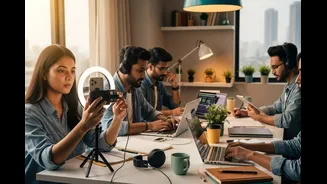
Successful creators increasingly function like small media companies. They employ video editors, graphic designers, scriptwriters, researchers, community managers, talent managers, social media strategists, photographers and business development professionals.
Gaming and livestreaming have created another layer of employment. Moderators, tournament organisers, stream producers, esports managers and community specialists are now part of a rapidly expanding digital entertainment industry.
Many of these roles did not exist at scale a decade ago. Today, a creator with a few hundred thousand followers may employ multiple freelancers, while top creators often manage teams comparable to small start-ups.
This expansion is also creating opportunities beyond India’s largest cities. Because most creator-related work can be performed remotely, professionals in Tier-2 and Tier-3 cities are increasingly participating in the ecosystem without relocating to metropolitan hubs.
“Creator work now sits inside India’s formal jobs conversation. The 2026 Union Budget projected the AVGC (Animation, Visual Effects, Gaming, Comics, and Extended Reality) sector alone will need 2 million professionals by 2030. The clearest proof is already on the ground. At STAN, over 300,000 creators earn a sustainable monthly income, most of them from Bharat. And these are not only on camera roles. Every successful creator spins up editors, thumbnail designers, community managers, scriptwriters and managers around them. This is an economy creating jobs the old labour market never even had a category for, and it is still early,” explained Chadha.
Over 70% of India’s 500 million social media consumers, and roughly the same number of digital transactors, come from Tier 2 locations. India currently has 700 million active smartphone users. Due to affordable smartphones and low data tariffs, these users are leading the expansion of $440 million interactive media market in FY2025 that’s growing at a 45% CAGR (Compound Annual Growth Rate) till FY2030.
Can Content Creation Become A Genuine Employment Engine?
The creator economy’s biggest strength lies in its ability to generate opportunities across multiple skill levels. Not everyone can become a successful influencer. However, not everyone needs to. The ecosystem supports an entire value chain of creative, technical and managerial roles.
According to global job search engine and hiring platform Indeed, the share of job openings in India requiring content creation skills, including content creators, influencers and related marketing and social media roles, rose 919% between 2020 and early 2026.
Content creations roles, which made up roughly one in every 1,000 marketing jobs in 2020 now account for nearly one in every 100. The data suggests creator hiring is moving from a niche requirement to an embedded function within marketing organisations.
The growth of regional-language content is particularly important. India’s next wave of internet users is coming from smaller towns and non-English-speaking audiences. This has created demand for local creators and support professionals who understand regional cultures, languages and consumer preferences.
“Metro creators chase scale. Bharat creators build belonging. The metro playbook is polished, English first and built for mass reach. The tier 2 and tier 3 creators win on trust, language and community density. Our own data points the same way. About 67% of STAN users come from Bharat, and they drive 72% of monetised engagement, with average revenue per user running 17 to 18% higher than tier 1 metros. The myth that money lives only in metros is breaking. The strongest creator economies are now built where investors once looked away,” pointed out Chadha.
The rise of creator-led commerce is further expanding opportunities. Many creators now sell courses, merchandise, digital products and consulting services, creating additional economic activity around their personal brands.
Unlike traditional industries, entry barriers are relatively low. A smartphone, internet connection and a specific skill can often be enough to begin building an audience or offering creator-related services.
“Creation used to mean one person and a camera,” pointed out Chadha. “Now it is a small studio. A single channel can employ an editor, a designer, a community manager and a strategist. In gaming that extends to coaches, casters, moderators and event leads. The employment engine is genuine where the platform shares real revenue and gives creators tools to grow, not just a feed to post in. The risk is calling every unpaid intern a job. The honest version counts only roles that actually earn. By that test, the engine is real and getting deeper every quarter,” he explained.
Is AI A Risk To Creator Economy?
The rapid adoption of artificial intelligence is creating both opportunities and concerns across the creator economy.
On one hand, AI tools can dramatically improve productivity. Content creators can now generate subtitles, edit videos, create thumbnails, analyse audience behaviour and produce marketing content in minutes rather than hours.
This allows smaller creators to operate more efficiently and compete with larger teams.
However, AI is also beginning to automate some of the support roles that emerged during the creator boom. Basic graphic design, routine editing, content summarisation and certain administrative tasks can increasingly be performed by software.
AI is “removing the grunt work, not the artist”, stressed Chadha. Editing, captioning, translation and thumbnail testing now take minutes instead of hours, so a solo creator can produce at studio pace, he said. That lowers the cost of entry for someone in a small town. “The honest caution is that AI now rewards taste and originality more than ever. The tools are commodities. Judgement, voice and community stay scarce and valuable,” pointed out Chadha.
The likely outcome is not the disappearance of creator jobs but a shift in the skills that are valued. Creative thinking, storytelling, community building and strategic planning remain difficult to automate. As AI handles repetitive tasks, human workers may increasingly focus on higher-value activities that require originality and emotional connection.
Why Brands Are Betting Big On Creators
The creator economy’s growth is closely tied to changes in advertising and consumer behaviour.
Traditional advertising channels no longer command the same attention they once did. Consumers, particularly younger audiences, spend more time on digital platforms and often trust creators more than conventional advertisements.
As a result, brands are shifting roughly 20% to 30% of their marketing budgets towards creator partnerships, influencer campaigns and community-driven engagement. Driven by rising Customer Acquisition Costs (CAC), many businesses have moved Google and Meta ad spend from 80% to as low as 40%-50% to fund creator-led storytelling.
Thus, creators offer authenticity that traditional advertising may struggle to deliver. They speak directly to highly engaged audiences and can influence purchasing decisions across categories ranging from beauty products and consumer electronics to financial services and automobiles.
“Because trust now converts better than reach,” said Chadha. “A creator’s recommendation carries the weight of a friend’s, which a banner ad never could. Brands followed the attention, and the attention moved to creators, especially in regional languages where mass media is weak. Creator content is also measurable, with engagement, saves and conversions visible in near real time. For a brand entering Bharat, a tier 2 gaming creator delivers depth that a generic television buy cannot. The shift is not sentiment. It is performance. Money goes where the audience actually listens and acts.
What Are The Risks Of Content Creator Jobs?
Despite the excitement, the creator economy may not always lead to financial success. Income distribution remains highly unequal. A small percentage of creators earn the majority of revenue, while many struggle to generate sustainable incomes.
“The risks are structural, not imaginary,” stresses Chadha. “Income is volatile and tied to algorithms a creator does not control. Burnout is common because the content treadmill never stops. Few have contracts, insurance or social security, a gap that already troubles India’s wider gig workforce. Platform dependence means one policy change can erase a livelihood overnight. And the monetisation gap is stark, with most creators still earning very little. The category will mature only when platforms treat creators as partners with stable payouts, transparency and support, rather than as supply to be optimised.”
That said, the creator economy is unlikely to replace traditional employment or solve every workforce challenge facing India. Yet it would be a mistake to dismiss it as merely an influencer phenomenon.
What makes the sector significant is its ability to create opportunities across content creation, technology, marketing, commerce and digital services. It is generating jobs that did not exist a decade ago and providing new avenues for entrepreneurship, particularly among younger Indians.
The bigger story may not be the rise of influencers, but the emergence of an entirely new economic ecosystem built around creativity, community and digital engagement.
Five Formats Expected To Dominate The Content Creation Market
Micro Dramas: The format, which grew in China and other global market, is expected to reach $125 million in FY2026 and $1 billion in 2030. Growing appetite for video streaming, coupled with declining attention span, has added to the success of format. While more than half of the viewership comes from metro and Tier 1 cities, Tier 2 audience base is expected to expand in the next two to three years. Over 80% of the revenue is subscription-led, indicating room for ad-based models to emerge.
Audio Streaming: This format capitalises on the time that consumers spend away from their screen. The market is expected to grow to $300 million by 2030 with platforms such as KukuFM and Pocket FM catering to audience interested in storylines and vernacular content. With 14 million monthly average users, and an average listening time of 95 minutes per day (versus 30 minutes on music streaming platforms), audio streaming platforms are showing all the signs of growing into a mainstream format.
AI Companions: Global funding for AI companion start-ups reached $500 million cumulative global funding till September 2025, with Indian start-ups like Rumik AI, Bezu AI, and ChaiMate building Hinglish and vernacular language models. This growth is driven by the customisability of conversational AI, rapidly evolving LLMs that render more “human”, empathetic AI companions, and a demand for self-expression and guidance (49% of ChatGPT messages globally ask for advice; 11% seek personal reflection).
Astro & Devotional Tech: Astrological and devotional tech services stand out as a primarily urban-first category, with high consumption among Gen Z, millennial, and NRI segments. These online platforms allow users to generate, match horoscopes, consult with priests/astrologers/numerologists, and offer virtual worship. Consequently, they are gaining traction with a mostly metropolitan, young adult user base. Astro and devotional tech still claim only a small share of the $42 billion astro and devotional products and services market.
Short-Form Video & Social Discovery: Post pandemic, the demand for “connect” apps and the TikTok ban in India made way for the growth of user-generated short-form content in regional languages and social discovery platforms. Players such as FRND have 50 million downloads, the majority of which is attributed to Tier 2+ India. Paid subscribers make up only 4% of SFV and 12% of social discovery users, underscoring the potential for monetisation through virtual tipping, 1:1 calling, and ad-based models.