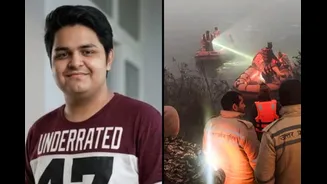










On a cold, fog-shrouded night in Noida’s Sector 150, 27-year-old software engineer Yuvraj Mehta was just minutes from home when his SUV crashed through a damaged roadside barrier and fell into a deep,
water-filled construction pit excavated for a project. The dense fog had made the pit nearly invisible—there were no barricades, reflectors, or warning lights to signal danger, despite prior complaints about hazards at the site.
As Mehta’s car started sinking in the water, the youth—who had no swimming skills—struggled to climb out and finally managed to perch atop the vehicle’s roof. Using his phone’s torch, he repeatedly flashed lights through the fog and called out for help. In a desperate phone call, he told his father: “Dad, I’m drowning, please come save me.”
A DESPERATE CRY FOR HELP
Within minutes of receiving his son’s call, Mehta’s father reached the scene and dialled emergency services. The local police and fire brigade soon arrived at the site, followed by the State Disaster Response Force (SDRF) and later the National Disaster Response Force (NDRF). However, poor visibility, freezing conditions and the depth of the water hampered efforts. Witnesses recounted how rope lines were thrown but didn’t reach the 27-year-old. A crane and ladders were also deployed but still couldn’t bridge the distance. However, what really exposed the apathy of the authorities was the refusal of the rescuers to enter the icy pit, citing dangerous submerged iron rods and the extreme conditions.
For nearly 90 minutes, Mehta continued to cry and wave his light as rescuers worked around the edges. Around 1.45am, the young engineer’s anguished cries abruptly stopped. He had drowned before teams could reach him—a life snuffed out by civic apathy.
WHY DIDN’T AUTHORITIES ACT?
It was in that same narrow window, just after Mehta’s final moments, that Moninder, a delivery agent, saw officials hesitate and decided to act. Tying a rope around his waist, he jumped into the freezing, water-filled pit and spent about 30 minutes searching for the youth and the submerged SUV. Though he did not find Mehta alive, his effort highlighted what many witnesses described as a failure of timely rescue.
Speaking to CNN-News18, Moninder said: “The police came here. They called the fire department, which got here within 15-20 minutes. The SDRF teams reached the site a bit late. However, despite having the required equipment and necessary safety materials, the man’s car was floating on top of the water for about two hours. He kept pleading for help, which fell on deaf ears. There were over 100 men around, but no one stepped up to help him.”
He added: “They asked me if I knew how to swim. I said yes. However, I also asked them why nobody was going to help the man. I noticed that the fire department was fully equipped with fire safety jackets and a crane. The man was alive when the fire department was here. They could have saved him 100 percent. They were well-equipped.”
Mehta’s body was eventually recovered at around 4.30am, after a prolonged multi-agency search operation. In the aftermath, police registered an FIR against the builders responsible for the unsafe construction site, and authorities have faced sharp criticism over delayed rescue action, lack of equipment and visible safety lapses.
However, Additional Commissioner of Police (Law and Order) Rajeev Narayan Mishra blamed low visibility due to fog for hampering rescue efforts, saying police and fire department had used equipment such as a crane, ladder, makeshift boat and searchlights.
A BROKEN FAMILY
Speaking to news agency ANI, Mehta’s father Rajkumar Mehta said: “My son was struggling to save himself. My son was crying out for help, asking people to help him, but most of the crowd was just watching. Some people were making videos”.
He added: “My son struggled for two hours to save his life. The officials and staff present there were not capable of saving him. They did not have any divers. There is negligence by the administration in this entire matter.”
Rajkumar Mehta, who stood helpless just metres away from his dying son, said if expert divers had been deployed, his son could have been saved.
ACTION TAKEN SO FAR
The Noida Authority has begun disciplinary action against officials linked to traffic oversight in the area where the incident occurred. A junior engineer has been dismissed from his post, while several other officials have been asked to explain their role.
In an official statement issued late Sunday, the authority said its chief executive, Lokesh M, directed immediate and firm action. As part of that decision, junior engineer Naveen Kumar was removed from the Noida Traffic Cell. The move followed a preliminary review of lapses in traffic arrangements, according to a PTI report.
In addition, show-cause notices have been issued to officers and staff responsible for managing traffic in and around Sector 150. The CEO has also instructed relevant departments to submit comprehensive reports on land allocation and construction work carried out by developer Lotus. A separate review of safety protocols at the site has been ordered to assess whether proper precautions were in place.
A case had been filed against two real estate companies under Sections 105, 106, and 125 of the Bharatiya Nyaya Sanhita (BNS), covering culpable homicide, death by negligence and endangering life and personal safety.