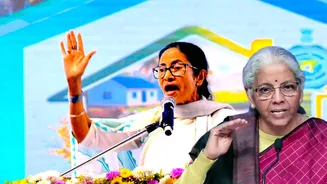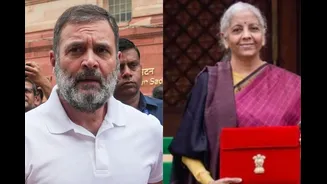

Union Finance Minister Nirmala Sitharaman on Sunday sharply responded to criticism from Congress leader Rahul Gandhi over the Union Budget 2026–27, saying that the fundamentals of the Indian economy remain
strong and that the government is open to debate rooted in facts.
Addressing the criticism, Sitharaman said the Budget focuses on stability and protection for vulnerable sections amid global uncertainty.
“The fundamentals of the economy remain strong. We have introduced multiple schemes for the textile sector and for ordinary citizens to ensure they are protected from volatility,” she said.
Emphasising openness to dissent, the finance minister added, “Political criticism is always welcome, but I want to know what you have to say based on facts. I am willing to listen and respond.”
Union Budget 2026 Live Updates
Her remarks came after Leader of the Opposition in the Lok Sabha, Rahul Gandhi, launched a scathing attack on the Budget, calling it “blind to India’s real crises.”
In a post on X, Gandhi accused the government of overlooking widespread economic distress faced by ordinary citizens.
Listing what he described as urgent national challenges, he wrote: “Youth without jobs. Falling manufacturing. Investors pulling out capital. Household savings plummeting. Farmers in distress. Looming global shocks, all ignored.”
Gandhi further argued that the Budget failed to acknowledge or address these concerns, describing it as one that “refuses course correction.”
His comments followed Sitharaman’s presentation of her ninth consecutive Union Budget, which proposed raising the capital expenditure target to Rs 12.2 lakh crore for FY27, up from Rs 11.2 lakh crore in the current fiscal year.
The Budget also placed emphasis on infrastructure development, including projects in tier-2 and tier-3 cities.
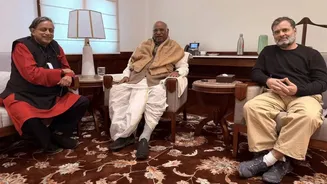
The Congress party continued its attack against the government, with party president Mallikarjun Kharge also criticising the Budget for what he described as a lack of vision.
“The Modi government has run out of ideas. Budget 2026 does not provide a single solution to India’s many economic, social, and political challenges,” Kharge said in a post.
In another statement, Kharge targeted the government’s reform agenda, claiming it lacked intent and direction.
He also flagged concerns over rural distress, inequality and federalism, arguing that farmers were still waiting for meaningful income support and that financially strained states had not been offered adequate relief.