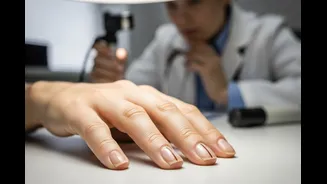








A seemingly harmless brown streak on a fingernail has become the centre of a global health conversation. A widely shared report by the Daily Mail highlighted the case of a woman who initially dismissed
a faint line on her nail as a minor issue, only to discover later it was a rare and potentially fatal form of skin cancer.
The story has since gained traction across social media, prompting dermatologists worldwide to warn about symptoms that often go unnoticed. This little-known condition, called subungual melanoma, is a form of cancer that develops under the nail and is frequently misdiagnosed.
While a small mark on the nail may often be harmless, doctors say this is precisely the problem, such signs are easy to ignore, and doing so can have serious consequences.
What Is Subungual Melanoma?
Subungual melanoma is a rare type of skin cancer that develops in the nail matrix, where new nail cells are produced. It originates from melanocytes—the pigment-producing cells responsible for skin and nail colour—that begin to grow uncontrollably.
“Usually, subungual melanoma shows up as a dark brown or black streak under your nail that gets wider over time. The colour might spread to the skin around it, which is called Hutchinson’s sign. Your nail could get brittle, split, or look weird. Sometimes, you might notice bleeding, pain, or a sore that won’t heal. It usually only affects one nail, not a bunch of them. Any discoloration that sticks around or changes should be checked out,” said Dr Dimple Kothari, Visiting Consultant, Dermatology, Narayana Hospital, Jaipur.
Unlike most skin cancers, this form is not strongly linked to sun exposure. Instead, it is often associated with factors such as repeated trauma to the nail, genetic predisposition, or changes in the immune system.
Globally, subungual melanoma accounts for just 0.7% to 3.5% of melanoma cases, making it relatively rare, but its outcomes can be severe if not detected early.
“Subungual melanoma is pretty rare in India. You don’t see it as much as other skin cancers because darker skin offers some natural protection from UV damage. But it often gets missed or found late because early signs look like fungal infections or nail injuries. It is not about being super active, but about being overlooked. People don’t know much about it, so cases usually show up late, making early detection way more important than how often it happens,” Dr Kothari.
What Are The Subtle Symptoms People Often Ignore?
One of the biggest challenges with subungual melanoma is how easily it blends in with everyday nail issues. The most common sign is a thin, dark streak, which could look like a bruise, especially if someone recalls bumping their finger or toe.
In other cases, it may resemble a fungal infection or pigmentation caused by vitamin deficiencies. Because of this, many people choose to ignore it or attempt home remedies rather than seeking medical advice.
However, doctors say there are warning signs that should not be overlooked. “The most common presentation is a dark vertical streak on the nail (longitudinal melanonychia). Red flags include a band that is widening, irregular in colour (brown to black), blurred borders, or pigment extending onto the surrounding skin (Hutchinson’s sign). Nail distortion, splitting, or unexplained nail damage without trauma should also raise suspicion,” Dr Asma Akhlaq, Consultant, Dermatology, CK Birla Hospitals, Jaipur.
A streak that gradually widens, darkens, or changes shape over time can be a red flag. Similarly, if the pigment extends to the surrounding skin or is accompanied by nail distortion, cracking, or bleeding, it may indicate something more serious.
The key issue is not just the appearance of the mark, but its persistence and progression. Unlike a bruise, which typically fades, melanoma-related streaks tend to remain and evolve.
Dr Kothari pointed out that brown lines on nails don’t necessarily mean skin cancer. “A lot of times, they are just from pigmentation changes, bumps, fungus, or some meds. If you have darker skin, it is pretty common to have harmless brown streaks. But if a line gets wider, weird-looking, or changes colour, that’s something to worry about. If you have a single dark streak that changes over time, you should definitely get it checked out to make sure it’s not cancer.”
Why Diagnosis Is Often Delayed
Despite being visible, subungual melanoma is frequently diagnosed late. The reasons are both medical and behavioural.
First, the location itself poses a challenge. Because the cancer develops under the nail, it is not as immediately noticeable as skin lesions on exposed areas of the body. Many people do not examine their nails closely or regularly.
Second, awareness remains low. While public health campaigns have made conditions such as breast and lung cancer widely recognisable, lesser-known cancers like subungual melanoma receive far less attention. As a result, even individuals who notice unusual changes may not consider them serious.
Misdiagnosis is another factor. In clinical settings, the condition is sometimes mistaken for more common nail disorders, particularly in its early stages. This can delay appropriate testing and treatment.
“Skin cancer can be deadly, especially aggressive types like melanoma. If caught early, most skin cancers are treatable with good results. But if the diagnosis is delayed, it can spread to other organs, which can become life-threatening. Accurate and early diagnosis is super important because how well treatment works depends on when it is found. A wrong diagnosis or delay can cause serious problems, so being aware and getting checked out quickly is key,” said Dr Kothari.
Dr Aklaq echoed similar views on timely and accurate diagnosis. She said certain cancers, especially melanoma, can metastasize and become life-threatening if not diagnosed early. Early-stage detection “dramatically improves survival rates and reduces the need for extensive treatment,” she added.
The consequences of late detection are significant. When diagnosed early, melanoma has a high survival rate, often exceeding 90-95%. But as the disease progresses and spreads, treatment becomes more complex and outcomes worsen considerably.
What Are The Common Types Of Skin Cancers In India?
While skin cancer is less common in India compared to Western countries, it is not insignificant. It accounts for roughly 1-3% of all cancers, with more than 1.5 million new cases reported annually across types. Basal cell carcinoma remains the most prevalent form, particularly in rural areas with high sun exposure. However, subungual melanoma presents a different challenge.
According to Dr Priyanka Hemrajani, Senior Consultant, Dermatology, Marengo Asia Hospitals, Gurugram, basal cell carcinoma (BCC), squamous cell carcinoma (SCC), and melanoma are the three most common types of skin cancer in India. “BCC is the most common type, but it grows slowly and does not spread very often. SCC is more aggressive and can spread to other parts of the body if not treated. Melanoma is not as common, but it is more dangerous because it can spread quickly. In India, SCC is often linked to long-term sun exposure, scars, or ulcers that don’t heal. Melanoma, however, can happen in places that don’t get a lot of sun, like the palms, soles and under the nails,” she added.
There is growing evidence that this type of melanoma is more common among people with darker skin tones than previously assumed. In India, where awareness of skin cancer symptoms is still developing, this creates a risk of underdiagnosis.
Cultural and behavioural factors also play a role. Minor physical changes, such as a mark on a nail, are often dismissed unless they cause pain or interfere with daily life. In many cases, individuals may seek treatment only when the condition becomes severe.
At the same time, urban India is witnessing a gradual shift towards preventive healthcare, with more people opting for regular check-ups and screenings. Dermatologists say this presents an opportunity to improve awareness around lesser-known warning signs, including those related to nails.
When To See A Doctor
Medical experts stress that not every nail streak is a cause for alarm. But certain patterns should prompt closer attention.
A streak that appears without any clear injury, continues to grow, or changes in colour should be evaluated by a doctor. Similarly, any associated symptoms such as pain, bleeding, or nail deformation warrant further investigation.
“Watch out for moles or spots that change in size, shape, or color, sores that don’t heal, or persistent itching, bleeding, or crusting. The ABCDE rule helps with melanoma: asymmetry, irregular borders, color variation, increasing diameter, and evolution. If any skin lesion changes over weeks or months, or a new, unusual growth appears, see a doctor. Early consultation helps with timely diagnosis,” warned Dr Akhlaq.
Diagnosis typically involves a clinical examination followed by a biopsy if required. Early intervention can significantly improve outcomes, making timely consultation critical.
“Even though Indians have more melanin, which only partially protects them from the sun, they should still make sun protection a regular part of their lives. Wear hats and sunglasses and use broad-spectrum sunscreen (SPF 30 or higher) every 2 to 3 hours. Stay out of the sun between 10 am and 4 pm. It is important to check your skin, including your nails, regularly to find any problems early on. Staying hydrated and staying away from tanning beds are also good for your skin,” explained Dr Priyanka Hemrajani, Senior Consultant, Dermatology, Marengo Asia Hospitals, Gurugram.