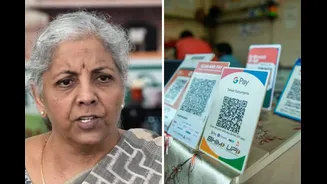








Union Finance Minister Nirmala Sitharaman on Monday said the newly introduced Merchant Discount Rate (MDR) on certain UPI transactions would not result in any additional charge for consumers, while accusing
the Opposition of spreading misinformation over the revised payment framework.
Speaking to ANI, FM Sitharaman said MDR should not be confused with a government levy, stressing that the amount collected would remain within the payments ecosystem rather than going to the government’s Consolidated Fund of India.
“It does not apply to transactions below Rs 2,000. It is neither a tax nor a cess; the funds will not be deposited into the Consolidated Fund of India. It is a charge levied by service providers to improve the system and provide better service, not for small transactions. Moreover, it is a charge between operators; it will not be passed on to the consumer. The burden does not fall on the customer,” the minister said.
UPI MDR Revised
The clarification comes after the National Payments Corporation of India (NPCI) announced a revised MDR framework on September 15. Under the framework, a 0.4% MDR will apply from October 15 to specified person-to-merchant (P2M) UPI transactions above Rs 2,000, with the charge capped at Rs 300 per transaction.
Person-to-person UPI transfers will continue to remain free irrespective of the amount, while payments to merchants up to ₹2,000 and transactions covered under the zero-MDR framework for small merchants will also remain free. The Finance Ministry has said around 96% of P2M transactions will remain unaffected.
Also Read: Why Was UPI MDR Introduced? Finance Ministry Explains Govt’s Logic, Dismisses ‘US Pressure’ Claim
Finance Minister Slams Oppn For Spreading Misinformation
Sitharaman said she had already addressed concerns about the MDR during the Parliament session and criticised Opposition parties for continuing to raise the issue.
“I provided a clarification on this very point when the issue was raised during the parliamentary session. Spreading misinformation, fueling debates based on it, and using that narrative to attack the government has become a habit for the Opposition. This is wrong; there is an effort to spread misconceptions and mislead the public. The public needs to remain vigilant.”
The Finance Ministry has said the MDR will be distributed among participants in the payments ecosystem, including banks and payment application providers, to support the operation and expansion of UPI. It has also clarified that MDR is not a tax collected by the government or NPCI.
Oppn On UPI MDR Revision
The Opposition and some trader groups have raised concerns over the impact of the new MDR framework on merchants, with some warning that businesses could eventually seek to pass the additional cost on to customers. The government, however, has maintained that the charge is not to be passed on to UPI users.
Also Read: UPI MDR: Govt Weighs Steps To Ensure Merchants Don’t Pass Fee To Consumers
The revised framework marks a change from the longstanding zero-MDR model for UPI merchant payments.
The government has said the new mechanism is intended to support the financial sustainability of the digital payments ecosystem while protecting consumers and smaller merchants from additional charges.
With inputs from ANI