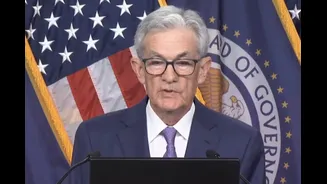









The US Federal Reserve has delivered its third consecutive rate cut, a move welcomed by global markets, but Fed Chair Jerome Powell’s unusual admission about US job data sparked fresh debate over the path
ahead for monetary policy. Powell noted that US payrolls continue to be overstated by around 60,000 per month, suggesting that true job growth may in fact be negative, a signal that would justify a shift towards a more neutral policy stance.
Madhavi Arora of Emkay Global said the takeaway from the meeting was clear: “The time for insurance cuts is over, and that further cuts will only come with a material labour market deterioration.” She added that Powell’s assessment that “true payroll growth has likely been closer to (-)20k per month since April” points to the possibility of downward benchmark revisions, indicating job losses may already be underway.
Although Powell struck a calmer tone on inflation, the Fed’s divided vote reflected the tension within its dual mandate: two hawkish dissents (Goolsbee and Schmid) and one dovish dissent (Miran).
Arora described the Fed’s projections as “Goldilocks-esque”, noting that the 2026 outlook saw an upward revision in growth and downward revision in inflation, which she said could signal expectations of improved productivity.
The Fed now sees 2026 growth at 2.3%, up 0.5 percentage points, while core inflation is forecast at 2.5%. The unemployment rate is projected to dip slightly to 4.4% from 4.5% this year.
JM Financial, however, called the projections optimistic, pointing out that Powell himself hinted at data distortions caused by the recent US government shutdown. The firm said, “We believe further deterioration in the labour market will open policy space for easing; moreover, the change of guard at the helm of the Fed will sentimentally revive expectations of policy easing in 2026.”
It added that markets have reacted positively and are now factoring in a status quo in January, although a clearer picture will only emerge as fresh labour and inflation data comes in.
Impact on Stock Markets
US equities greeted the policy decision with gains. The Dow Jones and S&P 500 rose up to 1%, while US Treasury yields fell between 2–5 basis points. The curve bull-steepened, with much of the movement occurring during Powell’s press conference, which markets interpreted as less hawkish than expected.
The 10-year US Treasury yield eased by 4 bps to 4.15%, and the Dollar Index weakened slightly.
Impact on the Rupee and FII Flows
Market uncertainty continues to cast a shadow over emerging markets, including India. Nachiketa Sawrikar of Artha Bharat Global Multiplier Fund said, “All this policy uncertainty is negative for emerging markets. Regarding India, the impact is a bit worse as the India–US trade deal has also not been finalised.”
He added that these developments are increasing downward pressure on the rupee–dollar exchange rate, and FII inflows into India may remain under pressure, potentially weighing on equity valuations and influencing debt markets.
Impact on Gold and Silver Prices
In contrast, precious metals stand to benefit. Sawrikar said that gold prices in India are likely to remain supported, as global uncertainty and a softening dollar typically strengthen safe-haven demand.
Ross Maxwell of VT Markets explained the dynamic: “A softer USD, combined with lower interest rates, supports gold and silver by reducing the opportunity cost of holding non-yielding assets. Investors tend to look toward safe-haven assets, strengthening demand for precious metals.”
He added that while silver also benefits, its industrial linkages introduce additional volatility and upside potential.
Maxwell further noted that although the rate cut provides relief, uncertainty surrounding US growth and limited room for further easing could restrain global sentiment: “Emerging markets could benefit from a softer USD, but volatility is likely to remain as the global markets adjusts to shifting US economic signals.”