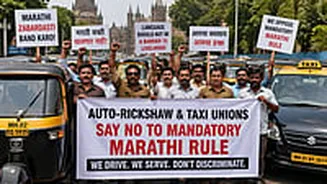






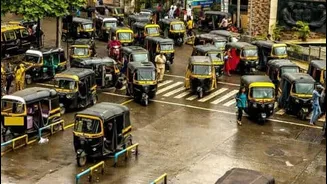
The Mumbai Autorickshawmen’s Union, the largest body representing auto drivers, has announced a statewide agitation beginning May 4. The protest is aimed at opposing the Maharashtra government’s decision
to make Marathi proficiency compulsory for auto and taxi drivers, as reported by The Times Of India.
The union has warned that the agitation could significantly disrupt services and may even lead to a shortage of autorickshaws on the roads.
Massive Participation Expected
Union leaders stated that nearly 15 lakh auto drivers across Maharashtra are likely to take part in the protests. Of these, around 5 lakh drivers are from the Mumbai Metropolitan Region (MMR).
They indicated that demonstrations will be held daily if the government does not roll back the order.
Deadline Before Agitation Begins
Before launching the protest, the union plans to submit a memorandum to the Minister of Transport of Maharashtra Pratap Sarnaik on April 28.
The demand is clear: withdraw the Marathi proficiency requirement before it comes into effect on May 1.
‘Unfair Targeting’ Alleged By Union
Union leader Shashank Rao criticised the move, claiming that traditional auto and kaali-peeli taxi drivers are being unfairly singled out. He pointed out that no strict action has been taken against allegedly illegal bike taxis, and aggregator cab drivers are not required to meet similar Marathi language criteria.
Rao warned that if the government fails to respond, drivers will stage aggressive protests outside railway stations, bus depots, and major auto stands from May 4, continuing daily until their demands are addressed.
New Rule From May 1
As per the government’s directive, all licensed auto and taxi drivers in Maharashtra will have to prove their ability to read and write Marathi.
This verification process will be carried out across 59 regional and sub-regional transport offices. Authorities have indicated that drivers who fail to meet the requirement could face cancellation of their licences.
Strong Opposition From Driver Bodies
The announcement has sparked widespread opposition among unions. They argue that existing drivers had already fulfilled the requirement of having a working knowledge of Marathi at the time of obtaining their badges.
Unions maintain that imposing fresh checks is unnecessary and discriminatory.
Concerns Over Unequal Enforcement
Rao further alleged that aggregator cab drivers are not subjected to proper verification, permit scrutiny, or regulatory restrictions.
He also raised concerns over petrol-run bike taxis, claiming they continue to operate illegally despite regulations allowing only electric bike taxi services.
In contrast, traditional auto and kaali-peeli taxi drivers have complied with multiple requirements, including paying permit fees, undergoing police verification, and meeting domicile and regulatory conditions. They also operate under fares fixed by the Regional Transport Office (RTO) and face penalties for violations.
Sector Supports Lakhs Of Families
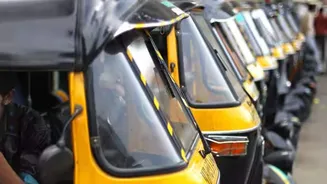
The union highlighted the scale of the sector and its importance to livelihoods. Mumbai alone has approximately 2.8 lakh autorickshaws, while the MMR region accounts for nearly 5 lakh.
Across Maharashtra, around 15 lakh permits have been issued, with the industry supporting an equal number of families, making the issue not just regulatory, but also socio-economic in nature.