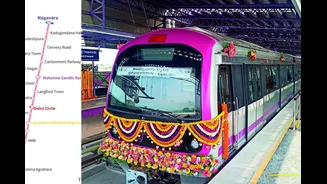

Bengaluru currently has the largest metro rail network in South India, with 96 km of operational lines and 121 km under construction. This information was shared by the Central Government in the Lok Sabha,
highlighting the rapid expansion of metro infrastructure across the country and Karnataka’s leading role in it.
The metro rail network is steadily expanding nationwide. At present, a total of 1,083 km of metro rail and Regional Rapid Transit System corridors are operational across 25 cities in India. Alongside this, several new metro projects are at different stages of construction to strengthen urban public transport systems.
South India’s Metro Network: Operational and Under Construction
Replying to a question raised by a Member of Parliament, the Ministry of Housing and Urban Affairs stated that South Indian states together have 247.68 km of operational metro rail network. In addition, construction is underway on 251.36 km of new metro lines across the region.
Among all South Indian states, Karnataka is leading in terms of metro expansion. The state currently has 121.16 km of metro lines under construction, the highest in the region. Tamil Nadu follows closely with 119 km under development, while Kerala has 11.2 km of metro projects in progress.
Karnataka Tops Operational Metro Length in the South
When it comes to metro lines that are already operational, Karnataka again ranks first among South Indian states. Bengaluru alone accounts for 96.1 km of functioning metro services.
Telangana follows with 69 km of operational metro network, Tamil Nadu has 54.10 km, and Kerala has 28.48 km currently in service. These figures underline Bengaluru’s position as the most extensive metro-enabled city in South India.
Upcoming Metro Lines in Bengaluru
Several new metro corridors are planned or under construction in Bengaluru, which will significantly expand the city’s network in the coming years. These lines are expected to improve connectivity across major residential, commercial, and transit corridors.
| Line | From – To | Distance | Expected Start |
| Pink Line | Kalena Agrahara – Nagawara | 21 km | May 2026 (Full scale by Dec 2026) |
| Blue Line 1 | Silk Board – K.R. Puram | 19 km | By end of 2027 |
| Blue Line 2 | K.R. Puram – Hebbal | 11 km | By end of 2027 |
| Blue Line 3 | Hebbal – Bengaluru Airport | 27 km | May 2027 |
| Orange Line | Kempapura – J.P. Nagar 4th Phase | 32 km | 2029 |
| Grey Line | Hosahalli – Kadabagere Cross | 12 km | 2030 |
Once completed, these corridors are expected to ease traffic congestion and reduce dependence on private vehicles in the city.
Metro Policy and Eligibility Criteria
As per the Metro Rail Policy introduced in 2017, cities with a population of 2 million or more are eligible to propose mass transit systems such as metro rail. These proposals must be based on a Comprehensive Mobility Plan that assesses the city’s transport needs and long-term growth.
The policy framework aims to ensure that metro projects are planned in a sustainable and financially viable manner rather than as isolated infrastructure additions.
Centre Pushes Public Transport With E-Bus Scheme
In addition to metro rail expansion, the Central Government has also launched the PM e-Bus Sewa scheme to strengthen urban public transport. Under this initiative, 10,000 air-conditioned electric buses will be deployed across cities at an estimated cost of Rs 20,000 crore.
The scheme is intended to complement metro networks by improving last-mile connectivity and offering cleaner, more efficient public transport options.
No Fixed Timelines for New Approvals
The Ministry of Housing and Urban Affairs has clarified that metro rail projects involve heavy capital investment and require detailed planning and assured financial resources. Due to these factors, it is not possible to specify exact timelines for the sanctioning of new metro projects.
The approval process depends on multiple variables, including funding arrangements, feasibility studies, and coordination between the Centre and state governments.