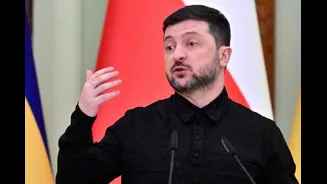





Nearly four years into the Russia–Ukraine war, diplomatic efforts have intensified in a way not seen since the invasion began in 2022. A new round of talks in Berlin brought together Ukrainian President
Volodymyr Zelenskyy, senior US envoys, and European leaders to refine a draft peace proposal that Washington plans to present to Moscow in the coming days. The meetings were followed by unusually upbeat public statements. Zelenskyy called the evolving framework “very workable,” and US President Donald Trump declared that an agreement was “closer than ever.” Germany said there was a small but real chance that a breakthrough could come soon.
But the optimism has come with caution. The draft documents remain incomplete, and the core issues at the heart of the war — Ukraine’s territorial integrity, Russia’s military demands, and the future of Kyiv’s security — are still unresolved. The Berlin discussions nonetheless represent the most coordinated attempt yet to move the conflict from the battlefield to the negotiating table.
What Happened At The Berlin Talks
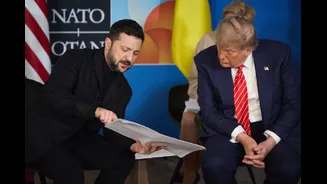
The talks in Berlin brought together Zelenskyy, Ukraine’s chief negotiator Rustem Umerov, US envoy Steve Witkoff, Trump’s son-in-law Jared Kushner, and German Chancellor Friedrich Merz. European leaders from France, the United Kingdom, Italy, the Netherlands, Poland, the Nordic countries and the European Union also held parallel meetings. Together, these sessions focused on the latest iteration of a US-backed peace plan aimed at stopping the fighting and establishing long-term safeguards that would make future Russian aggression more difficult.
Zelenskyy said after the meetings that the delegations had worked “in great detail on documents that could stop the war and guarantee security.” He added that “every single detail matters because not a single detail must become a reward for Russia’s aggression.” Speaking to reporters, he said the draft plan was “not perfect” but described it as “very workable,” and noted that Kyiv and Washington were “very close to (a deal on) strong security guarantees.”
There are now five separate documents under discussion. These include legally binding security guarantees that would require approval by the US Congress, as well as plans for funding Ukraine’s post-war recovery, and frameworks for Ukraine’s economic reconstruction and access to immobilised Russian sovereign assets in Europe. European leaders later said that they would work with the US to “provide robust security guarantees and economic recovery support measures for Ukraine.”
Trump addressed European leaders by phone during their dinner session and told reporters at the White House afterwards that “things are seemingly going well,” adding, “I think we’re closer now than we have been, ever.” He also said he had spoken at length with Zelenskyy and that the US had been in touch with Russian President Vladimir Putin.
What The Emerging Peace Plan Contains
The talks in Berlin centred on how to secure Ukraine once the fighting stops. A major element under consideration is a European-led multinational and multi-domain force that would operate inside Ukraine. According to European leaders, this force would strengthen Ukraine’s defences, help secure its skies and seas, and support the rebuilding of its armed forces, which they said should remain at a peacetime level of 800,000 troops. The US would play a central role by leading a ceasefire monitoring and verification mechanism with international participation.
Zelenskyy has made clear that Kyiv needs clarity on these guarantees before contemplating any territorial arrangements. Addressing the Dutch parliament, he said that Ukraine and Europe were working on a document that could “stop the killing,” and emphasised that “every detail represents a human life.”
US officials familiar with the negotiations have described the proposed guarantees as “Article 5-like,” referring to the NATO commitment that an attack on one member constitutes an attack on all. They have not specified what obligations the US would assume but have made clear that the guarantees would not involve American troops on the ground in Ukraine. German Chancellor Friedrich Merz said that what the US placed on the table in Berlin, in terms of legal and material guarantees, was “really considerable.”
Before the meetings, Zelenskyy signalled that Ukraine might be willing to abandon its ambition to join NATO if it received firm and legally binding security guarantees from the West. Russia has long cited Ukraine’s NATO aspirations as one of the reasons for its invasion in 2022.
Why Territory Remains The Hardest Roadblock
While there has been notable progress on security arrangements, the central question of territory — particularly in the eastern Donbas region — remains unresolved. Russia is demanding that Ukraine cede control of Donbas as a condition for a settlement. Zelenskyy, however, has taken a firm position that Ukraine will not give up this territory, and reiterated that it “will not recognise the temporarily occupied part of the eastern Donbas region as legally or de facto Russian.”
The US has floated a compromise idea involving a free economic zone in certain areas of Donbas. Under this proposal, the zone would be demilitarised. Ukraine would withdraw from the area, but Russian forces would not enter it. Ukraine has raised questions about who would manage such a zone and how reciprocal troop withdrawals would be enforced. It remains unclear whether Putin would consider this proposal at all, given his long-standing objectives in eastern Ukraine.
Russia currently controls nearly a fifth of Ukraine’s east and has been making incremental territorial gains while Kyiv faces military pressure and declining external ammunition supplies.
As per a CNN report, US officials claimed that roughly 90 per cent of the issues between Russia and Ukraine have been solved, describing the issue of territorial concessions as a key sticking point.
Russia’s Red Lines And Its Response To The Berlin Talks
Moscow said it had not seen the text of the proposals on NATO-style security guarantees but the Kremlin has reiterated its long-standing conditions. Spokesperson Dmitry Peskov dismissed the idea of a temporary halt in fighting, saying, “We want peace, we don’t want a truce that would give Ukraine a respite and prepare for the continuation of the war.” He added that Russia wanted to “stop this war, achieve our goals, secure our interests, and guarantee peace in Europe for the future.”
Russia has previously demanded that Ukraine amend its constitution to forswear joining NATO and accept limits on the size of its military. It has also insisted that any agreement must reflect its territorial claims in eastern Ukraine. Peskov said that if Ukraine was looking for “momentary, unsustainable solutions,” Russia would not participate in such negotiations.
These positions indicate that even if the US presents Moscow with the refined proposal next week, the Kremlin’s acceptance is far from guaranteed.
Why Trump Says Peace Is Close, And Why Many Remain Sceptical
Trump has said that there is “tremendous support from European leaders” for ending the war and has repeatedly expressed confidence that negotiations are moving forward. But analysts remain doubtful that a ceasefire is imminent.
Keir Giles, a Russian military expert at London think tank Chatham House, told Al Jazeera that “Trump has repeatedly claimed that a peace deal is close without sustainable agreement.” Nathalie Tocci, director of the Istituto Affari Internazionali, said it was “extremely unlikely that a ceasefire is going to be reached now,” citing the unresolved issues of territory and security.
Russia and Ukraine’s war aims remain fundamentally incompatible. Russia believes it can secure more on the battlefield, while Ukraine remains unwilling to legitimise territorial losses. Zelenskyy wrote on X that “we have different positions with Russia regarding territories. This must be acknowledged and discussed openly.” He added that the US, acting as mediator, would propose steps to find “some form of consensus.”
Giles noted that any ceasefire would only hold if Russia believed it would gain more by stopping its offensive than by continuing it. Without such an incentive, the likelihood of Moscow agreeing to a genuine halt in fighting remains low.
Is A Ceasefire Really On The Horizon?
The Berlin talks have brought the parties closer to articulating a framework for ending the war than at any point in recent years. The US and Europe have narrowed their differences on security guarantees. Ukraine says a draft plan could be finalised within days. Trump claims that momentum is building, and European leaders have spoken of a narrow but real window for progress.
Yet the largest obstacles — the fate of Donbas, Russia’s political and military demands, and the nature of Ukraine’s security guarantees — remain unresolved. Russia has restated that it seeks a comprehensive settlement, not a temporary truce. Ukraine insists it will not reward aggression. And on the ground, Russian forces continue to hold substantial territory.
For now, the diplomacy signals movement, but not resolution. Progress in Berlin may have opened the door slightly wider, but the fundamental questions at the core of the conflict still stand, and until those are addressed, a ceasefire, however close it appears, remains uncertain.