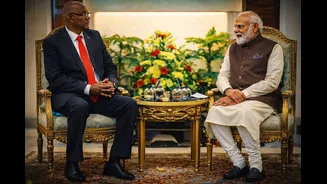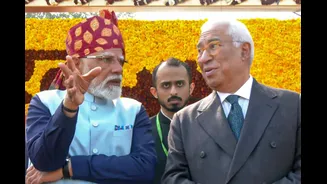

Terming the proposed India–European Union free trade agreement the “largest FTA in the world”, European Council President Antonio Costa has said the deal goes far beyond commerce and will act as a powerful
geopolitical signal at a time of growing global uncertainty.
The long-pending agreement is expected to be signed at the EU–India summit in New Delhi on Tuesday, hosted by Prime Minister Narendra Modi. According to Costa, the pact will be the most expansive trade agreement ever concluded by either side and a cornerstone of their evolving strategic partnership.
“This will be the largest free trade agreement globally and the biggest agreement ever signed by India or the European Union,” Costa told CNN-News18 in an interview with Managing Editor Zakka Jacob. “It carries enormous weight — economically, politically and in security and defence cooperation.”
Costa said the agreement reflects a shared worldview between New Delhi and Brussels, positioning free trade as a stabilising force rather than resorting to tariff-led economic nationalism.
“India and the EU believe in trade agreements, not trade wars,” he said. “Free trade strengthens economies, creates employment and brings prosperity. When two of the world’s largest democracies commit to predictable rules, it reinforces the global order.”
He added that the deal would anchor long-term certainty in India-EU relations at a time when supply chains and alliances are being reshaped.
Beyond trade, Costa emphasised that the pact would expand Indian companies’ access to European markets while deepening cooperation in defence and security.
“There is a clear economic dimension to our security cooperation,” he said. “Indian firms will find new opportunities in Europe, while both sides work to enhance defence capabilities.”
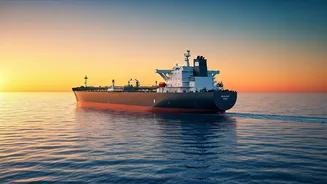
Maritime security will be a central pillar of this collaboration, he noted, given shared dependence on uninterrupted sea lanes.
“For India and Europe, safe shipping routes are essential. Maritime security is therefore a strategic priority,” Costa said.
Climate Cooperation And Energy Transition
Referring to India’s renewable energy showcase at the Republic Day parade, Costa highlighted climate action as another key area of convergence, particularly in the context of the EU’s Carbon Border Adjustment Mechanism (CBAM).
“India is firmly committed to the Paris Agreement, and that commitment is clearly visible,” he said. “Our objective is to work together on the energy transition and reach shared climate goals.”
EU Backs Denmark, Greenland Amid Tensions
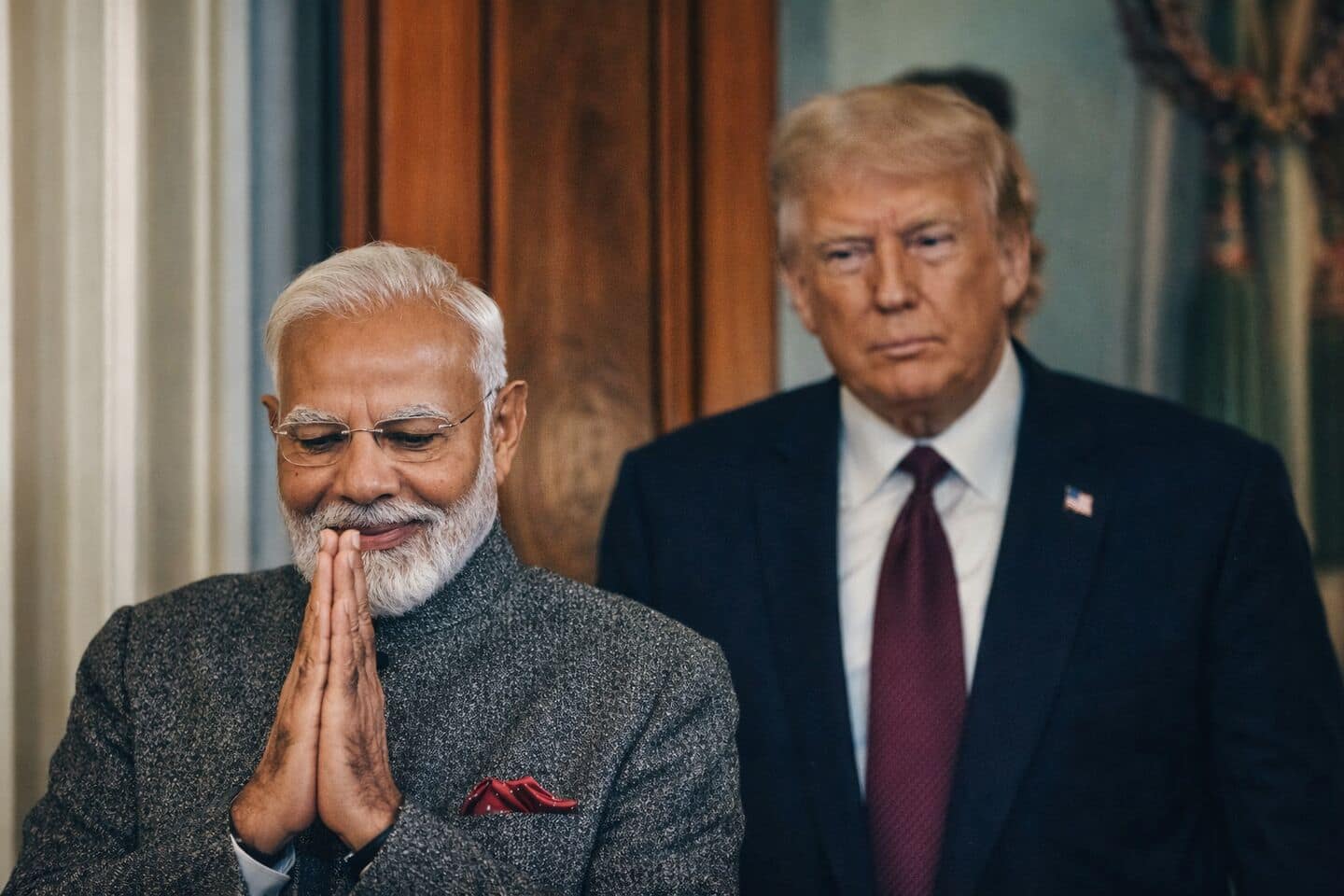
On US President Donald Trump’s remarks regarding Greenland, Costa firmly reiterated the European Union’s support for sovereignty and territorial integrity. “Greenland is part of the Kingdom of Denmark. Its future can only be decided by Denmark and Greenland,” he said. “The European Union fully supports both.”
While acknowledging Arctic security concerns and NATO’s role in regional defence, Costa said territorial expansion could not be justified under international law.
Ukraine And Global Stability
Costa also addressed the war in Ukraine, underlining continued European support for Kyiv and pressing Russia to engage meaningfully in peace efforts. “We are backing every serious initiative for peace,” he said. “But Russia continues to reject a ceasefire. Every day, lives are being lost.”
‘India Shows How Democracy Preserves Diversity’
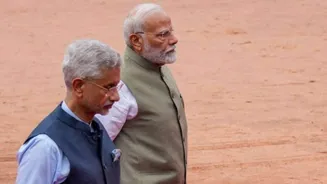
Attending the Republic Day celebrations alongside Prime Minister Modi and European Commission President Ursula von der Leyen, Costa spoke about India’s pluralism and democratic character.
“It was deeply meaningful for me personally,” said Costa, whose father grew up in Goa. “India demonstrates how the world’s largest democracy preserves its extraordinary diversity.”
He said the parade offered a powerful reminder that India’s strength lies not just in its military capabilities, but in its cultural and social fabric.