




The 2026 assembly elections across states are not just producing winners and losers but resetting political patterns. From Tamil Nadu to West Bengal, Kerala to Assam, the results point to a series of “firsts”
that could reshape regional and national politics for years.
Here are the top seven moments:
1. Break Of Duopoly In Tamil Nadu
For over five decades, Tamil Nadu politics revolved around a stable binary: DMK vs AIADMK. That system has now been fundamentally disrupted.
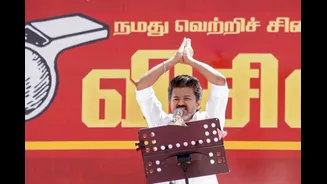
The numbers so far show Vijay’s TVK not just competing, but overtaking both Dravidian majors and pushing the DMK to third place in a scenario that was almost unthinkable until recently.
ALSO READ | From ‘I Am Waiting’ To ‘I Am Coming’: How Vijay Ended Tamil Nadu’s Dravidian Duopoly
What makes this a “first” is not just the emergence of a third force but the collapse of a deeply institutionalised political structure built on cadre networks, welfare politics, and ideological legacy. Analysts quoted by The Times of India note this reflects a broader anti-establishment churn, where voters are willing to abandon legacy loyalties in one sweep.
2. Youngest Possible CM? The Vijay Moment
If trends hold, Vijay could become one of Tamil Nadu’s youngest chief ministers in recent decades, but the significance goes beyond age.
This marks the first time in years that a first-time political entrant is on the verge of power without a gradual build-up through alliances or legislative experience. His rise mirrors MGR and NTR, but with a crucial difference: He is doing it in a crowded, competitive, post-coalition era, and not a transitional phase.
TVK’s surge to triple-digit leads underscores how celebrity capital, when combined with anti-incumbency, can translate instantly into political dominance, The Economic Times said.
3. BJP’s Breakthrough In West Bengal
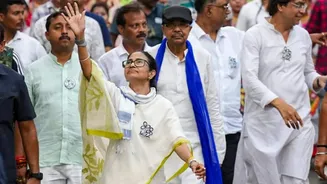
West Bengal has historically resisted the BJP, first under the Left and then under the Trinamool Congress (TMC). That resistance appears to be breaking.
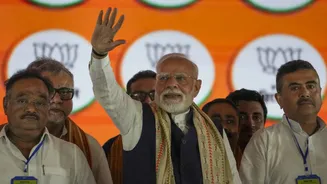
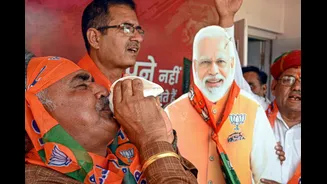
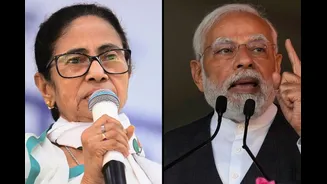
Trends so far show the BJP opening a decisive lead over the ruling TMC, marking its strongest-ever performance in the state and potentially its first real shot at forming a government in Bengal.
ALSO READ | ‘The Modi Mandate’: How PM’s Personal Brand Rewrote Rules Of 2026 State Polls In Favour Of BJP
This is significant because Bengal was seen as one of the last major states where the BJP had not cracked the regional stronghold. A breakthrough here signals the saffron party’s expansion into eastern India, weakening of a powerful regional satrap (Mamata Banerjee), and a shift in national political balance.
4. Hindu Consolidation In Bengal
Closely tied to the BJP’s surge is another first: visible consolidation of Hindu votes across regions.
According to The Indian Express, campaign narratives around identity, border issues, and local flashpoints appear to have translated into a more unified voting pattern, especially in tribal belts and districts where the BJP has built momentum over multiple election cycles.
This kind of consolidation is significant because Bengal has traditionally seen fragmented voting patterns based on class, region, and local networks, rather than large-scale religious alignment.
The shift suggests a move toward more polarised, identity-driven electoral behaviour, which could have long-term implications for the state’s politics.
5. Decimation Of Left In Kerala
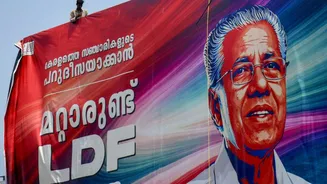
Kerala’s politics has long been defined by predictable alternation between the Left Democratic Front (LDF) and the Congress-led UDF. This time, that rhythm appears to have broken. Figures so far show the Left, particularly the CPI(M), reduced sharply, with the Congress-led UDF opening up a clear lead.
What makes this a “first” is not just defeat, but the scale of the decline, suggesting strong anti-incumbency against the Left, a potential weakening of ideological politics in favour of governance narratives, and a break in Kerala’s historically stable electoral cycle.
Even more significantly, analysts speaking to the Times of India note the emergence of new political spaces, with smaller parties and even the BJP attempting to position themselves as alternatives in select pockets.
6. BJP’s Solo Dominance In Assam
In Assam, the BJP’s performance marks another structural shift: from coalition dependence to standalone dominance.
Numbers so far show the party leading comfortably, positioning it for a third consecutive term and consolidating its grip on the state. What makes this a “first” is the nature of that dominance. According to Reuters, earlier, victories relied significantly on regional allies. This time, the BJP’s organisational strength appears self-sustaining, signalling a transition from alliance-era politics to single-party consolidation in the Northeast.
This also strengthens the BJP’s broader strategy of expanding and stabilising its footprint beyond its traditional Hindi heartland base.
7. Record Turnout & Silent Voting Paradox
One of the most striking “firsts” is the combination of extremely high turnout and extreme voter silence, two things that usually don’t go together.
West Bengal saw about 92-93 per cent turnout, among the highest ever. At the same time, pollsters reported an unprecedented refusal by voters to reveal choices, even forcing some agencies like Axis My India to skip exit polls.
This creates a new electoral pattern: Highly engaged voters who are publicly non-committal but privately decisive. That’s a major shift from earlier elections where high turnout usually came with visible political mobilisation.