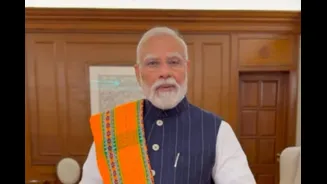




Nearly seven months after Nitin Nabin formally took charge as the national president of the Bharatiya Janata Party, and even Prime Minister Narendra Modi addressed him as his “boss”, the BJP has finally
announced its revamped team of national office-bearers.
The announcement comes at a crucial time. Delhi has witnessed large-scale student protests that led to the resignation of Education Minister Dharmendra Pradhan and Prime Minister Modi has urged BJP MPs to become more active on Instagram to connect with Gen Z, a key voting bloc ahead of the 2029 Lok Sabha election.
The new team also appears to be younger than the outgoing one, with Nabin himself being just 46 years old. This is the team that will steer the BJP through crucial state elections, including the Uttar Pradesh Assembly polls early next year, and eventually the bigger electoral battle — the 2029 Lok Sabha election, when Narendra Modi is expected to seek a fourth term as Prime Minister.
Here are the three big takeaways from BJP’s new team
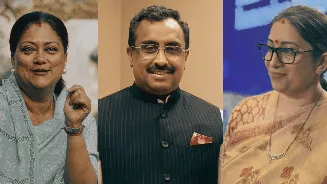
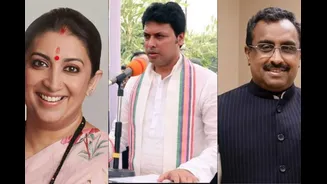
1. Smriti Irani And Biplab Deb Rewarded
In the BJP’s organisational hierarchy, national vice presidents may formally rank next to the party president, but the real political weight often rests with the national general secretaries. Smriti Irani’s elevation to the post is therefore significant.
Irani officially exited her last stint as a Union Cabinet minister on June 9, 2024, after her defeat in Amethi. Since then, however, she has remained actively involved in the party’s political campaigns. She campaigned extensively during the West Bengal Assembly election, where her communication skills and fluency in Bengali proved useful. Since June 2024, she has also campaigned for the BJP in Jammu and Kashmir, Maharashtra, Delhi and Bihar.
The BJP has often used periods when leaders are out of government to assess their organisational commitment and political usefulness. Irani appears to have passed that test, with her elevation now giving her a key role in determining how the party functions at the national level.
Biplab Kumar Deb’s elevation is equally significant.
After being asked to step down as Tripura Chief Minister and move to Delhi, Deb was appointed the BJP’s Haryana in-charge, where he was tasked with overseeing the party’s organisation and political affairs ahead of the 2024 Lok Sabha and subsequent Assembly elections. The BJP won both polls in the state.
On September 25, 2025, the BJP appointed Union Minister Bhupender Yadav as its Bengal election in-charge and Deb as election co-in-charge. Deb was tasked with overseeing election preparations, organisational coordination and efforts to expand the BJP’s footprint across West Bengal.
His role was particularly important in North Bengal. The BJP’s performance in the state earned Deb political credit within the organisation.
More importantly, Deb did not publicly display any rebellion after being removed as Tripura chief minister. The BJP has now rewarded that organisational loyalty and electoral performance with one of the most influential positions in the party’s new structure.
2. Is Piyush Goyal on his way out as minister?
One name tucked into the BJP’s new organisational list has triggered particular interest: Piyush Goyal, who has returned as the party’s national treasurer.
Goyal takes over a post that had been held by Rajesh Agarwal since September 26, 2020. Interestingly, Goyal himself was the BJP treasurer before he was elevated to the Union Cabinet during Modi’s first term.
His return to the post is, therefore, a kind of “ghar wapsi” within the BJP organisation for a leader who has since handled several important Union portfolios and currently serves as the Commerce and Industry Minister.
But there is another reason why Goyal’s appointment is significant: the BJP’s longstanding “one person, one post” principle.
When Amit Shah was the BJP president while also serving as Union Home Minister, he had indicated that he would make way for a new party president. The BJP has followed the same principle in several other instances.
In 2014, when Sarbananda Sonowal became a Union minister, he gave up the Assam BJP presidency. More recently, in 2023, Kailash Vijayvargiya explicitly cited the same principle when he resigned as BJP national general secretary after becoming a minister in the Madhya Pradesh government.
That raises an obvious question: does Goyal’s appointment as BJP treasurer indicate that he could eventually give up his ministerial position?
The answer is not clear yet. But with speculation over a possible Union Cabinet reshuffle already building, Goyal’s return to the BJP’s organisational structure has certainly added another layer to the discussion.
3. Ram Madhav Returns
Six years is a long time in politics. But Ram Madhav, once one of the BJP’s most influential general secretaries, has made a significant comeback.
When BJP president JP Nadda announced a new national team on September 26, 2020, Madhav was dropped as national general secretary, a position he had held since 2014.
At the time, there was speculation that the powerful BJP strategist could be accommodated in the Union Cabinet or inducted into the party’s Parliamentary Board. Neither happened.
Madhav returned to the Rashtriya Swayamsevak Sangh (RSS) in 2021 and was made an executive member of the organisation, where he had begun his political journey.
But 2024 provided the first clear indication that Madhav could return to active BJP politics. The party appointed him, along with Union minister G Kishan Reddy, as an in-charge for the Jammu and Kashmir Assembly elections.
Jammu and Kashmir was familiar territory for Madhav. He had played a key role in the BJP-PDP alliance following the 2014 Assembly election, which produced a hung verdict. He was also involved when the BJP ended its alliance with the PDP in 2018.
His return assignment proved successful. Under his charge, the BJP won 29 seats in the 2024 Jammu and Kashmir Assembly election — its highest-ever tally in the Union Territory, surpassing its previous record of 25 seats in 2014.
His elevation as a national vice president in Nitin Nabin’s team, therefore, marks more than just a return to the BJP fold.
Beyond The Three Big Takeaways
There are several other notable changes in the BJP’s new team. BL Santhosh remains unchanged as national general secretary (organisation), retaining one of the most powerful positions in the party structure.
Former journalist Pradeep Bhandari has also moved up the organisational ladder, transitioning from BJP national spokesperson to media co-convenor. The BJP has also effectively expanded the importance of its digital machinery, with the IT cell structure now being referred to as the social media setup.
But the three appointments that stand out are those of Smriti Irani, Biplab Deb and Ram Madhav — three leaders whose political trajectories over the past few years make their elevation particularly noteworthy.
Their task is now clear: reconnect the BJP with an increasingly aspirational Gen Z, strengthen the party’s organisation ahead of crucial state elections, help erase recent bypoll setbacks and prepare the ground for the bigger electoral battle of 2029.