








The Supreme Court on Monday said its November 20 judgment on a uniform definition of the Aravalli hills and the recommendations of the expert committee will be kept in abeyance for now, stressing the need
for an expert-led environmental impact study of the earlier report on the range.
The apex court’s previous ruling, where it accepted a uniform definition of the Aravalli hills and ranges and banned the grant of fresh mining leases inside its areas spanning Delhi, Haryana, Rajasthan and Gujarat, triggered sharp protests and criticism amid concerns over unregulated mining and environmental damage.
The matter, titled “In Re: Definition of Aravalli Hills and Ranges and Ancillary Issues”, was heard by a three-judge bench led by Chief Justice of India Surya Kant, alongside Justices JK Maheshwari and AG Masih. CJI Kant asked the government to clearly state whether mining would be stopped or allowed to continue under the new framework and to explain the rationale.
The CJI said the committee report and the observations of the court made last month were being misconstrued, and some clarifications are required. “Prior to the implementation of a report or direction of this court, a fair, impartial, independent expert opinion must be considered. Such a step is essential to provide definitive guidance,” he said.
The court proposed a committee of domain experts to be constituted to examine the report of the recommendations of a committee of the MoEF&CC (Ministry of Environment, Forest and Climate Change) on the definition of the Aravalli hills and ranges. It framed five questions to be considered.
- Whether the definition of Aravalli restricted to 500 m area creates a structural paradox where the conservation area is narrowed?
- Has it broadened the scope of any non-Aravalli area where regulated mining can be permitted?
- Whether regulated mining should be allowed in gaps — particularly where there are two hill areas of 100 metres or more in height, separated by a distance of around 700 metres — and how such gaps should be treated.
- What precise structural parameters will be utilised to ensure ecological continuity is not compromised?
- If a significant regulatory lacuna is discovered, then whether a significant assessment would be needed to maintain the structural integrity of the range?
“We propose that a high-powered expert committee comprising domain experts be constituted to analyse the report submitted by the expert committee,” the court said. It further said that the process would include public consultation.
The court also issued notice to the Centre, all states and directed that its November 20 order and the recommendations of the government-appointed committee be kept in abeyance, adding that the stay will remain in effect till constitution of a new committee. The matter will be taken up next on January 21, 2026.
What Is The Matter?
A different bench of the apex court accepted a standardised definition proposed by the Central government. Under this framework, a landform is classified as an “Aravalli Hill” only if it rises 100 metres or more above the local relief. Furthermore, a “range” is defined only when two such hills are located within 500 metres of each other.
Data from the Forest Survey of India (FSI) suggests that out of over 12,000 hill formations in the region, only about 8.7% meet this 100-metre threshold. The verdict was sharply criticised by environmentalists over concerns of unregulated mining and environmental harm, saying that this definition effectively strips legal protection from more than 90% of the Aravalli landscape.
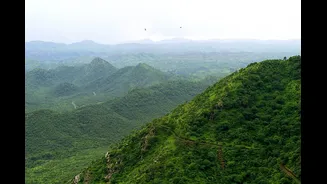
The Aravallis serve as a critical ecological corridor and a “green wall” that prevents the eastward expansion of the Thar Desert into the fertile plains of north India. They are also vital for groundwater recharge in parched states like Rajasthan and Haryana.
Amid the row, the Central Government on Wednesday directed the concerned states to impose a complete ban on granting any new mining leases across the entire Aravalli range.