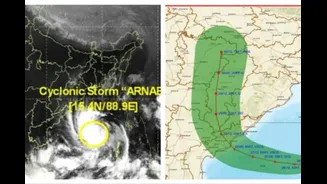









Cyclone Arnab is currently tracking across the east-central and adjoining west-central Bay of Bengal, positioned approximately 650 km east-southeast of Visakhapatnam and 730 km east-southeast of Kakinada.
According to the India Meteorological Department (IMD), the storm has intensified from a deep depression into a cyclonic storm and is projected to strengthen into a Very Severe Cyclonic Storm.
LANDFALL SCHEDULE & LOCATION
When: Forenoon of Wednesday, 28 October 2026.
Where: Crossing the Andhra Pradesh and Yanam coasts between Bapatla and Visakhapatnam.
Intensity: Anticipated sustained wind speeds of 115–125 kmph, gusting up to 140 kmph.
Cyclone Arnab is an active tropical cyclone forming over the east-central and adjoining west-central Bay of Bengal.
WHY ARNAB?
The name “Arnab” means “ocean” in Bengali and was contributed by Bangladesh as part of the regional tropical cyclone naming list maintained by the WMO/ESCAP Panel.
Moving west-northwestwards, it is forecasted to intensify further into a Very Severe Cyclonic Storm before making landfall between Bapatla and Visakhapatnam along the Andhra Pradesh and Yanam coasts on Wednesday forenoon, October 28, 2026.
Sustained wind speeds of 115–125 kmph gusting up to 140 kmph, accompanied by heavy to extremely heavy rainfall and rough sea conditions across coastal Andhra Pradesh and parts of southern Odisha.
CYCONE ARNAB: THE EVACUATIONS
Evacuations are actively underway as state administrations ramp up pre-landfall operations along the eastern coastline.
Andhra Pradesh: State authorities have identified 570,000 people as vulnerable in high-risk coastal and low-lying areas, with mass evacuations beginning Monday evening, October 26, 2026. Chief Minister N. Chandrababu Naidu has positioned 10 NDRF teams and 11 SDRF teams on standby, while local districts have opened control rooms and set up relief centers.
Odisha: The Odisha government has initiated the evacuation of residents from low-lying and landslide-prone areas across vulnerable southern districts. Chief Minister Mohan Charan Majhi has deployed 60 ODRAF teams, 17 NDRF teams, and 225 Fire Services teams, alongside closing schools and colleges in affected districts for Tuesday and Wednesday.
Fishermen and Sea Operations: Over 4,800 fishing boats have safely returned to the Kakinada coast and other harbors following a complete ban on venturing into the rough waters of the Bay of Bengal.
10 THINGS TO KNOW ABOUT EMERGENCY PREPARATION
If you are located in the red-alert coastal zones of Andhra Pradesh or Southern Odisha, execute these safety measures immediately:
- Know Your Shelter Location: Identify the closest government-designated cyclone shelters or high-ground concrete structures. Move early if you reside in a low-lying area or a thatched/kutcha house.
- Pack an Emergency Kit: Put together a waterproof bag containing a torch with extra batteries, a power bank, a first-aid kit, copies of essential documents, personal medications, and a whistle.
- Stock Food and Clean Water: Keep a 3-to-5-day supply of non-perishable ready-to-eat dry foods and clean drinking water stored in securely sealed containers.Secure
- Loose Outdoors Objects: High winds reaching 140 kmph can turn everyday items into dangerous projectiles. Tie down or bring inside all loose patio furniture, cycles, flower pots, and tools.
- Reinforce Windows and Doors: Fit storm shutters or securely brace windows and doors from the inside. Stay away from glass panels once high-velocity winds begin.
- Charge Devices & Unplug Appliances: Fully charge your mobile phones and emergency power banks now. Once the storm hits, unplug luxury electronics to prevent damage from power surges or lightning strikes.
- Strict No-Sea Rule for Fishermen: Obey the complete fishing ban issued by the National Disaster Management Authority (NDMA). Keep all commercial and mechanised boats anchored securely at port.
- Clear the Drainage: Ensure local drains around your property are clear of debris to reduce the pooling effect of the heavy rainfall (forecasted up to 210 mm).
- Keep Cattle and Pets Safe: Unloose domestic animals from their outdoor tethers so they have a chance to seek higher ground, or move them into reinforced indoor structures ahead of time.
- Follow Verified Updates Only: Do not spread unverified panic on social media. Rely exclusively on official updates broadcasted by local authorities, state disaster management cells, or the IMD Weather Tracker.