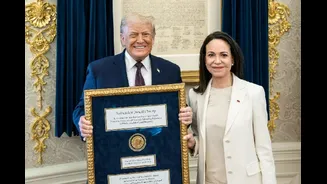



In early January 2026, US President Donald Trump hosted Venezuelan opposition leader María Corina Machado at the White House, where she presented him with her 2025 Nobel Peace Prize medal. Trump accepted
the gesture, praising it as recognition of his efforts in Venezuela and framing it as a symbol of shared commitment to freedom. Machado, who won the award for her non-violent advocacy against the Maduro regime, described the act as gratitude for Trump’s role in ousting Nicolás Maduro through a US military operation just days prior. This unprecedented move – transferring a Nobel medal to a foreign leader – has sparked global debate, raising questions about the integrity of international awards and the politicisation of peace efforts.
The backdrop is Trump’s aggressive foreign policy, exemplified by the January 3, 2026 raid that captured Maduro and his wife, Cilia Flores, in Caracas after US airstrikes. Trump declared the US would “run” Venezuela during a transition, citing Maduro’s narco-terrorism charges and promising to control its oil resources. Critics argue this intervention echoes historical US overreach in Latin America, undermining sovereignty and fuelling accusations of neo-imperialism. Maduro’s ouster, while welcomed by opposition figures like Machado, involved significant civilian casualties – over 100 reported from the strikes – and has left Delcy Rodríguez as acting president, who denounced the action as “brutal aggression.” Legal experts question the raid’s basis under international law, noting it violated Venezuelan sovereignty without UN approval.
Trump’s acceptance of the medal amid this turmoil symbolises a troubling fusion of personal acclaim and geopolitical muscle. It overlooks the Nobel’s emphasis on peaceful resolution, instead celebrating a military incursion that displaced power without a clear democratic path forward. As Republicans and Democrats grapple with America’s global role in 2026, this episode highlights tensions between interventionism and restraint, potentially alienating allies while emboldening adversaries. At a time when US leadership is scrutinised, Trump’s move risks portraying the nation as prioritising conquest over collaboration, setting a precedent that could erode trust in multilateral institutions.
A Condemnable Intervention
Trump’s acceptance of Machado’s Nobel medal casts a shadow over his administration’s handling of Venezuela, framing a forceful regime change as a “saviour” act worthy of peace honours. The January 3 operation, which captured Maduro after bombing key sites, exemplifies autocratic overreach. Maduro, indicted for narco-terrorism since 2020, faced a $50 million bounty, but the raid’s execution – resulting in around 100 deaths and US oversight of Venezuelan affairs – smacks of fascism, prioritising unilateral power over international norms. Trump’s vow to negotiate energy deals under threat, with Rodríguez as a sanctioned interim leader, questions the regime’s legitimacy and America’s role as an impartial actor.
This intervention in 2026’s geopolitical landscape raises alarms about fair play. By “running” Venezuela, the US risks accusations of resource plundering, especially oil worth billions, echoing colonial-era tactics. Machado’s gesture, while appreciative, politicises the Nobel, linking it to a questionable military success rather than genuine diplomacy. Deep-rooted politics here involve Republican hawks pushing aggressive stances, but it condemns the US to a cycle of endless interventions, alienating Latin American allies and bolstering anti-American sentiment worldwide.
Hollow Peacekeeping
Trump’s self-proclaimed peacekeeping prowess crumbles under scrutiny, making his Nobel acceptance ring hollow. In Gaza, his 20-point plan promised a ceasefire, yet violations persist: Israel continues bombings, killing hundreds since October 2025, with no Hamas disarmament. Netanyahu, after meetings with Trump, echoed warnings of “hell to pay” for non-compliance, but phase two stalls amid ongoing attacks and unreturned hostages. Hamas operates freely, undermining claims of success.
The Russia-Ukraine war fares no better; Trump’s meetings with Zelenskyy and Putin yielded tense exchanges but no ceasefire. A leaked 28-point plan drew Russian rejection, with fighting raging into 2026 despite US aid suspensions and failed talks. Trump’s boasts about halting India-Pakistan clashes post-Operation Sindoor are debunked – India clarified no US mediation, calling it a lie.
Yemen’s Operation Rough Rider degraded Houthi capabilities but ended in a ceasefire without full resolution until Gaza’s deal. Sudan’s civil war sees Trump’s pledges unmet, with no progress despite envoys. Iran’s nuclear strikes caused damage, setting back the programme by months to years, but protests rage without US intervention beyond attacks, questioning real impact on regime crackdowns. Greenland’s tariff threats escalate tensions without peace. These incomplete efforts expose tantrums over triumphs.
Not MAGA Material
Accepting Machado’s medal amid these failures is no badge of pride for Americans – it’s a distraction from MAGA’s core promise of internal strength. Trump’s foreign entanglements, from Venezuela’s oil grabs to Greenland threats, drain resources better spent at home, contradicting “America First.” With unfinished projects like Gaza’s fragile truce and Ukraine’s stalemate, this honour feels unearned, prioritising personal accolades over tangible wins.
MAGA envisioned economic revival and border security, not endless interventions or false claims. Backing out of deals, as in Iran where strikes didn’t fully halt nuclear goals, erodes credibility. Americans deserve focus on jobs, infrastructure, and unity, not a precedent that invites more global quagmires. This isn’t the bold vision supporters dreamed – it’s a problematic detour.
Sayantan Ghosh is author of The Aam Aadmi Party: The Untold Story of a Political Uprising and Its Undoing. He is on X as @sayantan_gh. Views expressed in the above piece are personal and solely those of the author. They do not necessarily reflect News18’s views.