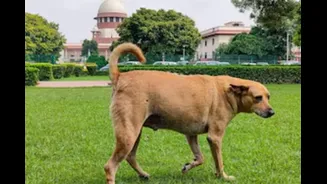









The Supreme Court on Tuesday refused to modify its November 25, 2025 order directing the removal of stray dogs from institutional areas such as schools, hospitals and other public facilities.
The apex court
also made it clear that stray dogs removed from such places cannot be released back into those areas.
Along with refusing to change its earlier order, the court issued a series of directions to states, Union Territories and authorities for implementing animal birth control rules and ensuring public safety.
What are the directions issued to states?
The Supreme Court directed all states and Union Territories to take stringent steps for the implementation of Animal Birth Control (ABC) guidelines. The court said governments must strengthen and properly implement the framework rules laid down by the Animal Welfare Board of India (AWBI).
The bench stressed that all directions issued by the court must be implemented “in letter and spirit”.
One ABC centre in every district: The court ordered states and Union Territories to establish at least one fully functional ABC centre in every district. These centres must have trained doctors and necessary facilities for carrying out sterilisation and other related procedures.
The apex court further said authorities should expand the number of centres depending on the population density of each district and state.
According to the directions, governments must take all necessary measures to ensure that the centres function effectively and help implement the rules framed under the AWBI system.
Anti-rabies medicine: The Supreme Court also said governments should take informed and reasoned decisions on extending its directions to other public places if needed to ensure a safe environment for the public.
The court said such decisions should be implemented in a time-bound manner. The order comes amid continuing concerns over stray dog attacks and public safety in several parts of the country.
The bench also directed authorities to ensure adequate availability of anti-rabies medicines.
Rabid, dangerous dogs can be euthanised: In a significant direction, the court said authorities could take legally permissible steps, including euthanasia, in cases involving rabid or dangerous dogs.
The court said such measures may be required to curb threats to human life.
At the same time, the bench underlined that actions taken by officials must remain within the legal framework.
Protection for officials implementing orders: The Supreme Court also said officials of municipal authorities, states and other bodies responsible for implementing the court’s directions would be entitled to due protection for acts performed by them while carrying out those duties.
The court’s observation is aimed at protecting officials involved in implementing stray dog control measures ordered by the judiciary.
Directions issued to NHAI on stray cattle
Apart from stray dogs, the court also addressed the issue of stray cattle on national highways.
The apex court directed the National Highways Authority of India to take steps in a time-bound manner to deal with stray cattle on highways.
The court said the authority could deploy depreciated transport vehicles and take other necessary measures to manage the problem.
The NHAI was also directed to establish a monitoring and coordination framework for handling stray cattle issues on highways.
Earlier order to continue
With Tuesday’s decision, the Supreme Court has effectively allowed its November 25 order to remain in force without any relaxation.
The court reiterated that stray dogs removed from schools, hospitals and similar public institutions should not be released back into those areas.
The ruling also places responsibility on state governments, local bodies and highway authorities to strengthen animal control systems while ensuring public safety measures are implemented within a fixed timeline.