



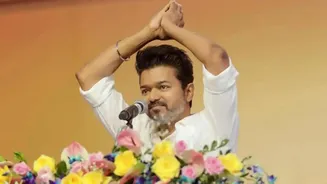
Resort politics have begun in Tamil Nadu as rumours have begun swirling of a possible alliance between the Dravida Munnetra Kazhagam (DMK) and the All India Anna Dravida Munnetra Kazhagam (AIADMK) in Tamil Nadu with
Vijay’s Tamilaga Vettri Kazhagam (TVK) falling short of majority and hunting for allies to form the government in the state. As per fresh reports, over 20 AIADMK MLAs have been shifted to a Puducherry resort, and may stay there at least till Friday, May 8.
Check Live updates on Tamil Nadu government formation here.
If a DMK-AIADMK alliance happens in Tamil Nadu, it would be a first for the state with two political rivals coming together to keep the third front away from power. However, it won’t be a first such instance in India. Politics is a game of power, and everything is fair when it’s about getting the chair.
Indian politics has a long history of unlikely friendships. Here are five major examples from Indian politics when rivals came together to form governments or power arrangements:
BJP And PDP In Jammu & Kashmir (2015)
Few alliances shocked political observers as much as the coming together of the BJP and the PDP in Jammu & Kashmir after the 2014 Assembly election. The BJP had its strength in Jammu and ran on a strong nationalist platform, while the PDP drew support from the Kashmir Valley and projected a softer political line on issues like autonomy and dialogue with Pakistan. The two parties had almost nothing in common ideologically.
Yet, faced with a fractured verdict, they decided to share power. Mufti Mohammad Sayeed became Chief Minister first, followed later by Mehbooba Mufti, who took over after his death. The alliance survived for over three years before collapsing in 2018 amid growing tensions.
Shiv Sena, Congress And NCP In Maharashtra (2019)
This was one of the most dramatic political twists in recent years. For decades, the Shiv Sena and the Congress had attacked each other relentlessly over ideology, Hindutva and regional politics. The Sena had been a long-time ally of the BJP as well.
But after the 2019 Maharashtra election, a bitter dispute broke out between the BJP and Shiv Sena over sharing the Chief Minister’s post. That opened the door for an unexpected new arrangement.
The Shiv Sena joined hands with the Congress and the Nationalist Congress Party to form the Maha Vikas Aghadi government, with Uddhav Thackeray as Chief Minister. Many voters who had seen these parties as sworn enemies were left stunned.
JD(U) and RJD In Bihar (2015 and 2022)
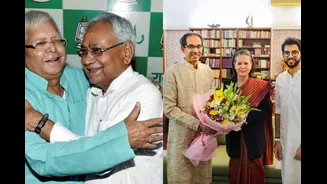
The coming together of the Janata Dal (United) and the Rashtriya Janata Dal in Bihar was another alliance few thought possible. For years, Nitish Kumar and Lalu Prasad Yadav represented opposing political camps in Bihar. Nitish Kumar had built much of his image around governance and development politics, often contrasting himself with the RJD’s “jungle raj” image from the 1990s and early 2000s.
But politics changed dramatically during the 2015 Bihar Assembly election. With the BJP expanding rapidly after its 2014 Lok Sabha sweep, Nitish Kumar and Lalu Prasad decided to put aside decades of rivalry. Along with the Congress, they formed the “Mahagathbandhan” or Grand Alliance. Nitish Kumar became Chief Minister, while the RJD emerged as the single-largest party in the Assembly.
The partnership, however, did not last. Nitish Kumar walked out in 2017 and returned to the BJP-led NDA. Then came another political twist in 2022, when he again broke ties with the BJP and reunited with the RJD to form a new government in Bihar.
The repeated break-ups and reunions between JD(U) and RJD have become one of the clearest examples of how Indian politics often runs on shifting equations rather than permanent friendships or rivalries.
Congress and NCP In Maharashtra (1999)
The NCP itself was born out of a rebellion against the Congress. Sharad Pawar and his colleagues broke away from the Congress after questioning Sonia Gandhi’s leadership and foreign origin. The split turned the two sides into fierce political opponents during the campaign.
But once the 1999 election results came in, both parties realised they needed each other to keep the BJP-Shiv Sena combine out of power in Maharashtra. The rivals quickly buried their differences and formed a coalition government that lasted for 15 years.
Shiv Sena And MNS In Maharashtra (2025)
The coming together of the Shiv Sena and the Maharashtra Navnirman Sena for local body elections in Maharashtra is another example of estranged political rivals finding common ground.
What makes this politically interesting is the personal and political history between Uddhav Thackeray and Raj Thackeray.
Raj Thackeray, nephew of Shiv Sena founder Bal Thackeray, quit the Shiv Sena in 2005 after differences over leadership succession and later formed the MNS in 2006. For years after that, the two parties directly competed for the same Marathi voter base, especially in Mumbai, Thane, Nashik and Pune.
The rivalry often turned bitter, with both sides accusing the other of betraying Bal Thackeray’s political legacy. In several elections, the split in Marathi votes was seen as helping rivals like the BJP or Congress-NCP alliances.
That is why their decision to cooperate in the recently held local body polls drew attention. Even though it was not a full-fledged state-level merger or alliance, it showed how regional political calculations can push even family rivals towards tactical cooperation.
Janata Party Coalition After Emergency (1977)
After the The Emergency ended, opposition parties across the country united against the Congress and Indira Gandhi. This coalition brought together socialists, former Congress leaders, the Bharatiya Jana Sangh and several regional forces — many of whom had spent years disagreeing with each other politically.
Their common goal was bigger than their differences: defeating Congress after the Emergency years. The alliance eventually formed the Janata Party government under Morarji Desai, marking the first time Congress lost power at the Centre.
Congress and Left Parties In Kerala (1967)
Kerala politics has traditionally seen the Congress-led UDF and the Left-led LDF as bitter rivals. Yet over the decades, there have been moments when political compulsions pushed smaller Left groups, regional parties and Congress factions into temporary understandings and support arrangements.
In the late 1960s, shifting anti-Congress and anti-establishment currents led to unusual power arrangements and tactical understandings among rivals. In 1967, a broad anti-Congress coalition led by EMS Namboodiripad included parties with conflicting ideological roots, regional interests and caste bases. Though not a direct Congress-Communist coalition government in the modern sense, it marked one of India’s earliest experiments in rivals and opposites sharing space in governance arrangements.