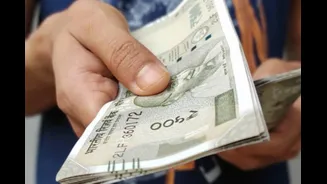










The Indian rupee’s recent weakness against the US dollar does not reflect the true strength of India’s economic fundamentals, according to the Economic Survey 2025-26, which makes a strong case that the currency
is “punching below its weight”.
While the rupee underperformed in 2025, the Survey argues that this has more to do with external flows and global uncertainty than any deterioration in India’s macroeconomic health
.The Economic Survey 2025-26, tabled by Finance Minister Nirmala Sitharaman on Thursday in the Lok Sabha, expects the Indian economy to grow 7.2 per cent in the next financial year 2026-27.
“The Indian rupee underperformed in 2025. India runs a trade deficit in goods. Its net trade surplus in services and remittances is not enough to offset it. India depends on foreign capital flows to maintain a healthy balance of payments. When they run drier, rupee stability becomes a casualty,” the Survey said.
However, it underlined that India’s core economic fundamentals remain exceptionally strong.
“Growth is good; the outlook remains favourable; inflation is contained; rainfall and agricultural prospects are supportive; external liabilities are low; banks are healthy; liquidity conditions are comfortable; credit growth is respectable; corporate balance sheets are strong; and the overall flow of funds to the commercial sector is robust. Policy dynamism and purposeful governance reinforce this backdrop,” it said.
Against this macro backdrop, the Survey concluded that the currency is undervalued.
“The rupee’s valuation does not accurately reflect India’s stellar economic fundamentals. In other words, the rupee, therefore, is punching below its weight,” it said.
External pressures, not domestic weakness
The Survey acknowledged that pressures on the rupee intensified as India slipped into a balance of payments deficit in the first half of FY26 amid foreign capital outflows.
“There was a balance of payments (BOP) deficit of $6.4 billion in H1 FY26 compared to a surplus of $23.8 billion in H1 FY25, which was funded by a decline in foreign exchange (forex) reserves,” it said.
It added that this widening BOP deficit, combined with market uncertainty surrounding a potential trade deal with the US, weighed on the currency.
“This widened BOP deficit, coupled with market uncertainty over the outcome of a trade deal with the US, has exerted pressure on the Indian Rupee, causing it to weaken,” the Survey noted.
Between April 1 and January 22, 2026, the rupee depreciated by around 6.5 per cent against the US dollar. However, the Survey stressed that the currency movement has been orderly, even amid global volatility.
Undervalued rupee offers strategic cushion
The Survey pointed out that an undervalued rupee is not entirely disadvantageous in the current global environment.
“Of course, it does not hurt to have an undervalued rupee in these times, as it offsets to some extent the impact of higher American tariffs on Indian goods, and there is no threat of higher inflation from higher-priced crude oil imports now,” it said.
At the same time, it flagged that currency undervaluation can cause investors to pause, making it important to examine the reasons behind capital flow hesitancy.
“However, it does cause investors to pause. Investor reluctance to commit to India warrants examination,” the Survey added.
Strong buffers, stable long-term outlook
Despite near-term pressures, the Survey struck an optimistic tone on India’s external sector strength and medium- to long-term currency outlook.
“Over the medium to long term, exchange rate dynamics are expected to be guided by structural fundamentals, such as productivity gains, export diversification towards higher-value goods and services, deeper integration into GVCs and a stable policy environment rather than short-term fluctuations,” it said.
India’s foreign exchange buffers remain comfortable.
“Forex reserves cover over 11 months of imports as of 16 January 2026 and approximately 94.0 per cent of the external debt outstanding as of the end of September 2025, offering a comfortable liquidity cushion,” the Survey said.