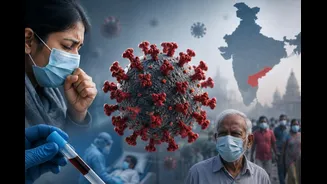









A new COVID-19 variant is drawing attention after the World Health Organization (WHO) classified PJ.2.1 as a Variant Under Monitoring (VUM), following its detection across 18 countries. The lineage has
been gaining ground in several regions, particularly in North America, and scientists are examining its genetic changes and how effectively it interacts with human cells.
What has caught attention is the number of mutations it carries: PJ.2.1 has 24 amino-acid differences in its spike protein alone compared with its parent lineage. Since the spike protein is the part of the virus that helps it attach to and enter human cells, such changes warrant scientific scrutiny.
But a highly mutated virus does not automatically mean a more dangerous one. In its initial risk evaluation published on November 19, 2026, the WHO assessed the additional global public-health risk posed by PJ.2.1 as low, although it emphasised that confidence in the assessment remains low and more evidence is needed.
So, what do we know about this new variant, how quickly is it spreading, and should people in India be concerned?
What is COVID variant PJ.2.1?
PJ.2.1 is a descendant of the JN.1 family of Omicron variants. It evolved from the lineage MC.10.1.7, with the earliest available sequence dating to May 25, 2026.
Scientists describe it as a ‘saltation’ variant—a lineage that appears to have accumulated a substantial number of genetic changes over a relatively short evolutionary period. The 24 amino-acid differences in its spike protein have prompted researchers to investigate whether these changes could affect how it binds to human cells, spreads or interacts with existing immunity.
The WHO’s classification as a Variant Under Monitoring means that the lineage has characteristics or epidemiological signals that merit closer observation. It is not the same as declaring it a Variant of Concern, nor does the designation indicate that it is causing a more severe disease outbreak.
PJ.2.1 has been detected in 18 countries: How fast is it spreading?
According to the WHO’s data, 722 sequences of PJ.2.1 had been submitted to GISAID from 18 countries as of November 8, 2026.
Its share of available global COVID-19 sequences increased from 1% in epidemiological week 33 to 11.6% in week 41. The increase was particularly noticeable in the Americas, where its proportion rose to 16.6% in week 41. Canada reported that PJ.2.1 accounted for 25.7% of available sequences in the same week, while the US reported 13.8%.
The variant has also been detected in Europe and the Western Pacific, with its proportion among available sequences rising in these regions as well.
However, the WHO cautions that these numbers must be interpreted carefully. Countries differ in how extensively they sequence COVID-19 samples, and the available data may be affected by reporting delays and uneven sampling. An increase in the proportion of sequences does not, by itself, establish exactly how much more transmissible the variant is.
Why are scientists watching its 24 mutations?
The spike protein plays an important role in how SARS-CoV-2 attaches to human cells. PJ.2.1’s genetic changes have therefore prompted laboratory studies examining its interaction with the ACE2 receptor, which the virus uses to enter cells.
Laboratory evidence reviewed by the WHO indicates that PJ.2.1 has greater human ACE2-binding capability than some contemporary variants, including XFG and NB.1.8.1. This could potentially contribute to its observed growth.
However, stronger receptor binding in laboratory experiments is not the same as proof that a virus spreads more easily between people in real-world conditions. Scientists still need epidemiological evidence to establish how much of its growth is attributable to its biological characteristics versus differences in immunity, population behaviour or surveillance.
The number of mutations alone is also not a reliable measure of a variant’s severity. Researchers need to understand what those changes actually do.
Can PJ.2.1 evade immunity from vaccines or previous infections?
This is one of the more reassuring findings so far. The WHO’s assessment found that available laboratory evidence did not demonstrate substantial additional antibody escape by PJ.2.1 compared with the contemporary variants tested. Researchers also found that serum from recipients of LP.8.1- and XFG-adapted vaccines could neutralise the variant in laboratory assays.
In one study involving 36 recipients of an LP.8.1-adapted vaccine, PJ.2.1 did not show greater antibody evasion than most of the variants examined. Another study involving 22 participants found that neutralising antibody titres against PJ.2.1 increased following an XFG-adapted mRNA vaccine.
These results suggest that vaccine-induced antibodies retain activity against PJ.2.1. However, laboratory neutralisation results should not be confused with real-world vaccine effectiveness. Researchers have not yet established how effectively current vaccines prevent infection specifically caused by PJ.2.1 or how much protection they provide against severe disease from this lineage.
Does the new variant cause more severe COVID-19?
At present, there is no evidence establishing that PJ.2.1 causes more severe disease than other circulating variants.
The WHO has noted that comparative clinical data remain insufficient to determine whether infections caused by this lineage are associated with higher rates of hospitalisation, oxygen requirement, intensive-care admission or death.
This is an important distinction. A variant may become more prevalent without necessarily causing more severe illness. Its overall public-health impact depends on several factors, including transmissibility, the population’s existing immunity, the number of infections it causes and the proportion of people who develop severe complications.
For now, the severity question remains unanswered—not because the variant has been shown to be more dangerous, but because there is not enough clinical evidence yet.
What are the symptoms of PJ.2.1?
There is currently no established symptom profile that distinguishes PJ.2.1 from other COVID-19 variants.
Symptoms may include:
Fever or chills
Sore throat
Cough
Runny or blocked nose
Headache
Fatigue
Muscle aches
These symptoms overlap considerably with common colds, influenza and other respiratory infections. Symptoms alone cannot confirm which virus or COVID-19 lineage is responsible.
A regular COVID-19 test can identify an infection, while identifying the specific variant generally requires genomic sequencing.
Is PJ.2.1 detected in India?
The WHO’s November 19 risk assessment documented sequences from 18 countries, with the detections concentrated particularly in Canada and the United States. India was not listed among the countries reporting sequences in the assessment’s country-level data.
However, this should not be interpreted as a guarantee that the variant is absent from India. Genomic surveillance and sequencing coverage are not uniform across countries, and the global data may change as additional samples are reported.
For India, the important development to watch is whether genomic surveillance identifies the lineage locally and whether it begins increasing in proportion among samples.
At present, the WHO’s global assessment does not indicate that PJ.2.1 requires special restrictions or a change in everyday public-health measures.
Should you worry about PJ.2.1?
The short answer is: there is no reason to panic, but it is worth staying informed. The WHO currently assesses the additional global risk from PJ.2.1 as low, with low confidence. Its increasing presence in several countries, genetic changes and stronger ACE2-binding capability are reasons for continued surveillance, but researchers have not established that it causes more severe illness or substantial additional immune escape.
Older adults, people with weakened immune systems and individuals with underlying health conditions should continue to take respiratory infections seriously. Staying up to date with vaccination as advised by a healthcare professional, improving ventilation, practising hand hygiene and avoiding close contact with others when ill remain sensible precautions.
If you develop respiratory symptoms, particularly if you are at higher risk of complications, consider testing and seek medical advice when needed. Breathing difficulty, chest pain, confusion or other serious symptoms warrant prompt medical attention.
COVID-19 continues to evolve, and new lineages will emerge. The important thing is to distinguish a variant that scientists are monitoring from one that has demonstrated a significant threat to public health. As of November 19, PJ.2.1 falls into the former category.