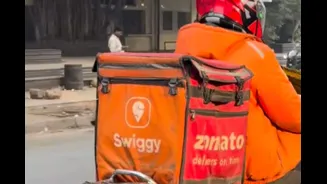








At a neighbourhood grocery store in Delhi’s Subash Nagar, a group of online delivery workers stood in a queue on a biting winter morning on December 31. Many had chosen not to log in to work, responding
to a nationwide strike call by gig workers’ unions. Others, however, continued taking orders- drawn by higher payouts announced by platforms ahead of New Year’s Eve.
Anger and fatigue surfaced repeatedly in conversations with delivery workers, many of whom said the festive incentives offered by platforms were a familiar tactic to dilute collective action rather than address long-standing grievances.
Aware of the nationwide strike, food delivery platforms Zomato and Swiggy announced higher incentives for successful deliveries, a practice workers say is routinely used during strikes and high-demand days to ensure minimal service disruption.
‘Our Earnings Have Only Gone Down’
Harpreet, an Instamart delivery partner who participated in the strike, said the companies projected unrealistic earning figures that did not match ground realities.
“On paper, they show that we earn ₹60,000–70,000 a month. If they can bring even one delivery partner with this much income, I will quit my job today,” he said, adding, “I’ve been working since 2022, and my earnings have only declined. Some of our riders have died on duty, yet their accounts still show them as ‘active partners’.”
Harpreet also criticised the classification of gig workers as “partners”, saying it stripped them of labour protections.
“Under the new labour codes, there is no security for us. By calling us partners, they have taken away our rights. If we are partners, where is our PF? Where is the financial security?” he asked.
He added that most delivery workers paid out of their own pockets for safety gear.
“Helmets, jackets, even drinking water — everything comes from our own money. These companies are worth billions and pay crores to celebrities for advertisements. Why can’t they provide us basic safety gear and water?” he said.
Cancelled Orders, Zero Pay
Jatin, a delivery worker from Uttar Pradesh protesting against Swiggy Instamart’s policies, said earnings had become increasingly unpredictable.
“I have earned ₹0 since the day started today. Earlier, we got ₹15 if an order was cancelled. Now it’s zero,” he said, adding, “Our managers don’t answer calls. And if we speak out publicly, our partner contracts can be terminated.”
He added that workers faced extreme weather, unsafe delivery pressure and abuse from customers with no social security.
“We are on the roads all day, but who listens to us?” he asked.
The Telangana Gig and Platform Workers’ Union (TGPWU) and the Indian Federation of App-Based Transport Workers (IFAT) said around 1.7 lakh app-based workers participated in the pan-India strike, with numbers expected to rise.
Shaik Salahuddin, founder president of TGPWU, said a previous nationwide flash strike on December 25 had already highlighted workers’ concerns.
“The December 25 action sent a clear warning about falling earnings, unsafe delivery pressure and loss of dignity at work. Companies responded with silence,” the statement said, adding, “Zomato’s last-minute notification offering earnings of up to ₹3,000 is a propaganda attempt to weaken the strike, not a genuine solution.”
‘Partners Without Rights’
Apoorva Sharma, president of the App Karm Chari Ekta Union, said significant delivery disruptions were expected on December 31.
“Such strikes are not new. Workers have raised demands repeatedly, but companies have not addressed them,” she said, adding, “Even after the December 25 strike disrupted services by 50–60% in several cities, there was no resolution.”
Apoorva Sharma said the contradiction at the heart of the gig economy remained unresolved.
“They call workers ‘partners’, but when they ask for rights, they become nobody,” she said, explaining, “Workers face low pay, unsafe delivery targets, lack of dignity, and almost no social protection.”
As platforms push festive incentives to keep operations running, gig workers say the anger on the streets reflects deeper anxieties- not just about pay, but about dignity, safety and recognition in India’s fast-growing convenience economy.