






Iran’s Foreign Ministry said on Monday that they would not tolerate the naval blockade by the United States at the Strait of Hormuz, and will use all “available tools” to confront it as Tehran felt the oil
squeeze in November.
Reports suggest that vessel traffic through the Strait fell by more than 40% between the first and fourth weeks of November. More than 25 tankers were reportedly hit in the preceding week alone. Traffic has dropped from the pre-war average of 125-140 vessels a day to just 28 recorded crossings in a recent 24-hour period.
Interestingly, oil prices have not risen in proportion to the disruption. Brent is currently trading below $90, much lower than $118 a barrel during the earlier stages of the conflict. This suggests that global supply, inventories and alternative sourcing are cushioning the immediate shock.
The naval blockade has largely halted Iranian oil exports. It was first imposed in April, but was lifted following the June memorandum of understanding. The blockade was reinstated weeks later after the agreement collapsed.
The strait has been the most strategically consequential maritime chokepoint of recent times, accounting for 25% of global seaborne oil trade. If the stream of ships is disrupted, it can affect many major economies, including India, which imports roughly 88% of its crude oil requirements.
What Is Happening In Strait Of Hormuz?
The Strait of Hormuz is one of the world’s most important energy shipping routes, connecting the Gulf with international markets. Any disruption to traffic through the narrow waterway can have immediate implications for global oil supplies, trade and shipping costs.
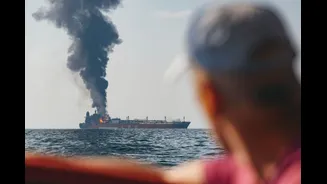
Attacks on oil tankers and commercial vessels have continued throughout the war. More recently, however, several tankers have caught fire after reportedly striking naval mines believed to have been laid by Iran.
Reports suggest that tankers are continuing to risk the passage without seeking Tehran’s approval. Some have reportedly been travelling under the cover of darkness and switching off their navigation transponders to avoid detection by Iranian authorities.
On the morning of November 24, Iran’s navy said two oil tankers had struck mines and caught fire in the waterway, according to a statement carried by the country’s Tasnim news agency.
The statement said the vessels had entered a restricted zone east of the strait after switching off their navigation and identification systems.
It also reiterated that the Strait of Hormuz would remain closed until Iran’s demands were met. These include an end to hostilities, the lifting of the blockade and the removal of sanctions. The statement added that “owners of oil tankers are required to coordinate with the armed forces to ensure safe passage through this strategic strait.”
Meanwhile, Iranian army commander Amir Hatami has called for tighter restrictions on movement through the Strait of Hormuz, saying Tehran needs to make conditions more difficult.
Ali Ozmaei, head of the Islamic Revolutionary Guard Corps’ (IRGC) navy, also warned vessels against using shipping routes that have not been approved by Iran.
Is Iran Winning Its Economic War?
President Masoud Pezeshkian has acknowledged that the country is facing an economic war harder than the missile attacks.
He described the struggle as harder than a conflict involving missiles and destruction, acknowledging that attacks on gas infrastructure had worsened shortages ahead of winter.
Pezeshkian maintained that industrial production had continued despite pressure aimed at crippling the economy. He also promised to shield factories from power cuts as far as possible, saying government offices would face electricity restrictions first.
The economic strain is reflected in the country’s inflation figures. Official data reported in November showed that year-on-year inflation had climbed to 88.7% in October, further eroding household purchasing power.
According to Reuters, food and beverage prices rose 121.8% year-on-year in September, forcing many families to cut back on even basic necessities.
The average monthly wage was estimated at around $92, while the minimum monthly living cost for a three-person working-class household stood at approximately $336.
Reports indicate that households are increasingly cutting spending on food, healthcare and education. Some families have also been forced to borrow money, use up their savings or move in with relatives to manage their expenses.
An Iran International survey conducted between October 30 and November 3 found that 71% of respondents had either reduced their food purchases or delayed medical treatment.
How Middle Eastern Countries Are Seeking Alternative Oil Routes
Before the war, Iraq exported around 3.3 million barrels per day (b/d) from its southern oilfields. By the second week of March, those exports had plunged. Shipments gradually recovered from mid-April, reaching 2.3 million b/d in August. The recovery was supported by discounts offered to buyers and reports that Iran had permitted Iraqi oil tankers to pass through the Strait of Hormuz.
Syria and Lebanon have been less directly affected by disruptions in the Strait of Hormuz. Neither country is a major oil exporter, and both have access to the Mediterranean Sea. However, their ports and transport networks could offer new links between Gulf producers and European markets as regional trade routes are reshaped, according to a Chatham House report.
Iraq, meanwhile, is exploring several options to reduce its dependence on the Strait of Hormuz. Baghdad is looking to increase oil exports through Turkey’s Mediterranean port of Ceyhan, which already receives Iraqi crude. It is also discussing the revival of a long-delayed proposal for a pipeline connecting Iraq to Jordan’s Red Sea port of Aqaba.
Iraq and Syria are also pursuing plans for a pipeline that would transport Iraqi crude westwards to the Mediterranean. The proposed route is intended to provide Baghdad with an alternative to its heavy reliance on shipments through the Strait of Hormuz. Often described as a revival of the historic Kirkuk-Baniyas pipeline, the project would link Iraq’s southern and northern oilfields to western Iraq, allowing crude to travel through Syria to the Mediterranean port of Baniyas and northwards towards Turkey.
The Trump administration is reportedly backing the $15 billion plan as part of a broader effort to reduce Iran’s regional influence by diversifying oil export routes and reducing dependence on the Strait of Hormuz.
Whether Iraq, Syria and Lebanon can turn their geographical advantages into viable trade and energy corridors could help determine their influence over the region’s post-war economic and political order.
Why Oil Prices Have Not Risen
Despite the attacks, the oil prices have fallen, with Brent at $88.35 per barrel. Brent has fallen nearly 24% (about $28 a barrel) from its late-October futures peak, to about $89 on November 24.
So far, according to the AIS ship-tracking platform, in the past 24 hours, 28 ships have crossed the strait: 12 into the Gulf and 16 out of it, carrying an estimated 4.18 million barrels of oil, according to a report by Al Jazeera.
It is worth noting that the tracking platform records only vessels with their transponders switched on. As a result, gaps in tracking data, including ships using routes without transmitting signals, mean the figures do not provide an accurate count of all vessels crossing the strait.
Before the war, 125 to 140 ships used to pass through the Strait daily.
The International Energy Agency (IEA) said on September 18 that oil producers outside the Gulf had added 2.3 million bopd to global supply since the war began, with the US and Brazil accounting for much of the increase.
According to Reuters, oil prices fell on November 23 amid a broader sell-off in equity markets driven by concerns over AI-led growth. Attacks on shipping in the Gulf, however, limited the decline. One analyst said prices had also eased after Trump indicated there was no immediate rush to decide on a renewed war with Iran.
Relatively resilient oil flows through the Strait of Hormuz, along with shipments using alternative routes, have helped ease pressure on prices. However, the picture in November is less straightforward, and incomplete vessel-tracking data makes it difficult to establish the full scale of shipping movements through the strait.
What About India And China?
India’s short-haul crude oil imports from the Middle East Gulf hit a record 5.8 million barrels per day in November, even as consumption remained about 3% lower than a year earlier.
The country’s fuel consumption rose nearly 10% month-on-month to 20.49 million metric tonnes in October, its highest level since March, according to data released earlier this month.
LPG imports declined to 1.30 million tonnes in October from 1.40 million tonnes in September. Fuel oil imports saw a sharper fall, plunging 87% year-on-year to 0.08 million tonnes in October, compared with 0.62 million tonnes a year earlier.
Petrol exports fell 29% year-on-year last month, while diesel exports recorded a marginal increase of 0.4% over the same period.
The IEA expects India’s crude oil imports from West Asia to remain broadly stable through 2035, even as the country’s overall import requirements continue to rise.
India has also diversified its crude sourcing in recent years, emerging as a major buyer of discounted Russian oil. Imports from Venezuela increased in 2026, supported by the ability of complex refineries such as Jamnagar to process extra-heavy crude.
The country is also expanding its refining capacity. According to the report, 840,000 barrels per day (bpd) of additional capacity is under construction. This includes 660,000 bpd of expansion at existing facilities and 180,000 bpd of capacity at new, greenfield projects.
The expansion is expected to strengthen India’s position as a supplier of light and middle distillates to international markets.
China, too, is replenishing its oil inventories, with seaborne imports at around 10.5 million barrels per day. Even independent ‘teapot’ refiners are returning to the market to buy crude, despite weaker domestic consumption.