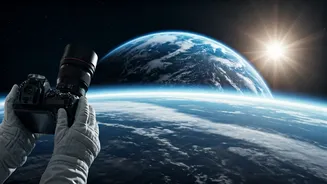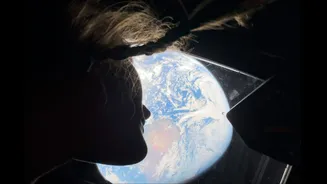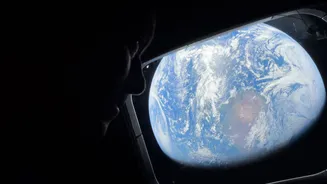






NASA’s Artemis II astronauts, currently on their historic mission to the Moon, are capturing breathtaking visuals using a mix of specialised professional gear and, for the first time, high-end consumer
smartphones. These images, including the “Hello World” Earth portrait, are being transmitted back in near real-time via advanced laser communications, according to Al Jazeera.
The Mission’s ‘Extraordinary Arsenal’ of Cameras
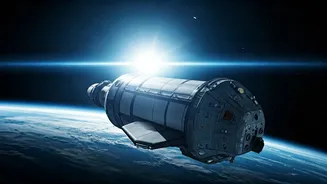
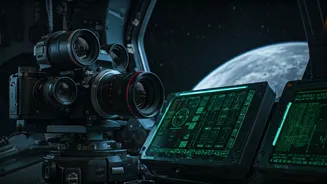
The Orion spacecraft is equipped with at least 28 cameras mounted both internally and externally to document every stage of the journey.
- The crew relies on high-resolution DSLR and mirrorless cameras, including the Nikon D5 and Nikon Z9, for technical and scientific imagery.
- GoPro HERO4 Black cameras are used to capture wide-angle, high-action footage of cabin activities and exterior views.
- For the first time, NASA approved personal smartphones for a lunar mission. Astronauts are using iPhone 17 Pro Max units to take candid, high-quality photos of Earth through Orion’s windows.
- These phones underwent a rigorous four-phase clearance process to ensure they could handle microgravity, heat dissipation, and battery stability without posing a hazard.
There are no words. pic.twitter.com/W7JRAN8JeJ
— Reid Wiseman (@astro_reid) April 5, 2026
What is the advanced transmission technology?
Unlike the delayed image releases of the Apollo era,Artemis IIuses the Orion Artemis II Optical Communications (O2O) system.
Instead of traditional radio waves, the Laser Beaming system uses infrared lasers to transmit data at speeds up to 260 Mbps.
This technologyallows the crew to beam back 4K video and high-resolution files almost instantly from lunar distances.
Why do the Artemis II astronauts keep calling their Orion spacecraft, “Integrity”?
The crew chose this name for their home away from home because it “embodies the foundation of trust, respect, candor, and humility” of the teams behind the Artemis II mission. pic.twitter.com/un20qoSWSW
— NASA Artemis (@NASAArtemis) April 5, 2026
What are they capturing?
During their April 6, 2026, lunar flyby, the crewis focused on:
The Moon’s Far Side: Taking high-resolution photos of crater edges, ridges, and lava flows in areas never before seen directly by human eyes.
Deep-Space Earth Views: Documenting the “overview effect” with images showing the Earth’s terminator line, city lights across continents, and vivid auroras.
Technical Observations: Using three Nikon cameras with various zoom lenses to assist scientists at NASA’s Johnson Space Center with geological analysis, according to NASA.
Sweet dreams, @NASAArtemis II crew.
One last look at the Moon before flight day six and your epic lunar flyby, taking you farther into space than humans have EVER traveled. pic.twitter.com/roqklB0iGQ
— NASA (@NASA) April 6, 2026
KEY FAQs
What tools were used to capture the images?
Orion spacecraft cameras and consumer devices like smartphones (e.g., iPhone)
How were the visuals captured in space?
Through spacecraft windows during lunar journey. Using high-resolution imaging during flyby and deep-space travel.
What made these visuals unique?
Deep-space perspective (over 100,000 miles from Earth), rare views of Earth, auroras, and Moon’s far side.
With agency inputs