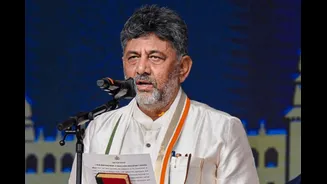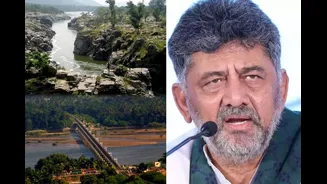








Karnataka Chief Minister D.K. Shivakumar on Sunday said the state government would protect Karnataka’s interests while dealing with the Cauvery water-sharing dispute and appealed to political parties and Kannada
organisations not to call for a bandh over the issue.
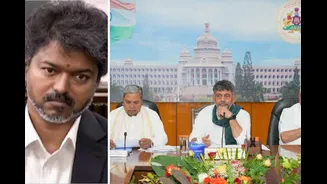
Speaking to reporters after an all-party meeting convened to discuss the Cauvery situation following directions from the Cauvery Water Management Authority (CWMA) and the Cauvery Water Regulation Committee (CWRC), Shivakumar described the meeting as “historic” and said leaders across party lines had come together to formulate the state’s response.
“The interests and welfare of Karnataka’s people remain our highest priority. Neither I nor my government will do anything that harms the state’s interests,” he said, adding that successive governments, from Gundurao, S.M. Krishna and Veerappa Moily to Siddaramaiah, had worked to safeguard Karnataka’s interests while ensuring justice.
Rainfall Deficit, Drinking Water Top Priority
The Chief Minister said Karnataka was facing a severe rainfall deficit and had requested farmers to remain patient until district-wise cultivation guidelines were issued.
According to him, the CWMA and CWRC have directed Karnataka to release 3,500 cusecs of water to Tamil Nadu. He noted that reservoir conditions had improved slightly due to recent rainfall, with Kabini now full.
Shivakumar said Karnataka had received only about 35 per cent of its normal rainfall so far this year. Reservoir inflows had increased in recent days, with around 24,000 cusecs entering reservoirs, including nearly 22,000 cusecs flowing into the Krishna Raja Sagar (KRS) reservoir. Kabini was receiving around 11,000 cusecs of inflows, although rainfall had reduced slightly since Saturday afternoon.
He stressed that ensuring drinking water remained the government’s immediate priority.
“We are releasing limited quantities of water through canals only to fill lakes and tanks meant for drinking water purposes, and not for irrigation,” he said.
Shivakumar added that Karnataka had requested the Tamil Nadu government to cooperate on the issue of drinking water, and Tamil Nadu had acknowledged its importance. He also said the state was making use of borewell water wherever necessary for agriculture.
Legal Strategy and Water Release Figures
The Chief Minister said Karnataka would act strictly within the legal framework and consult legal experts before taking any further steps.
“The Advocate General briefed us on the legal aspects and advised us on the legal course of action. Our expert team was present throughout the meeting. This is only the first stage of the process,” he said.
He noted that multiple meetings of the CWMA and CWRC would be held during the year and Karnataka would discharge its responsibilities before these authorities cautiously.
Shivakumar said Karnataka had released around 19.9 TMC of water in June last year, compared with only about 2.30 TMC this year. In July last year, the state released around 31 TMC, while only around 3.6 TMC had been released this year.
“Against the expected release of nearly 40 TMC by July, we have been able to release only around 3.6 TMC because of the severe shortage,” he said.
He added that the state had initially refrained from releasing water from its reservoirs but later discharged a limited quantity downstream after inflows improved and to ensure dam safety while maintaining safe reservoir levels.
Appeal Against Bandh, Political Consensus
Shivakumar said the Tamil Nadu government had also spoken about a distress-sharing formula and noted that the DMK had privately approached the Supreme Court.
“We will speak to our legal team and handle the court matters,” he said.
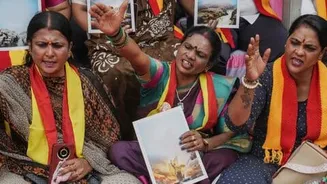
Appealing for unity, he urged Kannada organisations, the BJP, JD(S) and other political parties not to organise a bandh.
“I request all Kannada organisations, JD(S), BJP and all other parties not to call for a bandh. We decided this at the all-party meeting as well. I appeal on behalf of the government,” he said.
He said opposition leaders had assured the government of their support.
Former Chief Ministers H.D. Kumaraswamy, D.V. Sadananda Gowda, Siddaramaiah, Basavaraj Bommai and Veerappa Moily, Union Minister Shobha Karandlaje, and ministers H.K. Patil and M.B. Patil, among others, attended the meeting and offered suggestions.
Farmer Guidance, Drought Assessment and Mekedatu Project
The Chief Minister said crop planning would be based on water availability, with Agricultural University experts and technical specialists providing district-specific guidance on suitable crops.
“We will formulate and implement a programme of guidance for farmers,” he said.
Expressing satisfaction over the political consensus, Shivakumar said leaders across party lines had come together to share responsibility. He added that he had appealed to Prime Minister Narendra Modi and spoken to Union Minister and former Chief Minister H.D. Kumaraswamy, who assured him of his support and participation.
He also disclosed that he had requested Tamil Nadu Chief Minister Joseph Vijay to postpone his proposed visit to Bengaluru, and that the latter had agreed.
Referring to comments made by the Karnataka BJP president, Shivakumar said he did not wish to respond and that the BJP leader had expressed his views based on his own experience.
The Chief Minister said discussions with farmers, elected representatives, legal experts and government officials would continue at every stage to build confidence and provide timely guidance. He said the state was assessing the drought situation and expected to have a clearer picture by August before taking further decisions.
Ministers, he added, had already begun visiting their respective districts to assess the ground situation and interact with farmers. The Revenue Minister would subsequently review the findings in line with technical parameters and Government of India guidelines before the state government took any decision.
Calling the proposed Mekedatu balancing reservoir project the permanent solution to the Cauvery dispute, Shivakumar said the Supreme Court had already delivered its judgment and the Centre had also responded.
“We should move forward without wasting any more time. This is not about Tamil Nadu getting more or Karnataka getting less. We should use this opportunity to bring both Karnataka and Tamil Nadu to the table, hold discussions and resolve the issue amicably,” he said.
On the Detailed Project Report (DPR) for the Mekedatu project, he said there was no technical issue and only a minor documentation matter remained.
Shivakumar said the state had earlier proposed an allocation of 9 TMC of water and the Union Ministry had later directed that this quantity be specifically earmarked for drinking water.
“If it is not clearly specified, different regions may raise competing claims. Therefore, it has now been clarified that the 9 TMC is exclusively meant for drinking water. If any further clarification is sought, we will provide it and submit the necessary documents,” he added.