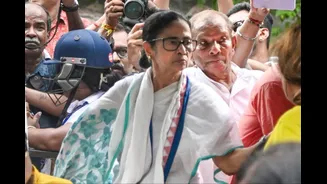







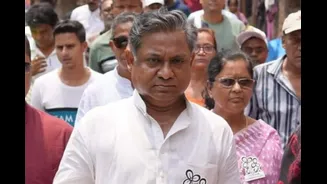

The Trinamool Congress (TMC), a party that for nearly three decades revolved around the political authority and mass appeal of Mamata Banerjee, is today finding itself confronting perhaps the deepest crisis
in its history.
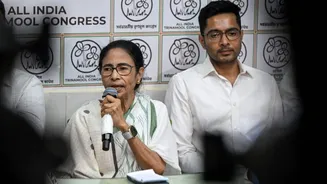
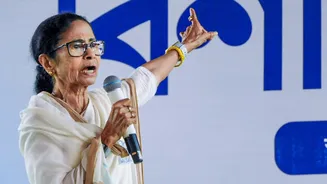
Just weeks after losing power in West Bengal to the BJP, the party has been rocked by an unprecedented rebellion from within, leaving observers asking a question that would have seemed unthinkable until recently – who still stands firmly with Mamata Banerjee?
The crisis exploded this week when 58 of the TMC’s 80 MLAs broke ranks and successfully staked claim to the legislature party, electing expelled leader Ritabrata Banerjee as Leader of Opposition and securing recognition from Assembly Speaker Rathindra Bose.
The development marked the first formal split in the 28-year-old party founded by Mamata Banerjee in 1998.
Yet even as the rebels moved to dismantle the existing power structure, they stopped short of challenging Mamata’s position directly.
Instead, their criticism was aimed squarely at her nephew and TMC national general secretary, Abhishek Banerjee.
The dissident camp has carefully crafted a narrative that seeks to separate Mamata Banerjee from the party’s internal troubles.
“We accept Mamata Banerjee as our leader but do not accept Abhishek Banerjee,” a leader associated with the rebel faction told PTI.
Ritabrata Banerjee went even further, proposing that Mamata assume the role of “chief adviser” to the legislature party while making it clear that Abhishek would have “absolutely no role” in its functioning.
According to PTI, resentment against Abhishek’s growing influence had been building since the party’s Assembly election defeat in May.
Several MLAs reportedly viewed the party’s decision-making process as increasingly centralised around the Diamond Harbour MP, fuelling concerns over succession and leadership within the organisation.
The rebellion gathered momentum following allegations that signatures of legislators had been forged on documents submitted to the Speaker regarding the selection of the Leader of Opposition.
What began as a procedural dispute soon evolved into a wider revolt over the future direction of the party.
THE SHRINKING CIRCLE AROUND MAMATA
The public fallout has also highlighted the narrowing circle of leaders standing visibly beside Mamata Banerjee.
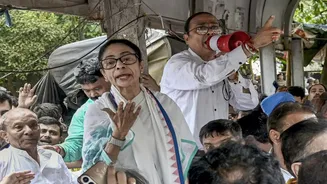
When Mamata took to the streets after the election defeat, she was accompanied by only a handful of legislators and senior leaders.
Among those seen alongside her were veterans such as Firhad Hakim, Sovandeb Chattopadhyay, Madan Mitra, Ashok Deb, Kunal Ghosh and Biman Bandopadhyay, many of whom have been with her since the formation of the TMC in 1998.
Their continued presence underscored the importance of old loyalists at a time when newer power centres within the party were being challenged.
A PARTY CAUGHT BETWEEN LEGACY AND SUCCESSION
Political observers say the current crisis is about much more than legislative numbers.
At its heart lies a struggle over succession in a party that has long been synonymous with a single leader.
PTI reported that unease intensified after Mamata reportedly asked legislators to applaud Abhishek Banerjee for his campaign role at a meeting shortly after the election defeat.
While intended as recognition, some lawmakers interpreted it as further evidence of a growing concentration of power within one family.
The rebels’ internal campaign reportedly acquired the name ‘Operation Crown Prince’, a reference to what they viewed as efforts to position Abhishek as the unquestioned successor.
Yet despite their open challenge to Abhishek, the dissidents have continued to invoke Mamata’s name, reflecting both her enduring popularity and the risks associated with directly confronting the party founder.
THE HIGH COMMAND STRIKES BACK
Faced with the rebellion, the TMC leadership moved swiftly, and the party dissolved all committees and frontal organisations across West Bengal, describing the move as part of an organisational review and introspection process.
Critics, however, viewed it as an attempt to regain control amid a rapidly escalating power struggle.
Senior leader Kunal Ghosh accused the rebels of betrayal, arguing that internal disagreements should have been resolved within the party rather than through a public confrontation.
The Mamata camp has also challenged the validity of the rebel faction’s actions and raised questions over the procedural legitimacy of communications submitted to the Speaker.
WHAT NEXT FOR MAMATA’S PARTY?
The immediate challenge for Mamata Banerjee is no longer merely organisational.
The rebellion has created the possibility of two competing centres of authority, one controlling the party structure, symbol and organisation, and another claiming legitimacy through legislative strength.
For now, even those leading the revolt continue to acknowledge Mamata as the face of the TMC. But the events of the past fortnight have demonstrated that her authority within the legislature party can no longer be taken for granted.
As Bengal’s principal opposition enters an uncertain phase, the question confronting the TMC is not only whether Mamata Banerjee can regain control, but whether the party she built can remain united without unquestioned acceptance of the leadership structure she helped create.