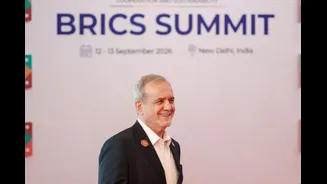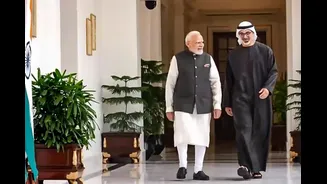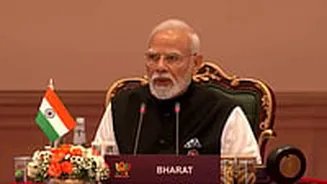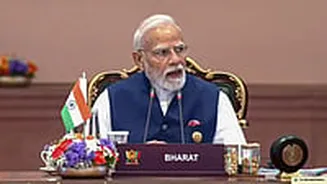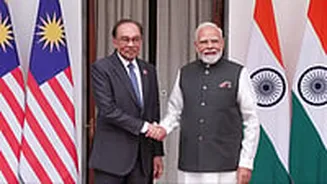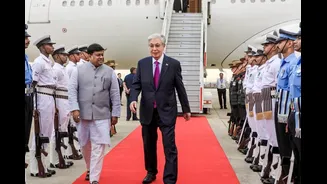






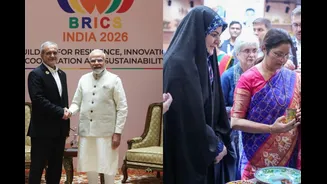
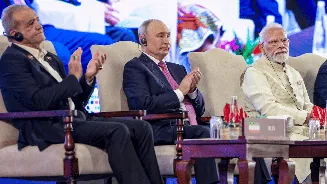
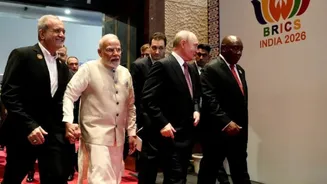
Prime Minister Narendra Modi will meet Kazakh President Kassym-Jomart Tokayev in New Delhi on Sunday on the sidelines of the ongoing BRICS Summit. The meeting comes at a moment when India’s Central Asia
strategy is increasingly moving from political outreach to the harder question of connectivity, trade and economic access.
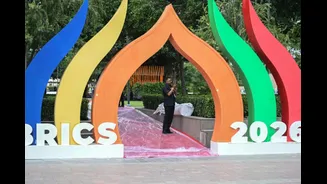
The meeting, scheduled on the sidelines of the 18th BRICS Summit, is expected to focus on practical areas of cooperation, including transport connectivity, critical minerals, energy, investment and trade. The larger objective is to convert years of political engagement between New Delhi and Astana into economic projects that can move goods, capital and resources more efficiently between India and Central Asia.
Click here for LIVE updates on BRICS Summit 2026
Kazakhstan is not a full BRICS member but became a partner country in 2025, and Tokayev’s participation in the New Delhi summit gives Astana a platform to deepen engagement with major economies beyond its traditional partners. The Astana Times quoted Kazakh strategic affairs expert Aidar Kurmashev as saying BRICS gives Kazakhstan access to a wider set of countries, including India, Brazil, South Africa, the UAE, Indonesia and Egypt.
For India, however, the more immediate prize could be Kazakhstan itself.
The Connectivity Problem India Looks To Solve
India has long described Central Asia as part of its extended neighbourhood, but geography has remained a major constraint. India has no direct land route to the region, while its conventional overland access is blocked by Pakistan.
PM Modi had underlined the strategic importance of the region at the first India-Central Asia Summit in 2022, saying, “Central Asia is central to India’s vision of an integrated and stable extended neighbourhood.” He had also stressed that cooperation with Central Asian countries was essential for regional security and prosperity.
The economic challenge is that political goodwill has not translated into trade at the scale either side believes is possible. India-Kazakhstan bilateral trade stood at $924.3 million in 2025, according to The Economic Times, a relatively modest figure considering the size and complementarity of the two economies. Both sides now recognise the need to remove logistical and tariff barriers and diversify the composition of trade.
That is where Kazakhstan’s geography becomes particularly important. The country is the largest economy in Central Asia and sits at the crossroads of routes linking China, Russia, the Caspian region and Europe. Kazakhstan is also developing its position as a Eurasian transit hub, including through the Trans-Caspian International Transport Route, commonly known as the Middle Corridor.
For India, the more relevant possibility is to connect into these networks through Iran.
Can India-Kazakhstan Route Become Commercially Viable?
The International North-South Transport Corridor, or INSTC, is at the centre of this ambition. The corridor is designed to connect India with Iran, the Caspian region, Russia and onward European markets through a multimodal network of sea, rail and road links.
Chabahar is particularly important because it gives India a route into Central Asia that bypasses Pakistan. But the next step is not simply building infrastructure, but getting the route to work commercially.
A recent discussion in Kazakhstan ahead of the BRICS summit proposed a possible long-term route connecting India-Iran-Turkmenistan-Kazakhstan, with onward access through Kazakhstan’s ports of Aktau and Kuryk to the Trans-Caspian network. Kazakh expert Kurmashev suggested that a pilot container shipment involving Indian, Iranian, Turkmen and Kazakh operators could help identify actual transit times, tariffs and bottlenecks.
A political declaration about connectivity is relatively easy. A pilot shipment that demonstrates how quickly and cheaply Indian goods can reach Kazakhstan would be far more consequential.
There are, however, obstacles. Payments, insurance, sanctions-related risks around Iran, multiple transshipment points and the availability of regular cargo volumes could all affect the commercial viability of the route. As Kurmashev pointed out, political declarations alone cannot make a transport corridor work; carriers and shippers ultimately have to find it commercially viable.
Kazakhstan’s Critical Minerals Are Important
Connectivity is not the only reason Kazakhstan matters to India. The two countries are also looking at cooperation in critical minerals, rare earth elements and natural uranium. Kazakhstan is rich in mineral resources, while India is seeking to secure diversified supplies of materials that will be increasingly important for electric vehicles, batteries, electronics, renewable energy and advanced manufacturing.
Kazakhstan’s BRICS agenda ahead of the summit has itself placed considerable emphasis on energy, critical minerals, transport connectivity and resilient supply chains. Kazakh Ambassador to India Azamat Eskarayev highlighted the country’s potential in traditional and renewable energy as well as critical minerals.
This creates a potentially useful convergence. India needs resources and reliable supply chains. Kazakhstan wants to move beyond being primarily a supplier of raw materials and attract investment into processing and higher-value industries. A partnership involving Indian technology, capital and markets could therefore go beyond simply buying Kazakh minerals.
Energy is another established pillar. Kazakhstan has been an important uranium supplier to India, making the relationship strategically relevant to New Delhi’s long-term nuclear-energy ambitions.
Why BRICS Matters To The India-Kazakh Relationship
The Modi-Tokayev meeting should therefore be viewed against the wider economic agenda India has pursued during its 2026 BRICS chairship.
At the summit, PM Modi has argued that the Global South should move from being a participant in the international system to becoming a “rule-shaper”, while calling for the existing “pyramid of privilege” in global governance to become a “platform of partnership”.
The New Delhi Declaration has also placed emphasis on resilient supply chains, energy security, cross-border infrastructure and cooperation on critical minerals.
For Kazakhstan, this creates an opportunity to use the BRICS partner-country platform to diversify economic relationships. For India, it provides another avenue to bring Central Asian economies into its larger connectivity and supply-chain architecture.
But the real test will come after the summit. Kazakh expert Kurmashev put that test bluntly: “Political presence should be assessed by the continuation” – specifically whether bilateral agreements are followed by responsible operators and projects with defined deadlines.
This could ultimately be the most important takeaway from PM Modi’s talks with Tokayev.
India’s Central Asia strategy has never suffered from a shortage of diplomatic intent. The bigger challenge has been turning geography into connectivity and connectivity into commerce. If New Delhi and Astana can move from broad commitments to actual cargo, mineral projects, investment and functioning transport links, the Modi-Tokayev meeting could mark something more important than another reaffirmation of bilateral friendship: the beginning of an economically viable India-Kazakhstan route into the heart of Eurasia.