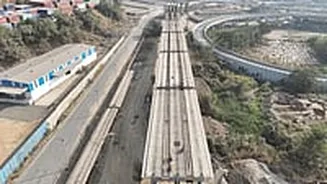








The Mumbai Metropolitan Region Development Authority (MMRDA) has stepped up construction activity on the Atal Setu-Mumbai-Pune Expressway connector, with steady progress reported across multiple stages.
The ambitious infrastructure project is now on track for completion by February 2027, officials confirmed.
Significant headway has been made in core construction components. Foundation work has been completed at 143 out of 176 designated locations, while piers have been erected at 141 sites, as reported in The Indian Express. Of these, 88 piers have already been fitted with pier caps, marking advancement in the structural framework.
In addition, 653 out of the total 830 precast girders required for the project have been completed, reflecting consistent progress in building the elevated corridor.
Ancillary Works Underway To Ease Traffic Flow
Alongside the main construction, supporting infrastructure work is also progressing. This includes the widening of slip roads and service roads at Palaspe in Panvel, aimed at improving connectivity and ensuring smoother traffic movement once the corridor becomes operational.
The 7.35-km-long, six-lane high-capacity corridor is designed to connect the Atal Setu with the Mumbai-Pune Expressway via Chirle and Palaspe in Navi Mumbai. The project is expected to significantly reduce travel time and enhance regional connectivity.
With the upcoming Navi Mumbai International Airport located close to Chirle, the connector is set to play a crucial role as a major access route. To facilitate seamless integration, two elevated corridors are being developed at Chirle and Palaspe, linking the project with the existing JNPT Highway.
Seamless, Signal-Free Travel Expected
MMRDA Metropolitan Commissioner Sanjay Mukherjee highlighted the broader benefits of the project, noting that the connector will enable uninterrupted, signal-free travel between Mumbai and the expressway.
He added that the corridor is expected to benefit a wide range of commuters, including students and working professionals, by making intercity travel between Mumbai and Pune faster and more convenient. The improved connectivity could also support flexible living arrangements, allowing people to reside in one city while working or studying in another.
Once completed, the connector is expected to become a vital infrastructure link, easing congestion, improving travel efficiency, and strengthening connectivity between key urban centres in the Mumbai Metropolitan Region.