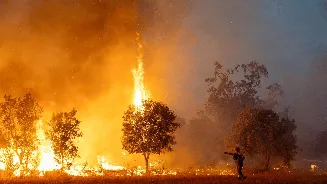





Wildfires almost always need a spark. It may come from lightning, arson, heavy machinery or even a hot exhaust pipe touching dry vegetation. But the source of ignition does not explain why fires across
Europe are increasingly growing into vast, fast-moving infernos that overwhelm firefighters and force mass evacuations.
Scientists say the scale of these fires is being driven by a dangerous combination of climate change, extreme swings between wet and dry weather, fuel-heavy forests and decades of changes in rural land use.
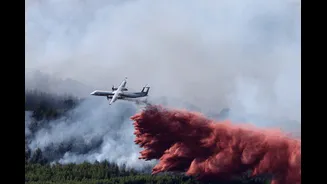
The impact has been enormous. More than 300,000 people have been forced to evacuate across France and Spain, according to The Wall Street Journal. More than 100,000 acres have burned around Bordeaux, while Spain has lost over 370,000 acres to wildfires this year.
How A Wet Winter Can Fuel Summer Fires
An exceptionally wet winter may appear to reduce wildfire risk. In reality, it can help create the fuel for a severe fire season.
Heavy rainfall encourages rapid growth of grass, shrubs and other vegetation. When intense heat and drought follow, that vegetation dries out and becomes highly combustible.
This rapid shift between wet and dry conditions is known as hydroclimatic whiplash.
“They are two faces of the same coin,” Francesca Di Giuseppe, fire forecast coordinator at the European Centre for Medium-Range Weather Forecasts, told The Wall Street Journal. “You go from extreme wet to extreme dry.”
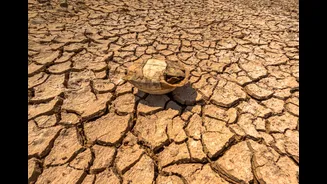
As the planet warms, the atmosphere can hold more moisture, intensifying rainfall during wet periods. Higher temperatures also draw water from soil and plants more quickly when dry conditions arrive.
“This has created an abundance of biomass that then has rapidly dried during a sequence of heat waves,” Di Giuseppe told DW.
In effect, wet weather grows the fuel, and subsequent heatwaves turn it into tinder.
Europe Is Getting Hotter And Its Fire Season Longer
June was the warmest ever recorded in Western Europe, with temperatures exceeding 104 degrees Fahrenheit in some areas.
Three factors largely determine whether a wildfire will spread rapidly: how much vegetation is available to burn, how dry it is and the weather around the fire.
“When all three of these conditions are very much fire-prone and they align, then you have this kind of fire event,” Di Giuseppe told DW.
Climate change is making those conditions more frequent and intense. According to WSJ, Europe is the world’s fastest-warming continent, with temperatures already around 2.5 degrees Celsius above pre-industrial levels, compared with approximately 1.4 degrees globally.
Repeated heatwaves dry out vegetation faster and lengthen the period during which fires can start and spread. Officials cited by the newspaper said the current fire season could continue until early November.
Why Some European Forests Burn So Quickly
Climate is not the only factor. The way forests have been planted and managed has also increased the danger.
Across parts of Europe, large areas are dominated by commercially valuable species such as pine and eucalyptus. These monocultures often consist of trees of similar age and height growing close together, allowing flames to spread rapidly.
The Landes de Gascogne forest in southwestern France is largely made up of maritime pine. The species sheds coarse needles that collect on the forest floor and add to the available fuel.
“Some of the fires we’ve been seeing in France and Spain are in places where you have these very flammable trees which are quite fine and they often are growing close together so fire spreads really easily,” Doug Kelley, a land surface modeller at the UK Centre for Ecology and Hydrology, told DW.
Eucalyptus presents a similar problem. The oily, fast-growing species accounts for more than a quarter of Portugal’s forestland, according to DW.
In Spain, around 3 million hectares of former farmland and pasture were planted with pine and eucalyptus during and after the Franco dictatorship, according to DW. The European Commission has said that replacing farmland and lower-biomass shrubland with more profitable but fire-prone species increased wildfire risk in some regions.
Rural Abandonment Has Left More Land Unmanaged
The movement of people from rural communities to towns and cities has also changed Europe’s fire landscape.
Fields and pastures that once acted as breaks between forests have been abandoned. Shrubs, weeds, young trees and leaf litter have grown in areas where farming and livestock grazing previously kept vegetation under control.
“We have a huge amount of gasoline in our forests, which is why they burn so violently. This fuel isn’t so much the trees themselves, but rather what lies beneath them—such as undergrowth, shrubs, and leaf litter,” Víctor Resco de Dios, a forestry expert at the University of Lleida, told the WSJ.
This continuous vegetation allows fires to travel across larger areas. In Spain, three separate fires near Madrid spread uncontrolled and eventually merged into a single megafire, according to the newspaper.
Dios estimated that the fires threatening Madrid carried energy equivalent to 29 Hiroshima bombs.
When Wildfires Generate Their Own Storm Clouds
The intensity of some recent fires has been great enough to produce pyrocumulonimbus clouds, also known as fire-fuelled thunderstorms.
The WSJ reported that such clouds formed in France for the first time in the country’s recent history. They develop when extreme heat lifts hot, smoky air into the atmosphere and water vapour condenses around ash particles.
These clouds can generate lightning, which may start additional fires and further complicate efforts to contain the blaze.
The fires are also adding to the problem that helped create them. Europe’s blazes have already emitted nearly 18 million tonnes of planet-warming carbon dioxide, according to EU figures.
Why Firefighting Alone Is Not Enough
Once a fire begins, thousands of firefighters may spend days or weeks trying to contain it. But experts say emergency response cannot be the only line of defence.
Reducing the amount of combustible vegetation before the fire season is equally important. Measures include removing dead wood and leaf litter, pruning low branches, creating breaks between trees, restoring grazing and conducting controlled burns to clear undergrowth.
Replacing monocultures with mixed forests can also improve resilience. Broadleaf trees such as oak, beech and maple generally retain more moisture than many conifers.
A simulation study of Portugal’s 2017 fires found that flames exceeding four metres in pine and eucalyptus stands fell below one-and-a-half metres in broadleaf forest, making them easier to contain.
“Trying to prevent in the first place the landscape becoming so flammable is one of the most effective ways to try to avoid this kind of extreme fire behavior,” Di Giuseppe told DW.
However, forest management addresses only one part of the crisis. Unless greenhouse gas emissions are reduced, Europe will continue to face higher temperatures, more intense drought and sharper swings between wet and dry conditions.