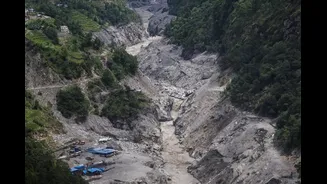






As Nepal emerges from August’s devastating flash flood triggered by a rock-ice avalanche near the Lhende River, on the Tibetan side of the Nepal-China border, a new report warns that a strong El Niño could
bring above-normal precipitation to parts of the Hindu Kush Himalaya region this winter.
The forecast raises concerns over an increased risk of floods, landslides and avalanches in parts of the region. The Hindu Kush Himalaya (HKH) Winter Outlook 2026, jointly prepared by the Kathmandu-based International Centre for Integrated Mountain Development (ICIMOD), Beijing Normal University and the Institute of Atmospheric Physics of the Chinese Academy of Sciences, forecasts wetter-than-normal conditions in countries including Nepal, Afghanistan and Bangladesh.
The outlook, however, is not limited to water-related hazards. It also warns that dry spells in parts of the region could leave vegetation vulnerable to forest and grassland fires.
The development comes amid the US National Oceanic and Atmospheric Administration (NOAA) alert of a strong-to-very-strong El Niño, with around a 60 per cent chance of it becoming the strongest since records began in 1950.
ICIMOD scientists say the weather phenomenon could bring more rain to the Himalayan foothills and increased snowfall at higher elevations.
Nepal and Bhutan are emerging from a particularly destructive monsoon season, marked by disasters linked to changes in high-mountain glaciers and permafrost. The devastating rock-ice avalanche that struck Nepal’s Rasuwa district in August 2026 is estimated to have cost the country USD 4.7 billion in relief and reconstruction, according to an estimate by Nepal’s National Disaster Risk Reduction and Management Authority.
The outlook also forecasts deeper-than-normal snow in parts of Afghanistan, Pakistan, northern India and Nepal, while shallower snow levels are expected in parts of Bhutan and eastern Xizang in China.
Snow depth plays a crucial role in sustaining river flows and determining water availability for the coming year. Shallower snow levels could affect irrigation, hydropower generation and spring flows, the report said.
“A wetter winter does not rule out the risk of fire, as other regions in the HKH are expected to face dry spells, leaving grass and other vegetation dry enough to burn,” the report warned.
It also projected a high to very high likelihood of forest and grassland fires in southeastern Xizang and parts of Myanmar.
“Preparedness cannot end with the monsoon. As rainfall becomes more erratic and intense, local authorities need seasonal outlooks to plan and short-range local forecasts to decide when and where to act,” said Manish Shrestha, a hydrologist at ICIMOD.
ICIMOD will discuss the findings at an international conference titled Advancing Science, Policy and Regional Cooperation for the HKH Cryosphere, scheduled to be held in Kathmandu from November 25 to 27.