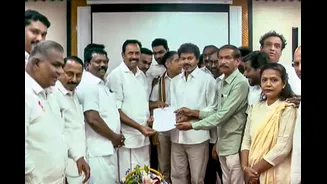








The emergence of actor-turned-politician Vijay’s Tamilaga Vettri Kazhagam (TVK) as the single-largest party in the 2026 Tamil Nadu assembly elections has sent shockwaves far beyond the borders of the state.
By securing 108 seats and moving towards government formation in alliance with the Congress, Vijay has not only dismantled a half-century-old regional duopoly but has also fundamentally altered the national political calculus. This seismic shift marks the arrival of a new power centre in the South, one that threatens to recalibrate the internal dynamics of the INDIA bloc and the BJP’s southern expansion strategy as the country eyes the 2029 general elections.
How does the TVK-Congress alliance reshape the INDIA bloc?
The success of the TVK-Congress partnership introduces a new, high-stakes variable into the national opposition alliance. For the Congress, this victory is a vital resurrection in a state where it has long played second fiddle to regional titans; it now finds itself as a partner in a governing coalition led by a fresh, charismatic force. This alters the “big brother” dynamics within the INDIA bloc, as the Congress is no longer solely dependent on the DMK for its southern seat share. For the broader alliance, Vijay represents a new model of “secular regionalism” that can bridge the gap between hardline Dravidian ideology and nationalistic aspirations, potentially serving as a template for other states where traditional regional parties are facing stagnation.
Does this victory make Vijay a national-level kingmaker?
Vijay’s transition from cinematic icon to the leader of the single-largest party in a major state arguably places him in the pantheon of national kingmakers. With 108 seats, his influence is no longer confined to the silver screen; he now controls the political narrative of one of India’s most economically and electorally significant states. In a fragmented national landscape, a leader who can command the loyalty of Tamil Nadu’s youth and a significant portion of its Lok Sabha seats becomes an indispensable ally for any coalition seeking power at the Centre. If Vijay can translate this assembly momentum into a formidable parliamentary presence, his “vanguard” will become the fulcrum upon which future Union governments may be balanced.
How does this alliance impact the BJP’s southern strategy?
The TVK-Congress alliance, observers say, creates a significant roadblock for the BJP’s “double engine” narrative in the South. While the BJP has sought to fill the vacuum left by a weakening AIADMK, Vijay’s rise has effectively occupied that space with a “saffron-neutral” yet distinctly Tamil alternative. By providing an outlet for anti-incumbency that is neither traditionally Dravidian nor aligned with the BJP, the TVK has intercepted the aspirational demographic that the saffron party was targeting. This forced recalibration means the BJP must now contend with a leader who possesses the same mass-mobilisation capabilities as their national icons but with a localised regional shield that is difficult to penetrate.
Can Vijay’s ‘Thalapathy template’ go national?
The “Thalapathy template”—converting a massive fan-club network into a disciplined electoral machine—is now a proven blueprint that other regional leaders and celebrities will likely study. Vijay’s ability to bypass legacy political structures to form a government as the single-largest party demonstrates that the Indian electorate is increasingly open to “disruptor” candidates who offer systemic change. As the road to 2029 begins, the 2026 Tamil Nadu result serves as a reminder that the national calculus is no longer a simple binary; it is an evolving puzzle where new, charismatic regional stars can suddenly emerge as the most powerful pieces on the board.