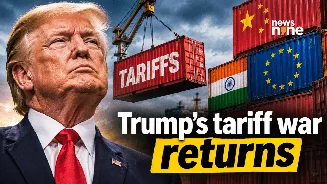









The United States has proposed fresh tariffs of up to 25% on imports from India and six other economies, while also planning duties of up to 20% on goods from Bangladesh, the European Union, Japan, Switzerland
and Singapore, Reuters reported, as President Donald Trump renewed his push to protect domestic industries.
The administration has proposed tariffs on 14 trading partners as part of an effort to address what it describes as structural excess industrial capacity. China faces the highest proposed rate of an additional 20%, with Washington accusing Beijing of flooding global markets with cheap exports, including steel, electric vehicles and solar products.
The move comes despite trade tensions and losses suffered by Trump’s Republican Party in the US midterm elections.
US seeks stability with China
A senior US official said the administration was seeking to maintain stable relations with China despite the proposed tariffs.
“We know that they don’t like these actions, but we are seeking stability with the Chinese. China is seeking stability with us,” the official said, adding that Trump’s meeting with Chinese President Xi Jinping last week was “really great”.
Beijing has opposed the idea of trade wars and rejected claims of excess industrial capacity, but has not threatened retaliatory measures.
“The so-called ‘overcapacity’ is a false issue, and China opposes using it as an excuse for political manipulation,” Chinese Foreign Ministry spokesperson Guo Jiakun said, urging the two largest economies to maintain stable relations.
The US administration has proposed tariffs on Bangladesh, Cambodia, the European Union, India, Indonesia, Japan, South Korea, Malaysia, Singapore, Switzerland, Taiwan, Thailand and Vietnam. Mexico and Norway have been excluded from the new levies for now.
The proposed duties will take into account trade deals agreed with the Trump administration and will not be added to some earlier tariff rounds, potentially limiting the increase in trade costs for several countries. However, the prospect of fresh duties weighed on stock markets on Wednesday, with MSCI’s gauge of global stocks falling 0.5% as a tech-led rally lost momentum.
New duties will not exceed negotiated limits
Trump’s tariffs have contributed to higher prices for consumer goods in the US. A Reuters/Ipsos opinion poll conducted following November’s midterm losses for Republicans found that 62% of respondents supported efforts to repeal the tariffs.
Trump has also indicated that he intends to rebuild tariffs struck down by the US Supreme Court in February. The latest proposals follow an eight-month Section 301 investigation into unfair trade practices.
A senior US official said the new duties would not exceed tariff limits agreed under trade deals with the Trump administration. This includes a 20% cap for China under a year-old truce with Beijing, which is due to expire on January 10.
The proposed tariffs would not apply to about $30 billion worth of Chinese imports that the US is considering for tariff reductions under a bilateral process. However, they would be added to tariffs imposed on China during Trump’s first term, which amounted to roughly 25%.
The proposed duties would also not be added to the 10% or 12.5% tariffs imposed in July on a wider group of 60 trading partners over allegations of lax enforcement of anti-forced labour laws.
Tariff rates would also be in line with trade agreements signed with other partners, including the 15% cap agreed by the European Union, Japan, South Korea and Taiwan, and the 19% cap agreed by Malaysia.
An US official said the tariff implementation may come into effect in January.