






Summer Solstice 2026 Date: The Summer Solstice 2026 marks one of the most important astronomical events of the year, occurring on June 21, when the Northern Hemisphere experiences its longest day and shortest
night. This natural phenomenon has fascinated scientists, cultures, and civilizations for centuries because it represents a turning point in Earth’s seasonal cycle.
Interestingly, the Summer Solstice often coincides with International Yoga Day, celebrated globally on June 21, making it a day associated not only with science and astronomy but also with wellness, mindfulness, and balance.
On this day, the Sun reaches its highest position in the sky at noon, resulting in maximum daylight hours. While many people associate it with heat or peak summer, the solstice is actually an astronomical event caused by Earth’s tilt rather than temperature.
Understanding why June 21 becomes the longest day of the year helps explain how our planet moves through space and how seasons are formed. The science behind this event is both simple and deeply fascinating, rooted in Earth’s axial tilt and orbit around the Sun.
What Is the Summer Solstice 2026?
The Summer Solstice is the day when the Northern Hemisphere receives the maximum daylight of the entire year. In 2026, this event will occur on June 21, marking the official longest day of the year.
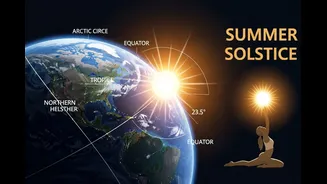
This happens because Earth’s axis is tilted at about 23.5 degrees, affecting how sunlight is distributed across the planet. This astronomical event is known as: Summer Solstice
Why June 21 Is the Longest Day of the Year
June 21 is the longest day because:
- The Northern Hemisphere is tilted toward the Sun
- Sunlight travels a longer path across the sky
- The Sun appears highest at noon
- Daylight duration reaches its yearly maximum
As a result, the Sun remains visible for the longest time in the sky.
The Science Behind The Solstice
The Summer Solstice is purely an astronomical event caused by Earth’s motion.
Key scientific reasons:
- Earth’s axial tilt of 23.5°
- Sun positioned over the Tropic of Cancer
- Northern Hemisphere receives direct sunlight
- Longer daylight arc across the sky
This leads to the longest day and shortest night of the year.
Summer Solstice In India
In India, the change in daylight is not extremely dramatic, but:
- Days are slightly longer than average
- The Sun appears higher in the sky
- Heat continues to build even after June 21
Cities like Mumbai, Delhi, and Chennai experience only minor differences in daylight duration.
Connection With International Yoga Day
The Summer Solstice often coincides with International Yoga Day, observed on June 21 worldwide. This alignment symbolizes:
- Balance between nature and human well-being
- Harmony of body and mind
- The connection between natural cycles and health
This makes the day significant not just scientifically, but also culturally and spiritually.
Does the Longest Day Mean the Hottest Day?
No. The longest day does not equal the hottest day.
This is due to thermal lag, meaning:
- Earth continues absorbing heat after June 21
- Oceans and land take time to warm up
- Peak summer temperatures occur weeks later
What Happens After June 21?
After the Summer Solstice:
- Days gradually become shorter
- Nights become longer
- Sunlight shifts southward
- The cycle continues toward the Winter Solstice
Cultural Importance of the Solstice
Across history, the Summer Solstice has been celebrated as:
- A symbol of light and life
- A turning point in seasonal cycles
- An important agricultural marker
Ancient monuments like Stonehenge are aligned with solstice sunrise directions.
Summer Solstice 2026 FAQs
What is the Summer Solstice?
It is the day with the longest daylight hours in the Northern Hemisphere due to Earth’s tilt.
Why is June 21 the longest day?
Because Earth is tilted toward the Sun, giving maximum sunlight exposure.
Does Summer Solstice always fall on June 21?
No, it can shift between June 20–22 depending on the year.
Does the longest day mean the hottest day?
No, the hottest days occur later due to delayed heating of Earth’s surface.
What happens after the Summer Solstice?
Days begin to shorten gradually until the Winter Solstice.
Why is it linked with Yoga Day?
Because both occur on June 21, symbolizing harmony, balance, and natural alignment.