







After years of discussion and missed timelines, Delhi’s Indira Gandhi International Airport (IGIA) is finally moving ahead with its long-awaited air train project.
Delhi International Airport Limited (DIAL),
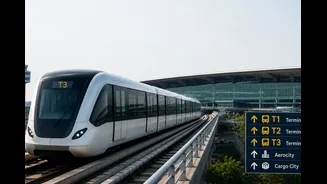
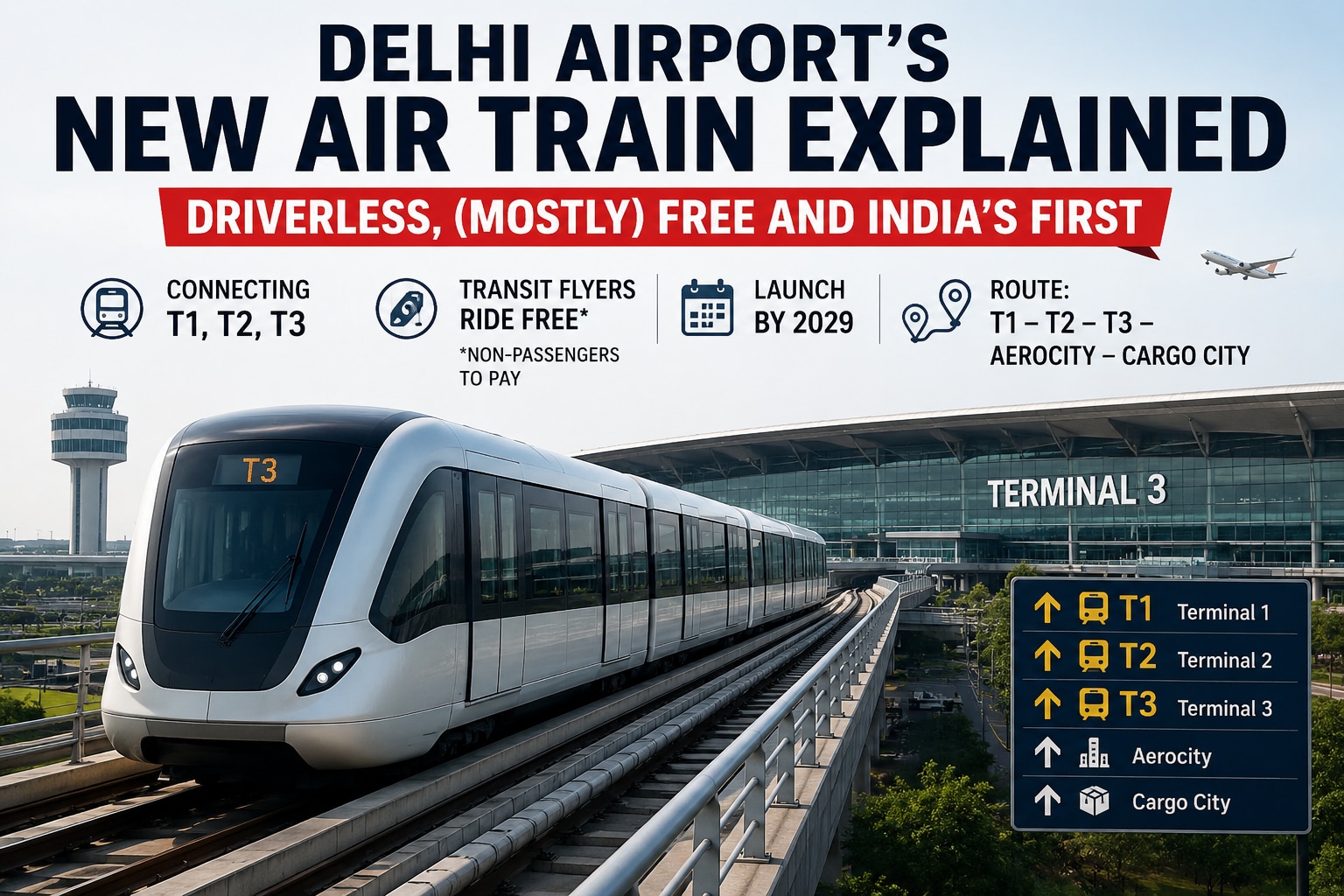
the operator of IGIA, has decided to directly fund and build an automated people mover (APM) system that will connect Terminal 1, Terminals 2 and 3, Aerocity and the cargo district. According to a report by The Times Of India, the project is expected to cost between Rs 3,000 crore and Rs 4,000 crore and, according to airport officials, could be operational within 30 months.
What Exactly Is The Delhi Airport Building?
The project is essentially an airporttransit train, similar to the automated systems seen at major international hubs in cities like Seoul, Zurich and Jakarta.
The planned APM will run across a 7.7-km corridor inside the airport ecosystem, helping passengers move quickly between terminals and airport-linked zones without relying on shuttle buses or road traffic.
For Delhi airport, this is more than just a convenience upgrade. Passenger traffic patterns have changed sharply over the years, especially as IGIA pushes to position itself as a global transit hub.
TOI quoted GMR Airports chairman GBS Raju as saying that transfer passengers at Delhi airport have risen from around 5% in 2006 to nearly 25% now. That share is still growing, especially with international connections increasing.
The airport operator believes smoother inter-terminal connectivity is now becoming as important as terminals and runways themselves.
Why Did DIAL Decide To Fund It On Its Own?
Interestingly, this project was originally supposed to come up through a concessionaire model.
Under that plan, a third-party company would finance, build and operate the system, recovering costs through advertisements and commercial revenue. But the model failed to attract enough interest.
According to the report, DIAL’s earlier tender on a DBFOT (Design, Build, Finance, Operate and Transfer) basis received only one bid and failed to move forward.
That experience appears to have changed the airport operator’s approach.
DIAL will now invest through internal accruals and later recover the money through airport tariffs and non-aeronautical revenues such as advertising.
The operator has also indicated it will try to reduce the impact on passenger tariffs while recovering costs.
How Will The Air Train Work?
The APM is expected to function like a driverless airport shuttle operating on dedicated tracks.
Passengers will be able to board the train after scanning their boarding passes. That feature is particularly important in India because airports often see large numbers of non-travellers entering terminal areas to drop or receive passengers.
Unlike many overseas transit hubs where access is more open inside airport zones, Delhi airport plans controlled access to the system.
The airport operator says transit passengers will be able to use the service free of cost. Non-passengers, however, are expected to pay a fee.
Will The Train Stop At Every Station?
Not always.
Airport officials say the system is being designed around Delhi airport’s ‘hub-and-spoke’ transfer model, where multiple connecting flights arrive and depart during concentrated peak windows.
During those high-traffic periods, trains may run directly between T1 and T3/T2 without stopping at Aerocity or cargo stations in order to speed up transfers.
That could become especially useful for passengers changing between domestic and international flights within tight connection windows.
Who Will Build The Project?
DIAL plans to split the project into two parts.
The civil infrastructure work like tracks and stations will likely be handled by Indian construction firms. The rolling stock and operating technology, however, may come from international players since this would be India’s first airport air train system of this scale.
According to the TOI report, airport officials studied systems in South Korea, Indonesia, Italy and Switzerland before narrowing down technology options.
Bidding for train technology providers is expected to begin soon.
<2h>Where Will The Stations Be Located?
The stations are expected to be built close to terminal entrances and integrated with other transport modes around the airport.
According to officials, the distance from stations to adjoining transport hubs would be around a two-to-three-minute walk.
That integration matters because IGIA is increasingly trying to function as a larger aviation and mobility hub rather than just a standalone airport.
Why Is This Project Important For Delhi Airport?
Delhi airport has been steadily competing with hubs like Dubai, Singapore and Doha for international transfer traffic, especially for passengers flying between Europe, Southeast Asia and Australia.
One of the biggest pain points at IGIA has been movement between terminals, particularly between T1 and T3.
Road transfers can often become slow and unpredictable because of traffic congestion, security checks and distance between terminals. An automated internal transit system could significantly reduce transfer uncertainty.
The project also comes as India’s aviation market continues to expand rapidly, with airports under pressure to improve passenger handling capacity without endlessly adding road-based transport.
FAQs On Delhi Airport Air Trains
What is an automated people mover (APM)?
An APM is a driverless transit train system commonly used at large airports to move passengers between terminals, parking zones and airport-linked districts.
Which terminals will Delhi airport’s air train connect?
The system will connect Terminal 1, Terminal 2, Terminal 3, Aerocity and the cargo district.
Will passengers have to pay to use the air train?
Transit passengers changing flights are expected to use it free of cost. Non-passengers may be charged.
When will Delhi airport’s air train become operational?
DIAL says the project should be ready within 30 months, which places the likely timeline around 2029 if work proceeds as planned.
Why is Delhi airport introducing this system now?
The airport says transfer passenger traffic has grown significantly over the years, increasing the need for faster inter-terminal connectivity.
Will this be India’s first airport air train?
Yes. According to airport officials, this would be the first automated airport people mover system of this scale in India.
How will passengers access the train?
Passengers will likely need to scan their boarding passes before boarding the system.