


This Independence Day, skip the predictable staycation and turn the long weekend into a journey through some of India’s most extraordinary chapters of history. The timing couldn’t be better: Sarnath has
just been added to the UNESCO World Heritage List, taking India’s tally to 45 World Heritage Sites. The inscription was announced on July 25, 2026, during the 48th session of the World Heritage Committee in Busan, South Korea.
From ancient Buddhist ruins and intricately carved temples to Mughal monuments and an entire historic city, these destinations offer a different way to experience India’s heritage. And because a great heritage holiday deserves an equally memorable address, we’ve paired each destination with a luxury stay.
1. Sarnath, Uttar Pradesh
India’s newest UNESCO World Heritage Site
Begin with the destination that has just made history.
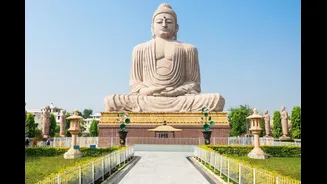
The Ancient Buddhist Site of Sarnath was inscribed on the UNESCO World Heritage List on July 25, 2026. The site holds enormous significance in Buddhist history: it is traditionally regarded as the place where Gautama Buddha delivered his first sermon after attaining enlightenment.
Today, visitors can explore the archaeological remains of monasteries, stupas and other structures that tell the story of Sarnath’s evolution as an important Buddhist centre. Among its most recognisable landmarks is the Dhamek Stupa, while the Sarnath Archaeological Museum houses the famous Lion Capital of Ashoka.
For the stay, Taj Ganges, Varanasi makes an elegant base. The hotel offers a dedicated Sarnath experience covering landmarks including the Dhamek Stupa, Chaukhandi Stupa and Archaeological Museum.
The combination gives you two very different sides of Uttar Pradesh: the sensory, spiritual energy of Varanasi and the quieter, contemplative landscape of Sarnath.
2. Khajuraho, Madhya Pradesh
Where architecture becomes art
Few heritage destinations are as visually arresting as the Khajuraho Group of Monuments. Built primarily between the 10th and 11th centuries under the Chandella dynasty, the temples are celebrated for their sophisticated architecture and extraordinary sculptural programme. UNESCO inscribed Khajuraho on the World Heritage List in 1986.
The temple walls unfold like an enormous stone manuscript, filled with depictions of deities, musicians, dancers, celestial figures and scenes from everyday life. The result is a destination where architecture, religion, art and human experience exist almost seamlessly alongside one another.
And now, there is a particularly compelling luxury stay to pair with it.
The Oberoi Rajgarh Palace is a restored 350-year-old palace set across a 76-acre estate, with the Maniyagarh Hills and surrounding wilderness providing its backdrop. The property is a short drive from the Khajuraho temples and also places guests near Panna National Park.
It is an especially fitting addition to this list because the stay itself becomes part of the heritage experience: explore the Chandella temples by day, then return to a restored royal residence by evening.
3. Taj Mahal, Agra
The world’s most famous monument to love
There are some Indian monuments that need no introduction, and the Taj Mahal is undoubtedly one of them.
Commissioned by Mughal emperor Shah Jahan in memory of Mumtaz Mahal, the white-marble mausoleum has become one of the world’s most recognisable symbols of love and architectural perfection. It was inscribed as a UNESCO World Heritage Site in 1983.
But an Agra trip needn’t begin and end with the Taj. The city is a fascinating immersion into Mughal history, with Agra Fort and the wider architectural legacy of the empire adding depth to the experience.
For the stay, check into ITC Mughal, A Luxury Collection Resort & Spa. Spread across 23 acres of gardens, the property takes its visual cues from Mughal architecture and was awarded the Aga Khan Award for Excellence in Architecture.
Its gardens, water channels, shaded walkways and Mughal-inspired design make the hotel feel like an extension of the destination itself.
The result is an ideal Independence Day escape for anyone who wants their heritage itinerary served with a generous dose of luxury.
4. Walled City Of Jaipur, Rajasthan
A royal city designed centuries ahead of its time
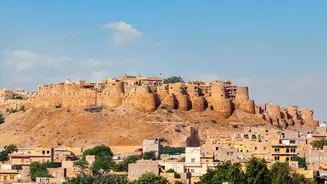
Jaipur’s heritage isn’t contained within a single monument. In 2019, the Walled City of Jaipur was inscribed as a UNESCO World Heritage Site for its remarkable urban planning and architecture.
Founded in 1727 by Sawai Jai Singh II, Jaipur was laid out according to a grid plan influenced by Vedic architectural principles. Its broad streets, markets, public squares, gates and uniform facades were conceived as part of a highly organised commercial city. UNESCO describes the city as an important interchange of Hindu, Mughal and Western planning ideas.
The best way to experience Jaipur is to allow yourself time to wander: through its historic bazaars, past its pink façades and into the palaces, temples and architectural landmarks that give the city its unmistakable character.
For a contemporary luxury address, Raffles Jaipur is an especially stylish choice. Located near the Aravalli Hills and within easy reach of the Pink City and Amber Fort, the palace-style hotel draws heavily on Rajasthan’s architectural and craft traditions. Its 50 rooms and suites feature handcrafted details, local objets d’art, Jaipur-woven carpets and elaborate decorative elements.
It is heritage hospitality without feeling like a museum, exactly the kind of balance a modern luxury traveller wants.
5. Fatehpur Sikri, Uttar Pradesh
Walk through Akbar’s imperial city
A short journey from Agra brings you to another extraordinary chapter of Mughal history: Fatehpur Sikri.
Built by Emperor Akbar between 1571 and 1573, the city served as the Mughal capital for approximately a decade. UNESCO describes it as the first planned city of the Mughals, bringing together palaces, administrative buildings, religious structures and residential areas in a remarkably cohesive architectural ensemble.
The complex is home to some of India’s most memorable Mughal structures, including the Jama Masjid, Buland Darwaza and Panch Mahal. Unlike a single monument, Fatehpur Sikri feels like an entire imperial world preserved in red sandstone.
Stay at ITC Mughal in Agra, which makes a natural base for exploring the city’s wider Mughal heritage. The resort’s own design is inspired by the great builders of the Mughal era, with expansive gardens, water channels and architectural details that echo the dynasty’s aesthetic.
This Independence Day, Make It A Heritage Holiday
India’s history isn’t one story. It is a collection of extraordinary civilisations, artistic traditions, architectural movements and cultural exchanges — and these five destinations offer five very different ways of experiencing it.
In Sarnath, it is the story of Buddhism and the Buddha’s first sermon. In Khajuraho, it is the extraordinary artistic imagination of the Chandella era. In Agra, it is the grandeur of Mughal architecture. In Jaipur, it is the vision of a meticulously planned royal city. And at Fatehpur Sikri, it is the ambition of an emperor who attempted to build an entire capital from scratch.
This August 15, perhaps skip the conventional staycation and check into India’s history instead, with a luxury address waiting at the end of each day’s journey.