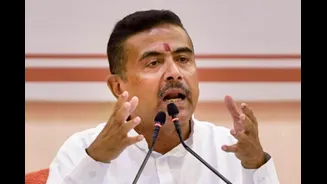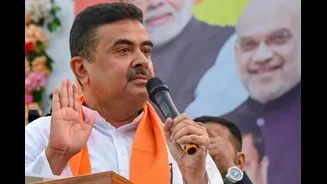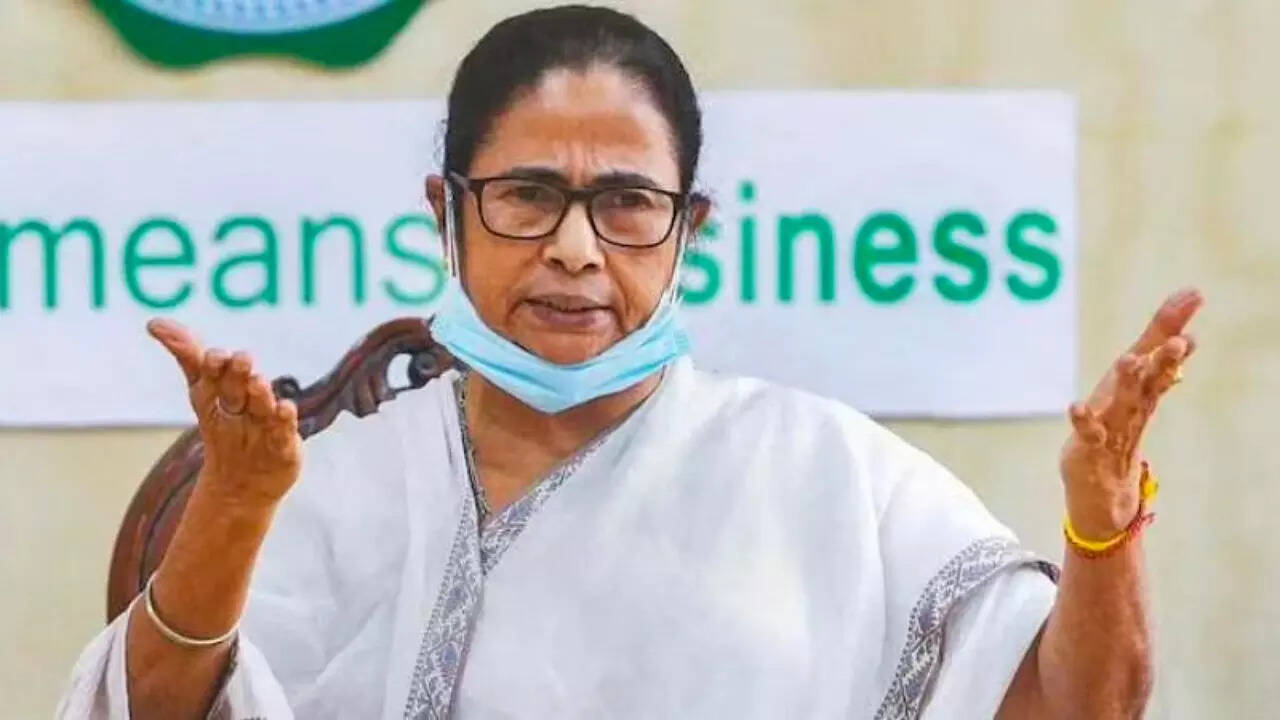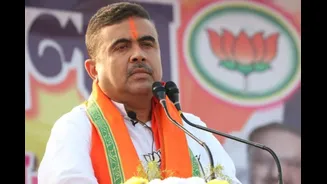









Following the Bharatiya Janata Party’s (BJP) historic victory in the West Bengal Assembly elections, Chief Minister Suvendu Adhikari took office on May 9 and immediately launched a massive policy overhaul.
His initial cabinet decisions focus squarely on reversing, dismantling, or modifying legacy initiatives from Mamata Banerjee’s Trinamool Congress (TMC) administration.
SUVENDU ADHIKARI’S KEY DECISIONS
The primary administrative and policy shifts executed by the Adhikari government include:
1. Detect, Delete, Deport: Adhikari announced a strict three-step process—”Detect, Delete, Deport”—to remove suspected illegal immigrantsfrom the state. Speaking at a public gathering in Bhabanipur following the Bharatiya Janata Party’s (BJP) electoral victory in West Bengal, Adhikari stated that the initial processes of identification and removal from official voter lists have already been completed, paving the way for immediate deportation actions.
2. Scrapping religion-based schemes: The state cabinet voted to discontinue all government welfare assistance based onreligious classification. Funding for specific allowances run by the Minority Affairs, Madrasa Education, and Information and Culture departments will officially cease.
3. Abolishing and reviewing the state OBC list: Adhikari’s government withdrew the state’s previous legal challenge and dismantled the existing state Other Backward Classes (OBC) list. This aligns with a Calcutta High Court ruling, and a new panel is being set up to strictly reassess quota eligibility.
4. Fast-Tracking border land transfers to the BSF: Reversing years of state-level delays, the new cabinet ordered the immediate transfer of required land to the Border Security Force (BSF). The Land Reforms Department has a strict 45-day deadline to clear land for India-Bangladesh border fencing.
5. Overhauling ‘Lakshmir Bhandar’ into ‘Annapurna’: The TMC’s signature financial handout scheme for women, Lakshmir Bhandar, is being systematically replaced. The newly approved ‘Annapurna’ scheme increases monthly financial assistance to ₹3,000 via direct bank transfers.
6. Implementation of all blocked central schemes: The state has given immediate clearance to roll out major Central Government programs previously resisted by the TMC. This includes Ayushman Bharat, PM Vishwakarma, Ujjwala Yojana, and Beti Bachao Beti Padhao.
7. Unblocking the National Census exercise: The new administration formally sanctioned pending census-related directives from the Union Home Ministry. Adhikari stated that the previous government had intentionally stalled files from June 2025 to obstruct the alignment of national policies.
8. Enforcing new national criminal laws (BNS): The statecabinet mandated the immediate adoption and implementation of the Bharatiya Nyaya Sanhita (BNS), India’s new criminal code. The move overrides previous state-level administrative delays that postponed replacing the colonial-era IPC.
9. Public safety reforms and “bulldozer” precedents: The government introduced strict restrictions on public religious practices blocking roadways, such as street prayers, and clamped down on illegal structures. Law enforcement has also been directed to use heavy administrative action against illegal encroachments.
10. Age relaxation for state government jobs: To address local youth unemployment complaints from prior years, the cabinet passed a policy increasing the upper age limit for state government job applications by five years.
11. Aligning state bureaucracy with New Delhi: In a push for standard administrative reform, West Bengal IAS and IPS officers are now required to participate in Central Government training programs. This ends a long-standing policy of bureaucratic non-cooperation maintained by the previous administration.
12. State hands over 7 national highways to Centre: Stuck for a year, CM Adhikari-led Bengal government has decided to hand over seven stretches of national highways to the National Highways Authority of India (NHAI) and the National Highways & Infrastructure Development Corporation Limited (NHIDCL).
Following Nabanna’s in-principle approval, a long-pending deadlock over several national highway projects has been resolved. These projects had reportedly been awaiting approval from the state government for nearly a year. With clearance now granted, the central agencies will be able to begin road development work at an accelerated pace.
13. Action against stone-pelters, protesters: Adhikari issued a stern warning to protestersin Park Circus, asserting that stone-pelting will be completely eliminated in the state, just like in Jammu and Kashmir. His remarks came after protests against the government’s actions, such as a ban on animal slaughter, restrictions on loudspeakers in religious places and the demolition of a factory, turned violent in Kolkata’s Park Circus area, where demonstrators allegedly pelted stones at police personnel and vandalised vehicles.
14. Police welfare board dissolved: The West Bengal government on Saturday dissolved thePolice Welfare Board, with Chief Minister Suvendu Adhikari saying the body had moved away from its original purpose and was no longer working for the welfare of police personnel.
15. Probe panels: Adhikari announced two major inquiry panels headed by former Calcutta High Court judges to investigate institutional corruption and atrocities against women during the previous Trinamool Congress (TMC) regime. The panels are expected to officially commence operations on June 1.
16. Ban on street namaz: Adhikari has officially banned offering Namaz on public roads and streets across the state. According to statements from BJP leaders and administrative directives, the policy mandates that all religious prayers must be confined strictly within designated religious premises or mosques. The restriction is intended to prioritize public convenience, maintain law and order, and prevent traffic disruptions