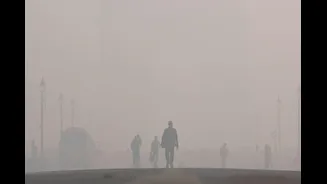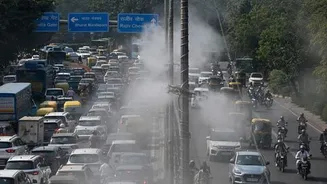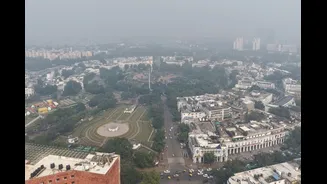






As the national capital struggles with deteriorating air quality, a new report has found that Delhi’s early winter pollution this October-mid November was worse than last year, with a sharp build-up ahead
of Diwali.
According to the latest assessment carried out by New Delhi-based Centre for Science & Environment (CSE), the week preceding Diwali (on November 8) recorded an average PM2.5 concentration of 236 µg/m³—a three-year high. This marks a 97 per cent increase over the 120 µg/m³ recorded in 2025 (Diwali on October 8) and a 32 per cent jump over the 179 µg/m³ seen in 2024 (Diwali on 31st October). “Both in 2025 and 2026, pollution surged in the days leading up to Diwali. However, the overall toxic burden during this pre-festive week was significantly worse this time, compared to previous years,” said Sharanjeet Kaur, Deputy Programme Manager, Urban Lab, CSE.
Transport remained the largest contributor among local sources, with emergency measures like traffic curbs, barring pre-BS VI vehicles failing to ease the congestion, said the researchers, adding that the year-round emission control across key sources remained inadequate.
“Diwali pollution is an annual tipping point, but elevated particulate levels before the festival this year show that baseline pollution is higher than in previous years. Had air quality been cleaner leading into winter, and episodic spikes from farm fires and firecrackers kept in check, seasonal weather shifts would not have triggered such severe pollution,” said Anumita Roychowdhury, Executive Director, Research and Advocacy, CSE.
54.4% OF DELHI PM2.5 FROM NCR DISTRICTS
The national capital is breathing toxic air, with the AQI levels oscillating between “very poor” to “severe” category over the past two weeks, indicating hazardous concentrations of PM10 and PM2.5 in the air.
According to the report, from November 1-8, pollution transported from neighbouring NCR districts accounted for 54.43 per cent of Delhi’s PM2.5, followed by local sources at 33 per cent and stubble burning at 14.29 per cent. Among Delhi’s local pollution sources, vehicular transport was the dominant polluter at 52 per cent, well ahead of residential activities (13 per cent) and Delhi’s peripheral industries (11 per cent). Construction contributed 7 per cent, energy use and waste burning generated 5 per cent each, and road dust and other sectors accounted for 4 per cent each.
TRAFFIC CURBS FAIL TO EASE CONGESTION
The assessment showed that emergency GRAP measures brought negligible relief to Delhi’s weekday gridlock. “During the restriction week (November 2-6), Delhi logged an average daily Travel Time Index (TTI) of 2.40 and an evening peak of 3.49—virtually identical to the 2.38 daily and 3.48 peak TTI recorded on October 30, right before curbs took effect. So, commuters still took 13 per cent longer to complete trips compared to standard weekdays from January to April 2026, with evening rush hours taking 13 to 31 per cent longer,” said Shubham Srivastava, Deputy Programme Manager, clean air and sustainable mobility, CSE.
To make matters worse, nearly 80 per cent of Nitrogen Dioxide (NO2) is emitted by vehicles. On an hourly basis in this period, it rose sharply during the evening rush and remained elevated through midnight—persisting for hours after road traffic had dispersed. “Short-term emergency steps cannot substitute for systemic solutions,” said Roychowdhury, adding that current clean air action plans targeting vehicular emissions focus on it primarily as a tailpipe technology or routing problem rather than an ‘absolute volume crisis’.
SEVERE AQI, DESPITE DROP IN CROP FIRES
According to the report, though the share of stubble smoke rose during this period, severe pollution episodes continued even when farm fire contributions dropped. For instance, Delhi’s air quality deteriorated sharply in late October, and plunged into the “very poor” category on November 2.
The contribution of stubble burning to citywide PM2.5 was 3.9 per cent during GRAP Stage I enforcement. It rose to 11.5 per cent on November 1 (ahead of GRAP Stage II), and eased to 8.6 per cent on November 2. Farm fire smoke peaked at a season high of 16.2 per cent on November 4. Yet by November 6, when GRAP Stage III was triggered, Delhi’s AQI deteriorated to 382 even as stubble smoke fell to around 8 per cent—proving that severe pollution episodes persist independently of declining farm fires, driven instead by intense local emissions.
The assessment is based on detailed analysis of data of the Central Pollution Control Board, the Indian Institute of Tropical Meteorology, the Indian Agricultural Research Institute, as well as the traffic data from Tom Tom, the geolocation and mapping technology company that aggregates GPS data to provide real-time and historical road traffic analytics.