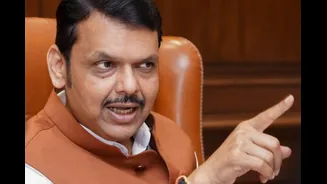









Following the historic mandate and emphatic victory for the Bharatiya Janata Party (BJP) in the recently concluded Municipal Elections in Maharashtra, Chief Minister Devendra Fadnavis has not only firmly
established himself as the man of the match but also as the man of the series and probably the greatest of all time, making him a role model for India’s ambitious vision of a Viksit Bharat by 2047.
What makes his journey especially compelling is that it is not a story of entitlement. He comes from a middle-class, progressive family in Nagpur and began his political life early, learning politics as a form of public service. There is a reason his supporters often describe him with a simple mantra: “People First.”
It is a phrase that can sound like a slogan — until you observe his method: preparation over posturing, execution over excuses, and measurable outcomes over rhetorical victories. His progression has been patient, grounded, and organisationally rooted. That is precisely what gives his leadership credibility: he is not a manufactured phenomenon; he is a built leader.
Fadnavis’s dedication to public service began early. By 1992, at age 22, he was elected as a corporator to the Nagpur Municipal Corporation, and at 27, he became India’s second-youngest mayor. These weren’t mere titles and medals; they were platforms for action and hard work. This relentless drive propelled him into the Maharashtra Legislative Assembly in 1999, where he won six consecutive terms from Nagpur constituencies.
Fadnavis’s mantra — “Politics is an instrument for socio-economic change” — guided his roles on committees on estimates, urban development, and reserve funds. By 2013, as BJP Maharashtra President, he orchestrated a historic turnaround, leading the party to 122 seats in the 2014 Assembly elections. At 44, he became Chief Minister for the first time and completed a full five-year term, only the second in Maharashtra’s history after Vasantrao Naik.
If one were to describe Fadnavis’s governance in one phrase, it would be this: he treats infrastructure as social policy. Roads are not ribbon-cutting opportunities; they are productivity, safety, jobs, and dignity. Metro systems are not vanity projects; they are time returned to citizens, cleaner air, and a modern urban economy.
Fadnavis’s true legacy, however, lies in his role as Maharashtra’s “Infrastructure Man”. The label is not hyperbole. It reflects a strategy: build the backbone first, and growth will follow. Under his stewardship, the state has undergone a metamorphosis, aligning with Prime Minister Modi’s Viksit Bharat vision. Maharashtra contributes nearly 15% to India’s GDP, 25% of its industrial output, and accounts for 31% of India’s total Foreign Direct Investment (FDI) inflows.
Fadnavis has accelerated this progress to target a $1 trillion economy. His flagship projects are testaments to visionary planning and execution:
Take the Hindu Hruday Samrat Balasaheb Thackeray Samruddhi Mahamarg, a 701-km expressway connecting Nagpur to Mumbai. Conceived in 2015 during his first term, it was fully operational by June 2025, slashing travel time from 16 hours to 8. The Atal Bihari Vajpayee Sewri–Nhava Sheva Atal Setu Mumbai Trans Harbour Link (MTHL) and Vadhvan Port position Maharashtra as a global logistics powerhouse.
In urban mobility, Fadnavis earned the moniker “Metro Man.” Mumbai Metro expanding to an 81 km network by 2025, with Pune and Nagpur metros adding 70+ km. These aren’t just tracks; they’re lifelines that enhance the ease of living — reducing commute times and cutting pollution. His War Room approach—monitoring projects weekly — cleared bottlenecks, attracting ₹15.7 lakh crore in MoUs at Davos 2025, creating 16 lakh jobs in steel, IT, and green energy.
Maharashtra’s Right to Service mindset and the push for digitisation of citizen services are strong examples of governance that respects people’s time. When services are time-bound, transparent, and increasingly online, it signals something powerful: the citizen is not a supplicant; the citizen is a stakeholder.
Maharashtra’s ambition to reach a $1 trillion economy is not merely a slogan—it is an outcome that requires three things:
(1) Capital formation,
(2) Competitive infrastructure, and
(3) Institutional reliability. Fadnavis’s model has aimed squarely at this triangle.
Maharashtra has consistently been among India’s most attractive destinations for industrial investment, and the state’s ability to secure large investment commitments—whether via global forums or direct industrial outreach—speaks to the credibility of its economic direction. But beyond the headline MoUs and big-ticket announcements lies the real work: land aggregation, permissions, power reliability, logistics readiness, skilling, and a governance culture that facilitates and catalyses enterprise.
This is a key point that is sometimes missed in political commentary: investors do not invest only in tax incentives; they invest in predictable execution. When they sense a state is being run with urgency, clarity, and coordination, they allocate capital. Fadnavis has made that confidence a core asset for Maharashtra.
If Maharashtra is to become a $1 trillion economy, it will do so not by hoping for growth, but by engineering it—through industrial depth, urban productivity, and connectivity-led expansion into the interiors. Fadnavis’s infrastructure-first approach is, in this sense, directly aligned to the trillion-dollar goal.
What makes the “Devendra Fadnavis Model” especially relevant for other Indian states is that it is not dependent on one-time populism. It is built on a few replicable principles:
- Build capacity, then scale delivery.
- Use infrastructure as an economic multiplier.
- Digitise citizen services to cut corruption and friction.
- Treat investment attraction as a full-time mission, not an annual event.
- Run government like a programme — monitoring, milestones, accountability.
- Balance urban ambition with rural resilience.
These principles are not ideological; they are practical. And they reflect a modern understanding of statecraft: development today is less about declarations and more about systems. Fadnavis’s model is a template for replication.
Fadnavis’s most important contribution is not any single project or policy. It is the governance culture he represents: hard work, focus, determination, and a steady sense of duty. In a world of turbulence — geopolitical, economic, and social — states need leaders who can keep building, keep delivering, and keep strengthening institutional trust.
That is why his story resonates across party lines and beyond Maharashtra. It is the story of a middle-class boy from Nagpur who rises through discipline and service to shape one of India’s most complex and largest states—and does so with a clear nation-building intent. That is why he is respectfully and fondly called ‘Deva Bhau’, meaning brother, and that is why he keeps winning the hearts and minds of people and elections as well!
The author is an angel investor and startup mentor for the Atal Innovation Mission, Government of India, and the Atal Incubation Centre-Rambhau Mhalgi Prabhodhini. He is presently the Convenor (Western Maharashtra) of the BJP Intellectual Cell and has recently co-edited the book Modi’s North East Story. Views expressed in the above piece are personal and solely those of the author. They do not necessarily reflect News18’s views.