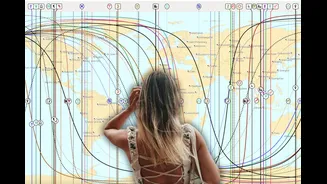

Ever felt an unexplainable pull towards a city you have never lived in, or an instant sense of calm the moment you arrived somewhere new? It is the kind of feeling travellers often struggle to put into
words. Most of us travel with a reason on paper, a wedding, a job, a break, a deadline. But once we get there, the experience often feels bigger than the plan.
Astrocartography suggests that different locations activate different parts of who you are, emotionally, creatively, professionally. In a time when travel has become less about collecting places and more about searching for meaning.
Once considered niche or fancy, astrocartography is now part of a wider shift towards spiritually guided travel. According to Booking.com’s Travel Predictions for 2026, travel decisions are increasingly shaped by astrology, moon phases and spiritual advice. Astrologer Gargi A. Jaitleey told News18, “Astrocartography is effective for both short-term travel and long-term relocation. Short visits activate planetary energies temporarily, while long-term residence anchors those energies into everyday life.”
What Is Astrocartography?
Astrocartography maps a person’s birth chart across the world, showing where planetary energies are strongest geographically. The idea is that different places activate different dimensions of your life, emotionally, professionally and spiritually.
Astrologer Gargi A. Jaitleey explains why this practice applies as much to a short holiday as it does to a long-term move. She links this approach to classical astrological thought, “This aligns with the Vedic principle of Desha–Kala–Patra mentioned in Brihat Parashara Hora Shastra, which states that planetary results vary according to place. Western astrologer Jim Lewis also explains in The Psychology of AstroCartoGraphy that planetary lines respond whenever a person visits or resides near them.”
What this really means is that location is not neutral, it participates in shaping experience. Astrocartography resonates strongly with Indian travellers, for whom spiritual geography has long been part of cultural consciousness. Pilgrimages, temple towns and sacred rivers have always been associated with specific energies. Astrocartography reframes this intuition through a personalised lens.
Why Are People Turning To Astrology To Plan Their Holidays?
Travel in 2026 is no longer driven solely by price alerts and leave calendars. According to Booking.com’s Travel trends, spiritual timing and astrology are becoming influential decision-making tools rather than fringe curiosities. Almost eight out of ten Indian travellers (74%) say they would consider changing or cancelling their travel plans if a spiritual advisor suggested it was not the right time. 70% would rethink a trip based on a horoscope warning, while two thirds (66%) say they would adjust plans if Mercury was in retrograde.
64% actively factor astrological cues into holiday planning, from moon phases to energy-rich destinations. Gen Z and millennials, in particular, are leading this shift, reframing travel as a form of self-discovery rather than escape.
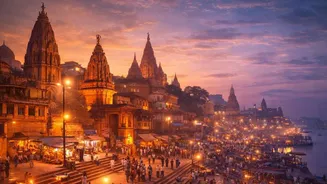
Jaitleey offers an example that does not involve crossing borders or chasing exotic destinations. Astrologer Gargi shares with us, “Ramesh has lived his entire life in India. His Moon line passes near Varanasi, where he regularly visits and feels deep mental peace and spiritual connection. His Mercury line passes near Hyderabad, and when he moved there for work, his career in IT and business communication grew steadily. He never left India, yet different Indian cities activated different parts of his life.”
She breaks the idea down simply, “Short trip to Moon place → emotional healing. Long stay near Mercury place → career growth.”
Astrologer and numerologist Sidhharrth S Kumaar further explains that travel, in Vedic astrology, is never random. It is shaped by timing, planetary cycles and what a person is seeking at that moment in life. Kumaar emphasis and shares with News18 correspondent, “The decider will be the dasa of the person, which planet dasa is running. Secondly, what transit is happening, and what is the profession of the person. Transit and dasa are the key deciders, along with profession, which will advise where the person should travel, so that luck activates.”
Can Destinations Be Chosen Based On Life Goals?
“Temporary travel has a very minimal effect, for a travel or for a city to have an impact on your chart, the period should be at least 5 days plus, and the longer it is, the better it is,” Sidhharrth who also practices introduces another layer, timing.
He explains that planetary periods, transits and even profession influence where travel can activate luck. Destination choice shifts depending on whether someone is seeking growth in relationships, career or inner stability.
For example, during Ketu phases, he advises mountainous or temple regions. Sun phases may benefit from rural environments with clear eastern exposure. Saturn periods often align better with quieter, grounded settings to the west of one’s birthplace. Sidhharrth explains that destinations change depending on intent, “If a person wants luck in dating life, the destination will be different. If the person wants to activate career luck, the person has to decide a different place.”
“If a person is going through ‘Surya ki dasa’, it is advisable to go and live on the village side, where the rising sun is visible, specifically towards the east from the birthplace.” Different planetary phases call for different landscapes.
“During Saturn phases like saadi saati or dhaiya, the person can prefer to go to rustic areas, specifically towards the west of the birthplace.”
Kumaar situates astrocartography within both modern and classical astrology, “Astro cartography is a branch of astrology which believes that when a person relocates from one place to another, the complete horoscope will change. This is very popular in western astrology, but it was a principle in Vedic astrology as well, where we talk about desh and kaal.”