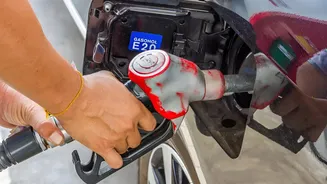








New Delhi, Jul 27 (PTI) The government on Monday said it has not assessed the proportion of vehicles in the country that are fully compatible with E20 petrol, but maintained that extensive studies and
field trials have found the fuel to be safe for use under prescribed standards.
In a written reply to a question in the Rajya Sabha, Minister of State for Petroleum and Natural Gas Suresh Gopi said, “Ministry of Heavy Industries (MHI) have informed that no such assessment has been done by them” of the percentage of vehicles currently compatible with E20 fuel (petrol doped with 20 per cent ethanol).
The minister said the Ethanol Blended Petrol (EBP) programme had been implemented through a phased and scientifically validated process involving NITI Aayog, automobile manufacturers, oil marketing companies, the Automotive Research Association of India (ARAI), the Society of Indian Automobile Manufacturers (SIAM), the Indian Institute of Petroleum (IIP) and other technical institutions.
He said laboratory studies and field trials covering engine durability, drivability, startability, corrosion resistance, material compatibility, emissions and fuel efficiency had confirmed that E20 was safe for use.
“These studies also established that legacy vehicles do not exhibit any significant variation in performance or abnormal wear and tear due to E20,” he said.
The rollout of E20 petrol (80 per cent petrol, 20 per cent ethanol) has drawn criticism from opposition parties and some consumer groups, who have raised concerns about its impact on older vehicles not specifically designed for 20 per cent ethanol blends. Critics have questioned whether all vehicles are fully compatible with E20, flagged the possibility of reduced fuel efficiency and higher maintenance costs, and sought clarity on liability if engine or fuel-system problems arise.
The government has maintained that the transition has been phased and backed by extensive testing, while automobile manufacturers have said they continue to honour warranty claims for vehicles using E20 fuel. Opposition parties have repeatedly sough greater transparency on vehicle compatibility and consumer safeguards.
Gopi said E15+ blended petrol (petrol containing 15 per cent ethanol) has been in widespread use for more than three-and-a-half years and E19-E20 fuel for more than two-and-a-half years, with over 20 crore two-wheelers and more than 3 crore petrol cars operating on these blends.
There is no “verified evidence of widespread engine failure or vehicle breakdown attributable to ethanol blending,” he said, adding that manufacturers continue to honour warranty obligations for vehicles using E20 fuel.
On fuel economy, the government said mileage depends on several factors, including driving conditions, driving habits and vehicle maintenance. It said any reduction in fuel economy in some vehicles originally designed for E10 petrol is generally limited to about 3-5 per cent, while E20 offers higher octane, better anti-knock characteristics, cleaner combustion and smoother engine performance.
Gopi added that E20 provides better acceleration, improved ride quality and about 30 per cent lower carbon emissions than E10 fuel, while higher ethanol blends result in cleaner combustion and near-zero particulate matter emissions.
Citing industry data, the government said a leading automobile manufacturer serviced 2.84 crore vehicles during 2025-26, including about 1.5 crore vehicles not originally certified as E20-compatible, without reporting E20-linked corrosion, abnormal wear or reduced component life. Another manufacturer tracked 1.4 crore vehicles operating on E20 over an extended period and found no evidence of ethanol-induced corrosion, it said.
Gopi said the ethanol production capacity created in the country has been planned not only to meet the current requirement of E20 blending but also to cater to future growth in petrol demand, provide operational flexibility during seasonal variations in feedstock availability and support higher ethanol blends, flex-fuel vehicles and other emerging biofuel applications, as and when approved by the Government.
“The Government follows a diversified feedstock strategy under the National Policy on Biofuels. Ethanol is produced from multiple approved feedstocks, including sugarcane-based feedstocks, maize, damaged foodgrains, broken rice, foodgrains unfit for human consumption, surplus foodgrains approved by the National Biofuel Coordination Committee (NBCC) and other approved agricultural feedstocks,” he said. “The diversion of foodgrains for ethanol production is carefully calibrated in consultation with the Department of Food & Public Distribution and other concerned Ministries.” Food security, Public Distribution System (PDS) requirements, National Food Security Act (NFSA) obligations, Other Welfare Schemes (OWS) and prescribed buffer stocks are accorded the highest priority. “Only surplus foodgrains, after meeting these requirements, are permitted for ethanol production,” he added. PTI ANZ ANU