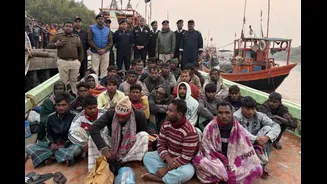

The Indian Coast Guard (ICG) on December 16 intercepted two Bangladeshi fishing boats engaged in illegal fishing inside India’s Exclusive Economic Zone (EEZ) in the northern Bay of Bengal. The vessels
and their 35 crew members were taken into custody and later handed over to the Marine Police at Frazerganj, West Bengal, for legal proceedings under the Maritime Zones of India (Regulation of Fishing by Foreign Vessels) Act, 1981.
According to reports, the ICG Ship Anmol spotted the boats well within India’s maritime limits during routine surveillance. Active fishing gear and an estimated 500 kilograms of fish catch on board indicated ongoing fishing operations, in violation of Indian maritime regulations. None of the crew could produce valid permits authorising them to fish in Indian waters.
This latest interdiction is part of a continuing pattern. Over the past three months, the Indian Coast Guard has reportedly apprehended multiple Bangladeshi fishing vessels and detained more than a hundred crew members for similar violations.
@IndiaCoastGuard Ship, while on patrol in the Northern #BayOfBengal on 16 Dec 25, intercepted and apprehended two #Bangladeshi fishing boats along with 35 crew members and 500 kg of illegally harvested fish catch inside #Indian water. The seized boats and crew were handed over to… pic.twitter.com/shahycyCpT
— Indian Coast Guard (@IndiaCoastGuard) December 18, 2025
However, intelligence and diplomatic sources tracking developments in Dhaka suggest a complex narrative beyond routine law enforcement. Officials familiar with the issue tell CNN-News18 that these intrusions are not merely navigational errors or economic necessity, but are increasingly being portrayed in Bangladesh as instances of Indian “harassment” of poor fishermen. Within Bangladesh’s domestic discourse — including political groups and media sections — the EEZ arrests are being framed as insensitive to the livelihoods of coastal fishing communities. Proponents of this view argue the issue fuels anti-India sentiment at a time when Bangladesh’s economy is under stress.
Top intelligence sources describe the repeated EEZ violations as deliberate and deniability-based pressure tactics. By using civilian fishing boats to cross maritime boundaries, they assert that Bangladesh can avoid overt military confrontation while still engaging in a form of grey-zone behaviour — a strategy where civilian actors are used to challenge a neighbour’s sovereignty without triggering full state-level escalation. These operations, they say, also provide opportunities for informal intelligence gathering and a predictable Coast Guard response. Critics in New Delhi see this as part of a broader effort to harness nationalist sentiment domestically by depicting India as aggressive toward Bangladeshi civilians.