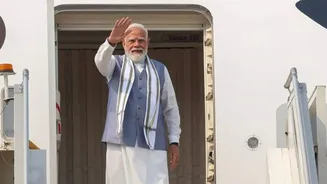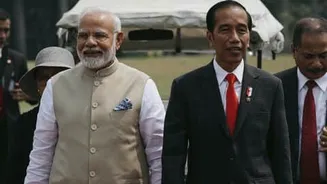









Prime Minister Narendra Modi’s upcoming visit to Indonesia is expected to give fresh momentum to India’s Act East Policy, but beyond defence, trade and maritime cooperation, another pillar of the relationship
has quietly gathered pace—Indonesia’s adoption of several of India’s flagship governance and development models.
As Jakarta pursues its ambitious Golden Indonesia 2045 vision, policymakers are increasingly looking to India’s experience in digital public infrastructure, healthcare, welfare delivery, agriculture and defence manufacturing. What began with interest in India’s digital payments ecosystem has evolved into a broader effort to adapt Indian policy innovations for a nation of over 280 million people spread across more than 17,000 islands.
India has emerged as one of Indonesia’s key governance partners, with several flagship schemes serving as templates for reforms in Southeast Asia’s largest economy.
Here’s how India’s flagship schemes are influencing Indonesia’s reforms
1. India Stack: Indonesia Wants More Than Just UPI
India’s Unified Payments Interface (UPI) has become one of the world’s most successful digital payment systems, processing billions of transactions every month.
But Indonesia’s interest extends far beyond digital payments.
Officials are studying the broader India Stack, the combination of digital identity, authentication, payments and document-sharing infrastructure that underpins India’s digital economy.
Indonesia Open Network (ION): One of the biggest examples is the Indonesia Open Network (ION). Like India’s Open Network for Digital Commerce (ONDC), ION aims to create an open digital marketplace that allows small businesses to compete without being locked into dominant e-commerce platforms.
The initiative seeks to support Indonesia’s 65 million micro, small and medium enterprises (MSMEs) through interoperable digital infrastructure rather than closed ecosystems.
UPI-QRIS Linkage: Indonesia is also working with India on linking UPI with its own Quick Response Code Indonesian Standard (QRIS). Once operational, Indian and Indonesian consumers will be able to make QR-code payments across both countries without relying on expensive international payment networks.
Digital Nusantara: Indonesia’s Digital Nusantara programme is also drawing lessons from India’s Aadhaar, DigiLocker, and e-KYC architecture. The objective is to create a unified digital identity ecosystem that can deliver government services efficiently across thousands of islands.
2. Jan Aushadhi Model for Affordable Medicines
Healthcare is another area where Indonesia sees India as a model. Officials are studying the Pradhan Mantri Bhartiya Janaushadhi Pariyojana (PMBJP), which provides affordable generic medicines through thousands of dedicated outlets across India.
Indonesia plans to incorporate elements of this model into its Red and White Village Cooperatives initiative to improve access to low-cost medicines, particularly in remote regions where healthcare costs remain high.
3. India’s Mid-Day Meal Scheme Inspires School Nutrition
Indonesia’s flagship Free Nutritious Meals Programme, one of President Prabowo Subianto’s biggest welfare initiatives, has drawn significant inspiration from India’s PM POSHAN scheme (formerly the Mid-Day Meal Programme).
Indonesian delegations have studied India’s experience in school meal logistics, food procurement, nutritional standards, and supply chain management. The goal is similar: improve child nutrition, reduce stunting and increase school attendance.
India’s programme currently serves over 110 million schoolchildren, making it one of the largest school feeding programmes in the world.
4. AgriStack And Welfare Delivery
Agriculture is another area of collaboration.
Indonesia has examined India’s AgriStack, digitised Public Distribution System (PDS), and fertiliser subsidy reforms. The objective is to make subsidy delivery more transparent, reduce leakages and improve targeting using digital platforms.
Officials believe India’s experience demonstrates how technology can improve welfare delivery at scale.
5. Atmanirbhar Bharat and Defence Manufacturing
Indonesia is also looking closely at India’s defence manufacturing strategy.
The Atmanirbhar Bharat initiative has transformed India from one of the world’s largest arms importers into an increasingly significant defence exporter.
Rather than simply buying military hardware, Indonesia is now exploring technology transfers, joint production, defence industrial cooperation, and military training partnerships. Officials view India’s model as a way to build long-term domestic defence capabilities.
Why Is Indonesia Looking to India?
For decades, developing countries looked primarily to Western economies or East Asian manufacturing powerhouses for policy inspiration. India now offers something different.
Many of its flagship programmes have been designed for challenges that resemble Indonesia’s own large populations, diverse geography, digital inclusion, welfare delivery, financial inclusion, and healthcare access.
As Moneycontrol noted, India’s ability to implement technology-driven public services at a population scale has made it an increasingly attractive governance partner for emerging economies.
What Does India Gain?
The partnership is not one-sided. Greater adoption of Indian digital public infrastructure strengthens India’s position as a global provider of Digital Public Infrastructure (DPI).
It also creates opportunities for Indian technology companies, fintech firms, healthcare providers, digital governance platforms, and defence manufacturers.
Officials increasingly see India’s governance architecture as an export in itself, alongside traditional goods and services.